Showing posts with label Silvio Gesell. Show all posts

Wednesday, May 8, 2024

Renovatio monetae

This silver pfennig from the Archbishopric of Magdeburg (1152-1192) was subject to a policy of renovatio monetae. Twice a year whoever held it had to bring it in to be changed for new coins at a rate of four old coins to three new coins. That suggests an annualized tax rate on coinage of 44%. Image source: British Museum

This is another post in a series that explores how European monarchs harnessed the minting of coins to earn revenues for their coffers. 

A king or queen generally resorted to two different strategies for profiting from the mints. The first was to mint long-lived coinage. The second involved issuing short-lived coinage subject to a policy of renovatio monetae, which is the topic of this post. These aren't mutually exclusive buckets. It's possible for elements of both policies to be blended together.

Almost everything I've written about medieval coinage on this blog has been about the long-lived sort, because that was the dominant pattern in Europe. Under a long-lived coinage system, once a coin had been minted it remained in permanent legal circulation. For example, England's long-lived coinage policy meant that an English penny produced in 1600 would have been just as valid a hundred years later, in 1700, as a penny produced in 1699.

The monarch earned a one-time fee from the original minting of the coin. More specifically, a citizen who brought raw silver to the royal mint left with that same amount of silver now transformed into coin form, less a small part going to the crown. This profit was known as seigniorage. In England, the seigniorage rate on silver typically hovered around 5%, my source for this number being The Debasement Puzzle by economists Rolnick, Velde, and Weber. Once a particular coin was produced, however, the king or queen no longer earned revenue from it.

As society grew and more coins were needed, raw silver was constantly brought to the royal mints by the public in order to be coined, the monarch earning a steady stream of income. This was known as free coinage, since everyone had the right to access the royal mints.

Short-lived coinage subject to a policy of renovatio monetae was an entirely different manner. Under this model, coins didn't circulate permanently. When a king or queen announced what was known as a renovatio monetae, or a renewal of the coinage, all existing coins had to be brought back to the mint to be recoined into new coins. The monarch collected a fee upon each renovatio monetae. 

To help reinforce the monarch's ability to collect a profit, only the most recent coin was allowed to be used within the monarch's domain. Older local coins and coins from other realms were illegal. To distinguish the new version from the outgoing version, the new type was stamped with a different pattern. The penalties for not obeying the rules of renovatio could be harsh. According to Philip Grierson, a numismatist, anyone caught using expired coinage could face imprisonment, a fine, or have their face branded with the old pattern of coin.

Source: Svensson

The period of time between one renovatio monetae and the next varied widely. In England, the monarch initially adopted an interval of nine years, beginning in 973 AD with Edgar. Later on, this was shortened to just three years. In many parts of Germany and Poland, renovatio monetae occurred yearly, as recounted by economist Roger Svensson in his wide-ranging book on the topic. In the Archbishopric of Magdeburg it was carried out twice a year, coinciding with important market days in the spring and autumn. The Teutonic order in Prussia used a much slower ten-year cycle, according to Svensson. 

The date for the switch was often chosen to occur just prior to annual tax payment day or, as in the case of Magdeburg, ahead of a regularly occurring market or festival (see figure above). Requiring that all tax payments or market transactions be conducted with new coins reinforced the necessity of  bringing in old coinage to be melted down into new coinage, thus guaranteeing a boost to the monarch's revenues.

The coinage that prevailed in Poland and Germany from the 12th century almost seems to have been designed with a short lifespan in mind, since it is leaf-thin and fragile. Coins minted in this style are known as bracteates, one of which can be seen below. Svensson speculates that the bracteate format was better suited for the purposes of renovatio monetae than standard coins since the costs of periodically reforming silver into thin and pliable coin would have been lower than heavier coins. 

Leaf-thin bracteates from Frankenhausen. Source: Svensson
 

How much profit did the monarch collect from renovatio monetae? 

For many years the Teutonic order in Prussia used a conversion rate of seven old coins to six new ones, says Svensson. Combined with the fact that renovatio only occurred every ten years, the effective tax rate was relatively light. According to Christine Desan, a law professor, English royal profits amounted to 25% of the metal minted (she cites Spufford), but recall that this tax was levied only every three years so that works out to a yearly tax of around 8%. (Some people may notice the similarity of renovatio monetae to ideas promulgated by Silvio Gesell, who came up with the idea of stamped scrip—money that depreciates.)

In some cases, though, the conversion rate bordered on exploitative. Svensson says that a common exchange rate in Germany was four old bracteates for three new ones. Given two renovatio per year in places like Magdeburg, that works out to a yearly tax rate on coinage of 44%! If a citizen of Magdeburg started the year with 16 bracteates in their stash, and they complied with both renovatio, by year-end target would only have nine bracteates.

This may have created a very weird effect whereby coins became "cheaper and cheaper" over the course of the year in anticipation of the inevitable withdrawal day, according to historian Sture Bolin. Since everyone would have known ahead of time that there was to be a 4:3 conversion on a fixed date, and no one wanted to be stuck holding coins and bearing the conversion tax, sellers would only accept coins at a discount to compensate them for conversion. That discount varied with time. As the final day approached, it would have got progressively wider.

In modern times we don't have to deal with the hassles of renovatio monetae. The coins and banknotes we use are long-lasting: a nickel from 1956 is just as valid as one from 2022. Or consider that while the $1 note is no longer printed in Canada, anyone can still bring them to a bank to be deposited for free. If a policy of renovatio monetae were to be announced by the Bank of Canada in 2025, and Canadians were required to bring our coins and banknotes in each year to be exchanged for new ones, there would probably be a revolt against the inconvenience of it, especially if the fee was high.

This combination of exploitation and inconvenience may explain why the English abandoned renovatio monetae in the middle of the 12th century in favor of permanent coinage. "The renovatio monetae witnessed to the extent of royal control and suggests that coining was routinely coercive," writes Desan. "This new system reduced the burdens placed on people required so frequently to remint their money at a cost."   

However, if renovatio monetae was inconvenient (and frequently exploitative), it also had a key benefit. As silver coins passed from hand to hand, they suffered from natural wear and tear. On top of that, bad actors regularly clipped off their edges, keeping the silver shavings for themselves. By renewing the coinage every year or two, the monarch ensured that the coinage was kept in relatively good condition.

Alas, the same can't be said for long-lived coinage systems, which were particularly prone to the wear and tear problem. After a decade or two of circulating, a typical coin would have lost a significant amount of its original silver content, at which point it would no longer be equal in weight to new coins. This meant that the realm's coins were no longer fungible, or interchangeable, with each other. The familiar problem of Gresham's law would now begin to plague the monetary system, whereby the "bad" coins, which meant the old underweight coins, drove out the "good" coins, the new full-weighted ones. With only shabby coins being used in trade, the money supply was more prone to counterfeiting and clipping, leading to an even shabbier coin supply, and more counterfeiting and clipping. 

Mind you, there were ways to defend against the inevitable downward spiral of long-lived coinage. By adopting a policy of defensive debasements, which I've written about before, the fungibility of coins could be restored.

Nor were long-lived coinage systems spared from being exploitative in nature. The method of abuse was different than that used to exploit short-lived coinage, involving a policy of repetitive debasements in the silver content of coinage.

As an example of this, I wrote a post last year exploring how Henry VIII financed his wars in France using debasement of his long-lived coinage. Do read it, but in short the trick was to increase the number of people visiting the royal mints to convert raw silver into new coins. This would in turn boost the monarch's profits. After all, he or she earned a 5% cut from each new coin produced.  The rush to the mint was linked to the fact that, post-debasement, the public could now get more silver pennies from the mint than before for a given quantity of silver, which in turn allowed them to buy more goods and services than they would have otherwise been able to purchase.

After a series of such debasements, Henry VIII was much richer, but the coinage was debauched. Going into 1542, for instance, the English penny contained 92.5% silver. Nine years later its purity stood at just 25% silver, the majority being base metal such as copper. 

To sum up, short-lived coinage issued under a policy of renovatio monetae was one of several ways to administer the monetary system. It had some advantages over other methods, but was also easily abused. This abuse was linked to the fact that coinage was simultaneously a crucial tool for day-to-day commerce, both as a medium of exchange and a unit of account, and also a way for the monarch to fund itself. Maximizing its latter role by relying on frequent and onerous renovatio may have done severe damage to money's capacity to perform the former role. 

This tension was not necessarily resolved with the move towards long-lived coinage, as Henry VIII demonstrates. And while we may think we have left these these medieval issues behind in the 21st century, I don't think that we can ever fully escape the tensions embodied in money's dual roles as crucial tool of commerce and source of government funding.

Tuesday, February 21, 2017

Demonetization by serial number


This continues a series of posts (1, 2, 3) I've been writing that tries to improve on Indian PM Narendra Modi's clumsy demonetization, or what I prefer to call a policy of surprise note swaps.

The main goal of Modi's demonetization (i.e. note swapping) is to attack holdings of so-called "black money," or unaccounted cash. The problem here is that to have a genuine long-run effect on the behavior of illicit cash users, a policy of demonetization needs to be more than a one-off game. It needs to be a repeatable one. A credible threat of a repeat swap a few months down the road ensures that stocks of licit money don't get rebuilt after the most recent swap. If that threat isn't credible, then people will simply go back to old patterns of cash usage.

It's worth pointing out that the idea of behind demonetization precedes Modi by many decades. In a 1976 article entitled Calling in the Big Bills and a 1980 a follow-up How to Make the Mob Miserable, James S. Henry, who is on Twitter, described what he called "surprise currency recalls."

Specifically, Henry advocated a sudden cancellation and reissuance of all US$50 and $100 notes as a way to hurt "tax cheats, Mafiosi, and other pillars of the criminal community." Rather than a one-shot action, which would only annoy criminals, the idea was that "the recalls could be repeated, at random, every few years or so, raising the 'transaction costs' of doing illegal business."

In order to credibly threaten a series of repeat note swaps, I'd argue that the quantity of notes recalled in each demonetization must be small. Small batches of notes can be quickly cancelled and replaced without disturbing people's lives. This keeps the economic and political costs of withdrawing demonetized cash (lineups, cash shortages, etc) manageable. If these costs are too high, the threat of repeats isn't credible.

Instead of going small, Narendra Modi decided to go big by having the Reserve Bank of India demonetize both of India's highest value banknotes, the ₹500 and ₹1000 note, which together comprised some 86% of India's cash. This has caused all sorts of problems. For instance, almost four months after the November 8 announcement the amount of cash in circulation is still far below the required levels of ₹17-19 trillion, the RBI unable to run its printing presses fast enough to keep up. The RBI's inability to fill the vacuum left by demonetized notes has been ably explained by James Wilson and is illustrated in the chart below:


Because of the enormous disruption it has caused, Modi's massive demonetization departs from Henry's script—it cannot be repeated, not for decades (a point that Russell A. Green makes here as well). Were Modi to begin discussing another demonetization, say for 2018, Indians would probably rise up in anger at the possibility of more lineups, empty ATMs, and hurdles to making basic purchases. Which means that post-Modi demonetization, it's entirely safe for India's illicit users of cash to wade back into the waters. If cash usage patterns return to normal, it seems to me that the entire demonetization project was an exercise in futility.

In India's case, demonetizing entire note denominations is too powerful a tool to ensure repeatability. Even if Modi had demonetized the ₹1000 note and not the ₹500, for instance, the exercise would still have involved some 30-40% of the nation's cash supply. This would have been an arduous affair for all involved, certainly not one that could be repeated for many years.

Weeding out rupee banknotes according to serial number rather than denomination would have allowed for a more refined policy along the lines advocated by Henry. Here's how it would work. The government begins by declaring that all ₹1000 notes ending with the number 9 are henceforth illegal. Anyone owning an offending note can bring it to a bank to be swapped for a legitimate ₹1000 note (one that doesn't end in 9). However, the government sets a limit on the number of demonetized notes that can be exchanged directly for legitimate notes, say no more than three. Anything above that can only be exchanged in person at a bank teller for deposits, which requires that they have an account (i.e. their anonymity will be lifted). Once an individual has deposited five notes in their account, all subsequent deposits of demonetized notes would require a good explanation for the notes' provenance. Should the requisite paper trail be missing, the depositor gives up the entire amount.

The process begins anew a few months hence, the specific timing and banknote target being randomly chosen. So maybe thirteen months after the first swap, the government demonetizes all ₹500 notes ending in 6. Randomness prevents people from anticipating the move and hiding their illicit wealth in a different high denomination note. 

Too understand how this affects black money owners, consider someone who owns a large quantity of illicit ₹1000 banknotes, say ₹70 million (US$1 million, or 70,000 banknotes). This person faces the threat of losing 10% to the note swap. After all, when the 9s are called, odds are that he or she will have around 7,000 of them, of which only eight can be returned without requiring a paper trail. The owner can simply accept a continuing string of 10% losses each year as a cost of doing business.

Alternatively, they might protect themselves ahead of time by converting their hoard into a competing store of value, say gold, bitcoin or low denomination rupee notes like ₹100s (which are not subject to the policy of ongoing swaps). If they flee high denomination notes to avoid subsequent demonetizations, illicit cash users in a worse position than before the adoption of the policy of note swapping. Gold and small denomination notes have far higher storage and handling costs than ₹1000 banknote. And unlike gold and bitcoin, a banknote is both supremely liquid and stable. So even if large-scale owners of banknotes manage to avoid painful note swaps, they still endure higher costs.

As for licit users of high denomination notes, the fact that the 10% clawback would not apply to them means they needn't change their behavior. Nor would the poor--who are unlikely to be able to provide a paper trail--have to worry about the policy. Demonetizations would only occur in high denominations, in India's case ₹500 and 1000s, and the poor are less likely to own these in quantities above the three note limit.

Incidentally, readers may recognize a policy of repeat demonetizations as akin to a Gesell stamp tax, named after Silvio Gesell, who in 1916 proposed the idea of taxing currency holdings in order to increase the velocity of circulation. Greg Mankiw famously updated Gesell's idea during the 2008 credit crisis to remove the zero lower bound. He did so by using serial numbers as the device for imposing a negative return rather than stamps. This post updates Mankiw's idea, except rather than applying the tax to all cash it strikes only at illicit cash holdings, and does so in the name of an entirely different policy goal—attacking the underground economy, not removal of the zero lower bound.

A series of small serial number-based swaps seems like a better policy than Modi's ham-handed demonetization of all ₹1000 and ₹500s. It would certainly do a better job of promoting a long-term decline in undocumented cash holdings and would do so by imposing a much smaller blast radius on the Indian public. There would be no currency shortages, huge lineups at banks, empty ATMs, or trades going unconsummated due to lack of paper money.

 That being said, while superior to Modi's shock & awe approach, a policy of repeat note swaps certainly has its flaws. In principle, the idea of surprising citizens every few months—i.e. forcing them to keep on guessing—does not seem entirely consistent with the rule of law. Another problem is that once the policy has been ongoing for several years, the list of demonetized serial numbers will be quite long. The process of buying stuff with notes will become evermore difficult given the necessity that the merchant consult this list prior to each deal to ensure that bad notes aren't being fobbed off. Finally, commenting recently on Henry's plan, Ken Rogoff notes that "there is a fine line between a snap currency exchange and a debt default, especially for a highly developed economy in peacetime." Since debt defaults hurt a countries credit standing, serial demonetizations might lead the investment community to be more leery about the nation's other liabilities, say its bonds.

Thursday, September 24, 2015

Andy Haldane and BOEcoin

The 1995 British two pound "Dove" coin

The Bank of England's chief economist Andrew Haldane recently called for central banks to think more imaginatively about how to deal with the technological constraint imposed by the zero lower bound on interest rates. Haldane says that the lower bound isn't a passing problem. Rather, there is a growing probability that when policy makers need three percentage points of headroom to cushion the effects of a typical recession, that headroom just won't be there.

Haldane pans higher inflation targets and further quantitative easing as ways to slacken the bound, preferring to focus on negative interest rates on paper currency, a topic which gets discussed often on this blog. He mentions the classic Silvio Gesell stamp tax (which I discussed here), an all out ban on cash as advocated by Ken Rogoff, and Miles Kimball's crawling peg (see here).

According to Haldane, the problem with Gesell's tax, Rogoff's ban (pdf), and Kimball's peg is that each of these faces a significant 'behavioural constraint.'  The use of paper money is a social convention, both as a unit of account and medium of exchange, and conventions can only be shifted at large cost. Tony Yates joins in, pointing out the difficulties of the Gesell option. Instead, Haldane floats the possibility of replacing paper money with a government-backed cryptocurrency, or what we on the blogosphere have been calling Fedcoin (in this case BOEcoin). Unlike cash, it would be easy to impose a negative interest rate on users of Fedcoin or BOEcoin, thus relaxing the lower bound constraint. Conventions stay intact; people still get to use government-backed currency as a medium of exchange and unit of account.*

While I like the way Haldane delineates the problem and his general approach to solving it, I'm not a fan of his chosen solution. As Robert Sams once pointed out, Fedcoin/BoEcoin could be so good that it ends up outcompeting private bank deposits, thus bringing our traditional banking model to an abrupt end. Frequent commenter JKH calls it Chicago Plan #37, a reference to a depression-era reform (since resuscitated) that would have outlawed fractional reserve banking. If Haldane is uncomfortable with the Gesell/Rogoff/Kimball options for slackening the lower bound because they interfere with convention, he should be plenty worried about BOEcoin.

---

I do agree, however, with Haldane's point that the apparatus adopted to loosen the constraint should interfere with convention as little as possible. We want the cheapest policies; those that only slightly impede the daily lives of the typical Brit on the street while securing the Bank of England a sufficient amount of slack.

With that in mind, here's what I think is the cheapest way for the Bank of England to slacken the lower bound: just freeze the quantity of £50 bills in circulation. Yep, it's that easy. There are currently 236 million £50 notes in circulation. Don't print any more of them, Victoria Cleland.**

I call this a policy of embargoing the largest value note. How does it work?***

Say that in the next crisis, the Bank of England decides to chop rates from 0.5% to -2.0%. Faced with deeply negative interest rates, the UK runs smack dab into the lower bound as Brits collectively try to flee into banknotes. After all, banknotes offer a safe 0% return, the £50 note being the chosen escape route since those are the cheapest to store and convey.

Flooded with withdrawal requests, banks will quickly run out of £50s. At that point the banks would normally turn to the Bank of England to replenish their stash in order to fill customers' demands. But with the Bank of England having frozen the number of £50s at 236 million and not printing any new ones, bankers will only be able to offer their customers low denomination notes. But this will immediately slow the run for cash since £20s, £10s, and £5s are much more expensive to store, ship and transfer than £50s. Whereas people will surely prefer a sleek high denomination note to a deposit that pays -2%, they will be relatively indifferent when the choice is between a bulky low denomination cash and a deposit that pays -2%. Thus the lower bound has been successfully softened by an embargo on the largest value note.

Once negative interest rates have served their purpose and the crisis has abated, they can be boosted back above 0% and the central bank can unfreeze the quantity of £50s. Everything returns to normal.

A few conventions will change when the largest value note is embargoed.

1. People will no longer be able to convert £50 worth of deposits into a £50 note. Instead they'll have to be satisfied with getting two £20s and a £10. That doesn't seem like an expensive convention to discard. And if folks really want to get their hands on £50s, they'll still be able to buy them in the secondary market, albeit at a small premium.

2. In normal times, £50 notes always trade at par. Because their quantity will be fixed under this scheme, £50s will rise to a varying premium above face value whenever interest rates fall significantly below zero. For instance, at a -2.0% interest rate a £50 note might trade in the market at £51 or £52.

The par value of £50 notes is a cheap convention to overturn. The majority of the British population probably don't deal in £50s anyways. Those who do use £50 notes in their daily life will have to get used to monitoring their market price so that they can transact at correct prices. But the inconveniences faced by  this tiny minority is a small cost for society to pay in order to slacken the lower bound.

3. Importantly, there will be no need to proclaim a unit of account switch upon the enacting of an embargo on £50s; the switch will be seamless.

Because the £50 was never an important part of day-to-day commercial and retail existence, come negative interest rates no retailers will set their prices in terms of a £50 standard. If they do choose to set sticker prices in terms of the £50 note, they will find that if they want to preserve their margins they will have to levy a small surcharge each time someone pays with £20s, £10s, and £5s and bank deposits. Given the prevalence of these payment options, that means surcharging on almost every single transaction. That's terribly inconvenient. Far better for a retailer to set sticker prices in terms of the dominant payments media—£20s, £10s, and £5s and bank deposits—and provide a small discount to the rare customer that wants to pay with £50s.

It's entirely possible that the majority of retailers will not bother offering any discount whatsoever on £50s. This would effectively undervalue the £50 note. Gresham's Law tells us that given this undervaluation, the £50 will disappear from circulation as it gets hoarded under people's mattresses. For the regular British citizen, never seeing £50s in circulation probably won't change much. And anyone who does want a £50 can simply advertise on Craig's list for one, offering a high enough premium to draw it out of someone's hoard.

In closing, a few caveats. The figures I am using in this post are ballpark. It could be that a policy of freezing the supply of £50 notes allows the Bank of England to get to -2%. But maybe it only allows for a level of -1.75%, or maybe it slackens the bound so much as to allow a -2.5% rate.

Haldane mentions that the Bank of England could need 3% of headroom to combat subsequent recessions. But as Tony Yates has pointed out, in 2008 bank officials calculated that a -8% rate was needed. The Bank could get part way there by not only embargoing the £50 but also the next highest value note; the £20. But that probably wouldn't be enough. As ever smaller notes have their quantities frozen, this starts to intrude on the lives of the people on the street, making the policy more costly. If it needs to slacken the lower bound in order to allow for rates of -8%, I think the Bank of England should be planning for a heftier policy like Miles Kimball's crawling peg. After all, when the sort of crisis that requires such deeply negative rates hits, the last thing we should be worried about is disturbing a few conventions. Until another 2008-style crisis hits, embargoing large value notes might be the least intrusive, lowest cost option. 


*Of these policies, I think Miles Kimball's plan is by far the best one.
**Specifically, the Bank would only print new bills to replace ripped/worn out bills. Otherwise the outstanding issue will wear out and become easier to counterfeit. As for Scotland, which issues 100 pound notes, their quantity would have to be fixed as well.
*** I first mentioned the idea of embargoing large notes in relation to the Swiss 1000 CHF note, and later elaborated on it in the Lazy Central Banker's Guide to Escaping Liquidity Traps.

Tuesday, May 26, 2015

Alberta Prosperity Certificates and a Greek parallel currency


This post is about the Alberta Prosperity Certificate, one of the world's stranger monetary experiments. Issued in late 1936 and early 1937 by the newly-elected Alberta government, these monetary instruments are the largest-scale example of Silvio Gesell's "shrinking money," or stamp scrip, in action. Gesell, a German business man and self taught economist, had written a treatise in 1891 in which he described a currency that depreciated in value, thus preventing hoarding and encouraging spending.

To make this more interesting, let's jump forward in time. In 2014, Greece's Finance Minister Yanis Varoufakis wrote a blog post that described a new Greek financial instrument that could be used to make payments while circulating in parallel with the already-existing euro. Varoufakis's post, combined with constant rumors that Greece may be planning to issue its own parallel currency in order to make internal payments,* means that a revisitation of Alberta's early dalliance with scrip, which circulated concurrently with Canadian dollars, is more relevant than ever. The attempt by Albertan authorities to issue scrip 80 years ago would end in failure; most of the paper refused to stay in circulation. Understanding why this happened provides some insights into what sorts of conditions might promote the success of a Greek parallel currency—or its downfall.

Virginius Frank Coe

The best source on Prosperity Certificates is a 1938 survey by Virginius Frank Coe, an American economist who visited Alberta in August 1937, five months after the program had been abandoned. Coe's life is interesting enough to deserve its own tangent. An economist educated at the University of Chicago, Coe would go on to hold a number of important positions in various U.S. government institutions both during and after World War II, including monetary research director at the Treasury Department. This brought him into the orbit of Harry Dexter White, then the Assistant Secretary of the Treasury and the architect of the Bretton Woods agreements. Coe himself was a representative at Bretton Woods and would go on to become secretary of the International Monetary Fund in 1946, nine years after having written his Prosperity Certificate paper.

Readers of Benn Steil's The Battle of Bretton Woods will know that much of the evidence incriminates Harry Dexter White as spying for the Soviets, an accusation White himself denied. The same sources who named White as a Soviet agent also fingered Coe, and in 1952 Coe was forced to resign from his post at the IMF. He would appear in front of the McCarran Committee later that year, pleading the fifth in response to all questions posed to him, and would later face Senator Joseph McCarthy. His passport revoked, and unable to find work in the U.S., Coe headed to China to serve as an adviser to Mao until his death in 1980.

Coe's Prosperity Certificate paper betrays the author as someone with a strong interest in alternative monetary systems. While we can't know for sure if his interest in alternative systems extended as far as being a Soviet mole, we shouldn't let this possibility detract from what is otherwise an excellent account of this early Canadian monetary experiment.

Alberta and Social Credit 

Coe describes an Alberta electorate that is facing the same economic backdrop as Greece's voters did prior to the recent election of Syriza. Just as Greeks had endured seven years of famine prior to the 2015 election, Albertans going into the 1935 election had been beset by seven years of distress associated with low farm prices and bad crop yields. The incumbent United Farmers of Alberta government was not willing to implement the more drastic policies that the Albertan electorate demanded, says Coe. Into the void stepped William Aberhart, a pastor and newly-recruited believer in the tenets of Social Credit. Dreamt up by British engineer C.H. Douglas, the idea behind Social Credit was to create a more equal society by augmenting consumers' purchasing power via the payment of a national dividend. Aberhart formed the Alberta Social Credit party in 1935 and won the election a few months later. In electing Syriza, the Greeks, like the Albertans before them, have entrusted their future to a party of political novices.

Reading Coe, one gets the sense that the Aberhart government stumbled into Prosperity Certificates rather than purposefully selecting them as a policy. Gesell's dated stamp scrip was a rival monetary reform to Social Credit, not a complement. Why turn to a non-Social Credit policy? It seems that several months after coming to power, the new Social Credit government was already splintering as one faction had grown impatient with Aberhart's inability to implement economic changes. Coe, speculating that the decision to implement dated stamp money was a token gesture to demonstrate forward momentum and heal internal rifts, says that "any one of a number of plans would have done as well." If a non-Social Credit monetary scheme such as Gesell money were to fail, at least a Social Credit policy option still had a kick at the can. The implication that the government didn't put much thought into the design of the certificates finds some confirmation in the fact that the Free-Economy League, an organization formed by Gesell, published a criticism of the Alberta government's procedure for creating Prosperity Certificates and predicted their failure.

How the certificates worked

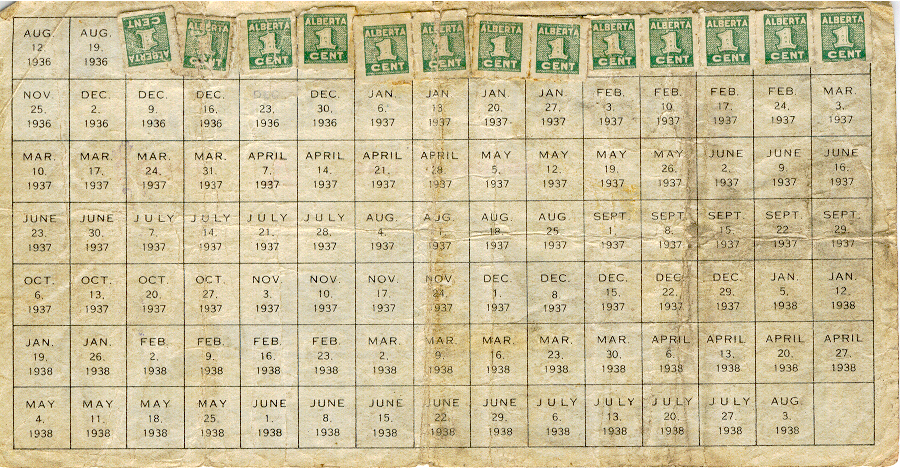
Here's how Alberta's stamp scrip worked. In early August 1936, when the program debuted, an unemployed Albertan was paid, say, a $1 certificate for each $1 worth of road maintenance work rendered. This certificate was to be redeemed by the Alberta government two years hence, or in August 1938, for $1 in Canadian dollars. However, redemption required that the certificate have 104 stamps affixed to it (see figure above). Each week during that two year period, the owner of the certificate was to buy a government stamp for 1 cent from an approved stamp dealer and glue it to the note.

The necessity of buying stamps created a fairly onerous fee on cash holdings. As such, any laborer who received the scrip from the government was unlikely to hoard it, preferring instead to spend it on, say at a retailer, who in turn would only accept scrip as payment for goods and services if the correct number of stamps has been affixed. In order to avoid the cost of buying the next weekly stamp in order to keep the scrip current, the retailer themselves would quickly offload it to their suppliers and so on.

The 1 cent stamp fee was collected by the Alberta government and held as a reserve for redemption in two years. With 104 cents being collected over each $1 certificate's life time, this meant that the scheme was entirely self financing. The extra four cents represented a profit to the government.

Failure

We know that the Prosperity Certificate scheme didn't work. The certificates began to be paid to unemployed Albertans in August 1936 for roadwork rendered in July. According to Coe, the maximum amount of outstanding certificates in circulation in August and early September was $239,391 (around $9 million in current dollars). However, by mid-September 1937, just one month after the program's debut, over 60% of the certificates outstanding, or $144,280 out of $239,391, had ceased to circulate.

Where had they gone? The government now held them. The reason for this development was a last minute decision by Aberhart to offer monthly redemption of certificates at par in Dominion currency (i.e. $1 in certificates for $1 in Canadian bills). This short-circuited the original two-year life of the certificates. Rather than continuing to pass the scrip along to the next Albertan, Albertans leapt at the government's offer and converted en masse when the first redemption date presented itself in early September.

In the end, the government might as well have paid for work rendered using Canadian dollars, since the net effect of paying in either Certificates or Canadian dollars was the same. As Coe says, "the dated stamp scrip was in the end little more than a small nuisance." Subsequent issues of scrip were small relative to the original August 1936 issue and the government officially ended the program in April 1937.

"The problem of the wholesalers"

In the planning stages of the program, government officials ran into what Coe refers to as the "problem of the wholesaler." The first to receive the certificates would be farmers on relief, who in turn would make payments to retailers. The payments by retailers would primarily flow to Albertan wholesalers whose dominant payments were to manufacturers and others outside the province. However, those outside the province would not accept Prosperity Certificates, requiring instead hard currency, or Canadian dollars. The Albertan wholesaler would be left holding the bag, so to say, having acquired the entire issue of Prosperity Certificates with no outlet. According to Coe, wholesalers and large retailers were vocal in their opposition to the plan, which they expressed through trade associations and in the press.

One way of solving the wholesalers' problem would have been to establish an exchange market such that wholesalers could sell certificates in order to buy the necessary hard currency and thus fund out-of-Province imports. Banks would normally be an important party to the creation of such a market. Irving Fisher, who wrote a book on stamp scrip, entitled one paragraph "Have at Least one Bank." But the banks who operated in Alberta refused to participate in the Prosperity Certificate scheme—no wonder given that one of the Social Credit party's planks advocated the removal of the "banking monopoly" on the issuance of credit. The tenets of Social Credit thus interfered with the execution of Gesell money, impeding the latter's success.

Even if such a market were to be created, chances are that it would have priced the Certificates at a large discount to Canadian dollars given the onerous fee on certificates relative to Canadian notes and the inferior credit of their issuer. After all, by then the Alberta government had defaulted on its international obligations whereas the Federal government's credit was still good. Such a discount would have been at odds with the Alberta government's policy of using a dollar's worth of certificates to buy one Canadian dollar's worth of labour. If the certificates were trading at 69 cents on the dollar in the wholesale market, workers paid in scrip would be loath to accept them at face value, for if they did, they would probably have problems passing them off at retailers for that amount.

In the end, the government's solution to the problem of the wholesalers was to allow wholesalers (and even retailers) to benefit from free monthly redemption at par. As I noted earlier, this resulted in most of the certificates being returned for redemption just a few weeks after having been issued.** Rather than bad money driving out the good, a garbled version of Gresham's Law had taken hold in Alberta, which Coe describes thusly: "Bad money obviously does not drive out good money when the government is willing to redeem the bad money in good money."

This garbled version of Gresham's law is a phenomenon I've described before to explain a number of monetary puzzles including the failure of the Susan B. Anthony dollar, the European Target2 bank runs of 2011-12, the proliferation of credit cards, and the zero-lower bound problem. See here and here.

What about Greece?

Alberta in 1936 and Greece in 2015 are in similar situations. Both are non-currency issuers within a larger monetary zone, in Alberta's case the Canadian dollar zone and in Greece's case the Eurozone. Both have awful credit. Neither is part of a larger fiscal union. In Greece's case, the mechanism hasn't yet been created whereas in Alberta's case, the Social Credit party was at such odds with the Federal government and the rest of Canada that it could not expect much help.

I'd argue that anyone planning to introduce a Greek parallel currency to circulate alongside euros faces the same problem that Alberta faced; the so-called problem of the wholesalers. If the Greek government starts to pay employees and contractors in Greek parallel IOUs denominated in euros, and employees buy stuff at stores with those IOUs, and stores purchase inventory from wholesalers, these wholesalers will need a mechanism to offload their parallel note surpluses in order to get euros to buy foreign imports. The IOUs can either find their own price, in which case they will most likely trade at a large and varying discount to euros, or the Greek government can offer one-to-one convertibility. They can do this by either redeeming IOUs directly for euros or allowing one euro worth of taxes to be paid with an equivalent number of IOUs.

Neither solution is ideal. If the IOUs trade at a variable discount to euros, then their ability to serve as a competing medium of exchange will suffer. People always prefer to trade using the medium in which a nation's prices are expressed, or, put differently, the medium which functions as a unit of account. For example, people see benefit in the fact that one euro will always discharge a euro's worth of Greek debt or a buy a euro's worth of Greek olive oil. But as long as Greek IOUs trade at a varying discount to euros, it is impossible to know ahead of time how many IOUs will discharge a euro's worth of debt or buy a euro's worth of oil, given that the euro will surely remain Greece's unit of account. This would hinder the IOU's ability to function as a currency. The fact that people prefer to accept stable exchange media in trade to unstable media is one of the reasons that bitcoin hasn't caught on.

So rather than serving as a competing medium of exchange, the parallel IOUs will probably function as illiquid and highly risky speculative fixed income securities. In order to compensate recipients of IOUs for this lack of liquidity, the Greek government will have to issue the IOUs at a larger discount to par than they would for an otherwise liquid equivalent, thus increasing the government's financing costs.

This lack of liquidity militates against one of the key selling points of a Greek parallel unit, which is to finance the government by displacing some of the existing circulating medium of exchange, euros, from citizens' wallets. Preferably, unwanted euros would trickle back to the European Central Bank to be cancelled, reducing the ECB's seigniorage but augmenting the seigniorage of the Greek state as Greek IOUs rush in to fill the void. However, if the new Greek parallel unit cannot compete with the euro's liquidity, then there will be very little 'space' for Greek IOUs to occupy in Greek portfolios, and little relief for beleaguered government finances.

If the Greek government tries to promote the liquidity of its parallel currency by having the units trade at a fixed one-to-one rate with euros, then the same garbled version of Gresham's Law that took hold in Alberta would overwhelm Greece. In Coe's words, the Syriza government's willingness to buy bad money, or parallel currency units, from the public with good money, or euros, will promote mass conversion into euros and thereby drive all the bad money from circulation. Greek parallel units will cease to exist.***

In sum, anyone planning a Greek parallel currency faces a conundrum. In order to pay its bills the government can do little more than introduce a volatile asset that trades at varying discount to euros. This asset's volatility and relative illiquidity won't make it very popular with its recipients. An attempt to render that asset more acceptable in trade by setting a one-to-one conversion rate to the euro will result in a short-circuiting of the scheme as everyone races to redeem IOUs. The issuance of parallel currencies seems like a hard battle to win.


*There are a number of plans including that of Biagio Bossone & Marco Cattaneo, Thomas Mayer, and Robert Paranteau
** Compounding the problem was that redemption at face value put a premium upon redemption, says Coe. "The holder who redeemed received face value; the person who did not redeem ran the risk of losing 1 per cent of the face value if he failed to pass the certificates within the next few days, and more for longer periods. This premium placed upon redemption could only have been eliminated by redeeming the certificates at a discount of more than 1 per cent-say, 2 or 3 per cent." So the government accidentally created an even greater incentive for certificate owners to redeem.
*** This is particularly damaging in Greece's case at will result in a perpetual draw down in the state's euro balances. These reserves are vital since the Greek government needs to service its (existing or renegotiated) Euro debts to the IMF and pay external suppliers, and can only do so with hard currency. 

Tuesday, February 17, 2015

A lazy central banker's guide to escaping liquidity traps


For lazy central bankers, this post describes three lite strategies for getting interest rates below the zero lower bound. Rather than requiring drastic action, these methods can be quickly deployed without having to spend too much energyleaving plenty of time for the afternoon squash game.

1) Let's start at the beginning. What is the zero lower bound? If a central bank reduces interest rates below 0% then banks will rapidly convert all their central bank deposits into cash. No point accepting a -2% return if you can get 0%, right?

2) The zero lower bound is a problem. From time to time, a central bank may need to venture into negative territory to hit its monetary policy targets. Cash impedes the smooth descent into negative territory.

3) We already have a few go-to plays for dealing with our inability to get below zero: quantitative easing, forward guidance, and fiscal policy, each with its own set of warts. While quantitative easing has become a popular tool over the last few years, theory tells us that purchases are irrelevant at the zero lower bound. Promising to keep rates at 0% for longer than is prudent has also been used by a few central banks, notably the Bank of Canada. Unfortunately the market finds forward guidance confusing and may see little credibility in it, given the fact that the central banker who initiates the promise may not be in office to carry it out. This problem is called time inconsistency. And lastly, while fiscal policy may be a good way to evade the zero lower bound problem, it hinges on flaky political processes and arduous negotiations.

4) A more direct way to get around the zero lower bound problem may be necessary. Our lazy central banker might have to make alterations to the very nature of cash itself.

5) A sure-fire way to remove the lower bound is an outright abolition of cash. It gets around the time inconsistency problem and the flakiness of politics. But abolishing cash is a drastic step. Banknotes serves a role in protecting privacy and are popular with the unbanked. Abolish cash and you hurt both. Given the degree of preparation and effort needed to remove cash, and the political wrangling this option would require, a lazy central banker may want to take a pass.

6) Rather than removing cash, just harm it. Silvio Gesell's stamp tax, for instance, attacks cash's pecuniary return. In this spirit, Miles Kimball's crawling peg between electronic currency and paper currency burdens those who own cash with a capital loss. The crawling peg banishes the zero lower boundwithout requiring the drastic step of immediately removing all banknotes. It's an elegant solution, you can read the details here (pdf).

7) There are a few drawbacks to a crawling peg. Driving a wedge between paper and electronic currency creates two different sets of prices at the till, one for deposits and the other for cash. A chocolate bar, for instance, might have a sticker price of $1.00 in electronic money, but require a cash payment of $1.05. This will be confusing and inconvenient for shoppers, necessitating an expensive and costly education campaign by our central banker. According to Kimball, instituting a crawling peg requires that a nation enact a unit of account switch. Prices must be set in terms of electronic currency, not paper currency, otherwise the central bank will lose control over the price level. While a switch in standards is by no means impossible, it does require time and effort.

8) Which finally gets us to our lite strategies for lazy central bankers. These options don't suffer from time inconsistency or flaky politics. They get us below zero without requiring the abolition of cash, nor do we get two different sets of prices at the till, nor do we need a nation to switch to a new unit of account. In short, if enacted, they'd keep our system pretty close to the current system.

9) Laziness isn't without a cost. Unlike the abolition of cash and Miles Kimball's crawling peg, the lite methods don't free us entirely of the lower bound. They only soften it up a bit, re-situating the bound a few percentage points lower. This buys room for central banks to cut rates,  but not infinite amounts. If extremely negative rates are necessary, say -6%, then there is no lazy option: best get off the couch and go with a full-out crawling peg.

10) There are a number carrying costs on cash holdings, including storage fees, insurance, handling, and transportation costs. This means that a central bank can safely reduce interest rates a few dozen basis points below zero before flight into cash begins. The lower bound isn't a zero bound, but a -0.5% bound (or thereabouts).

11) The various lite strategies all exploit the fact that differences in carrying costs among the various note denominations mean that banknotes are not naturally fungible. Put differently, bills aren't perfect substitutes for each other. Large denomination notes, say $100 bills, incur lower storage and handling fees than small denomination notes like $10s. After all, a hundred-thousand $10 bills (worth $1,000,000) take up ten times more storage space than a ten-thousand $100s (also worth $1,000,000). However, a central bank renders the two types of notes equivalent by offering to convert pesky low denomination $10s into sleek large denomination $100s at no cost to the owner. This means that the public can avoid the nuisances of small denomination note storage, for free. So at any point in time the note-owning public is bearing the carrying cost of the highest denomination note, not the lowest ones.

12) To get a bite, the following three lazy techniques all boost the carrying cost of cash.

13) They do so by interfering with the traditional smooth switch out of small denomination notes and deposits into large denomination notes afforded by a central bank. The effect is to put an end to banknote fungibility. The public, previously sheltered from the hassles of holding pesky low denomination notes, must now bear those costs, while being barred from racing into sleek high denomination notes.

14) By implementing any one of these lite techniques, the additional carrying costs now imposed on cash remove any incentive to convert increasingly negative yielding deposits into banknotes. A central bank that had previously reduced its deposit rate to, say, -0.5% before finding itself snug against the lower bound, will now be able to reduce its deposit rate to a much lower level, say -2.5%, without fear of mass flight into cash.

15) The first method a lazy central banker should consider is the abolition of large denomination notes. A central bank issues a proclamation giving people one month to bring in all $100s for conversion into ten $10 bills. Any large denomination notes remaining in circulation after one month will be disavowed. Once all high-value denomination are demonetized, the market clearing carrying cost on cash holdings will no longer be the superior rate on $100s, but the much heftier one on $10s. The expected return on cash holdings having been diminished, a central banker who had previously found him or herself stuck against the lower bound now has room to go lower without fear of mass flight into cash.

16) Even with the $100 having been abolished, the remaining low denomination notes in circulation can continue to serve a role in protecting privacy and serving the unbanked.

17) The second method involves closing the high denomination "conversion window." Specifically, a central bank ceases converting both low denomination notes and deposits into high denomination notes. The only window the central bank will keep open is between deposits and low denomination notes. This means that anyone who converts deposits into cash can now only get pesky small notes, forcing them to bear the higher carrying costs of $10s rather than the minimal inconveniences of sleek $100s. A central bank can now cut its deposit rate much deeper into negative territory than before since depositors are far less likely to flee into bulky cash.

18) If we close the conversion window, won't those who hold negative-yielding deposits and low denomination notes simply trade them for zero-yielding high denomination notes on the secondary market? Sure, but the opportunity will be a fleeting one. The closing of the conversion window effectively freezes the quantity of high denomination notes in circulation. The price of $100s will immediately rise to a premium over bulky low denomination $10s and negative-yielding deposits. After all, $100s impose much lower carrying costs than the other two instruments. This premium removes any incentive to flee deposits and low denomination notes.

19) Won't the public suffer the inconveniences of having two different sets of prices? Not really. Rather than having an electronic currency price and a cash price (as in point 7), the closing of the high denomination conversion window will create a combined electronic/low denomination price and a high denomination price. The public, which almost never transacts in high denomination $100s anyways, can conveniently ignore the high denomination price level.

20) Nor does our lazy central banker need to worry about switching standards. Given that consumers only rarely pay with high denomination notes, it's highly unlikely that retailers currently set prices in terms of $100s. In fact, even now retailers often refuse to accept large value notes. It's likely that we probably already live in a world with a low denomination/electronic currency standard.

21) Which brings us to our third method: vary the conversion rate between low denomination notes/electronic currency and large denomination notes. Central banks currently allow free conversion between deposits, low value notes, and high value denominations. The idea here is to keep the conversion window open, but levy a fee, say three cents on the dollar, on anyone who wants to convert either deposits or low denomination notes into high denomination notes. Conversion between low value notes and deposits remains free of charge.

22) A central banker can now safely guide rates to a much more negative rate than before, say to -2.5% rather than just -0.5%. Prior to instituting a conversion charge, the public would have fled from deposits to cash at such low rates. Now, while people can still convert deposits at no cost into low denomination notes, this offers them no real advantages given the high carrying costs on such notes. And flight into high value notes is forestalled by the conversion fee.

23) As with the second lite method, the third creates two different sets of prices: one for low denomination notes/deposits and one for high denomination notes. But this doesn't matter, see point 19. Nor do we have to switch standards, see point 20.

24) The main difference between the second method and the third one is that the exchange rate between high denomination notes and low denomination notes/deposits is allowed to float in the former versus being fixed under the latter.

25) The third lite method is akin to Miles Kimball's crawling peg, except that the conversion penalty is set on high denomination notes only, not cash in general. But if we steadily widen the peg so that it includes mid-value denominations, and then add small denominations, then the third lite technique isn't so lite anymore. It has basically become Kimball's peg. At some point along that transition, we start to inherit the inconveniences of the crawling peg (see point 7). For instance, the dual price level becomes much more inconvenient, especially once $10s (and lower) are included. However, the advantage is that we can now push rates much deeper into negative territory.

26) Which means its possible to incrementally transition from a lite program to an all-out option like a crawling peg or total abolishment of cash. Lazy central bankers may prefer to stick their toes in the water before jumping all the way in.

27) By the way, I've mentioned the first lite technique here, here, here, and here. I mentioned the second lite technique here. I haven't mentioned the third before.

28) If I was a lazy central banker, of the three lite programs I'd be partial to the second one; the closing of the high denomination conversion window. Removing high denomination notes from circulation would probably have messy political implications and draw the public's wrath. Levying a fee is an assertive, some might say aggressive stance necessitating the creation of new processes and administration expenses. Simply closing the $100 window seems like it would take the least amount of effort. It doesn't require that any new infrastructure or the decommissioning of existing machinery. As for the pricing of high denomination notes, this gets outsourced to the market.

Sunday, October 28, 2012

No need to ban cash to avoid the zero-lower bound problem


Tyler Cowen and Scott Sumner discuss the idea of abolishing central bank-issued cash. The existence of cash can create problems for monetary policy. Say a central bank wants to reduce the rate it pays on central bank deposits to below zero. If it did so, everyone would immediately convert deposits into cash, since owning 0% yielding paper notes is better than owning an instrument that pays a penalty rate. There appears to be a zero-lower bound to the interest rate on deposits. Ban cash and you might remove that bound.

Tyler points out that the alternative to an outright ban is to put a Silvio Gesell-style tax on cash that brings a bank note's yield to something below 0%. This way, no one will prefer cash to negative yielding deposits. But as he points out, this is slightly "goofy" since it requires serial numbers and scans on all paper notes.

There is a simple alternative that doesn't require a ban, nor does it require that all cash carry sensors, serial numbers, or whatnot. Instead, the central bank can reduce the convenience of cash by constricting the denominations of currency it issues. The Federal Reserve currently prints notes in denominations of $1, $5, $10, $20, $50 and $100. Say that the Fed reduces the rate it pays on deposits to -2%. Households, small businesses, large corporations, and banks flock to turn in all their deposits for bills. The kicker is, the Fed will only provide them with cash in $5s.

This imposes a real burden on people because it is more expensive to hold $5s than it is $100s. Banks keep their cash in vaults, but these vaults have been designed to store thousands of $100s, not hundreds of thousands of $5s. Given this inconvenience, deposit holders will be less willing to flee -2% interest rates by moving to cash. Gone is the zero-lower bound problem.

I pointed out here that one problem with this policy is that the entire cash-using sector, particular criminals, might Euroize. Rather than hold, say, thirty US$5 bills, or US$150 in -2% deposits people might choose to hold one €100 bill. This decline in the dollar's "brand" would in turn hurt seignorage earned by the Fed.

In any case, the core issue here is how to reduce the attractiveness of central bank liabilities in a world in which central banks issue two types - cash and deposits. Reducing interest rates on deposits below 0% works only as long as you simultaneously hurt the convenience of cash by doing something like only issuing $5s (or putting a Gesell tax on cash). Alternatively,one can reduce the attractiveness of both notes and deposits in one fell swoop by doing what Scott Sumner advocates: promise to reduce the future purchasing power of all central bank liabilities. I'm on the fence about policy implications of all of this. I'm a macroeconomic agnostic, for the time being at least. But I think the zero-low bound problem is probably an over-exaggerated problem.

Updates: Bill Woolsey has an excellent post on this debate. Other things that can be done to avoid the zero-lower bound apart from taxing or banning cash include ceasing redemptions of deposits for cash. Banks can threaten holders of cash to deposit it now or deposit it later at a discount. Bill also notes that if the quality of bank notes is reduced by making them junior claims on bank assets, then senior claims like deposits can easily yield negative amounts without causing a rush to cash.