Showing posts with label overdraft facility. Show all posts

Wednesday, December 4, 2019

Mooning over daylight overdrafts


Every few days for the last month or so I've been refreshing a Federal Reserve page that shows data about daylight overdrafts. For some reason the Fed only updates it every few months. I had been getting quite curious to see what happened during the great September interest rate spike. Well, finally the Fed has uploaded the data.

If you don't know about the September rate spike, I'd suggest reading Nathan Tankus's tweet, listening to David Beckworth's podcast with Bill Nelson, or picking through this blog post from Stephen Cecchetti and Kermit Schoenholtz. In short, there was a sudden increase in the demand for Fed balances (also known as reserves), and the Fed was slow to react by increasing the supply of balances. And so the rate at which banks were willing to borrow balances spiked to desperation levels.

Why did the demand for balances increase?

That's where daylight overdrafts can inform us. By way of background, the Fed has had a long-standing policy of providing banks with daylight overdrafts. These are loans that last a few minutes or hours and are always paid back by the end of the day.

Why overdrafts? Banks often have to make large and unexpected payments to other banks on behalf of their customers. To facilitate this, banks keep balances on hand in payments accounts held at the Fed. For instance, say that Microsoft wants its bank to wire $200 million to Google. Microsoft's bank tells the Fed to debit its account and credit the account of Google's bank by $200 million.

But say Microsoft's bank only has $50 million in its Fed account. How can it make good on Microsoft's request? No problem. It gets a $150 million overdraft from the Fed. Combined with the $50 million it already had, it can now make the $200 million payment to Google's bank. Microsoft and Google are square, but Microsoft's bank still owes the Fed $150 million. Over the course of the day, Microsoft's bank may get enough incoming payments from other banks to settle up. (Or it may have to sell some assets to pay back its overdraft, or borrow from another bank to make good with the Fed).

Banks have to pay a fee for each minute that they borrow from the Fed. They can avoid this fee by providing collateral to secure the loan. Collateralization protects the Fed from fallout should a bank that is in overdraft go bankrupt. Either way, overdrafts are costly to banks. Fees must be coughed up or collateral sacrificed.

In the 2000s, the Fed kept a tight lid on the supply of balances it issued. Banks couldn't keep very much money in their Fed accounts--there just wasn't that much of it. So there was a big demand to get daylight overdrafts from the Fed to facilitate payments like the one between Microsoft and Google.

But during the credit crisis, the Fed created a massive amount of balances. Suddenly, banks could (and did) keep a lot of money at the Fed. And so when Microsoft wanted to pay Google $200 million, Microsoft's bank just didn't have to rely on overdrafts anymore. Odds were that it already had the money in its account. Overdraft usage cratered, as the chart below illustrates. Whereas peak Fed daylight overdrafts typically came in near $250 billion in 2008, by 2013 peak borrowing by banks typically registered below $10 billion.


(Note, to bring out the data I have used a log scale for this chart, which may not entirely convey the degree to which overdraft usage collapsed.)

Which leads back to the September jump in demand for Fed balances. One potential explanation is that banks are concerned about holding sufficient liquidity in anticipation of customer payment requests. Perhaps banks are running into more situations in which they can't immediately satisfy Microsoft's request to pay $200 million to Google, and so they want to build up the amount of balances they keep in their accounts at the Fed.

But if this was the case, we'd also expect to see a big jump in overdrafts. After all, overdrafts are an alternative way for Microsoft's bank to satisfy Microsoft's payment requests. The chart above shows that peak daylight overdrafts clocked in at $19 billion during the two-week period ending September 25, the highest level since 2013. But that's still a tiny amount compared to $250 billion in 2008.

So the big jump in the demand for Fed balances probably arises from something other than a desire on the part of banks to facilitate routine intraday payments flow. Banks still aren't making much use of daylight overdrafts, a good indication that they still have plenty of balances on hand for transactional purposes. Other motivations must be behind the demand for Fed balances, presumably various regulations that might not have existed in 2008 or increase supervisory expectations.

Saturday, June 1, 2013

From intimate to distant: the relationship between Her Majesty's Treasury and the Bank of England


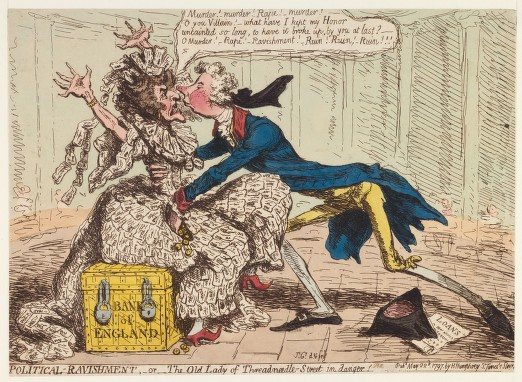
James Gillray, a popular caricaturist, drew the above cartoon in 1797. In it, England's Prime Minister William Pitt the Younger is fishing through the pockets of the Old Lady on Threadneedle Street -- the Bank of England -- for gold. At the time, England was in the middle of fighting the Napoleonic wars and its bills were piling up.

According to its original 1694 charter, the Bank of England was prohibited from lending directly to the Treasury without the express authority of Parliament. Over the years, the Bank had adopted a compromise of sorts in which it provided the government with limited advances without Parliamentary approval, as long as those amounts did not exceed £50,000. In 1793 Pitt had this prohibition removed and in formalizing the Bank's lending policies, imposed no limit on the amounts that could be advanced by the Bank.

Thenceforth Pitt made large and continuous appeals to the Bank for loans. Without the traditional Parliamentary check, there was little the Bank could do except satisfy Pitt's demands. As Pitt liberally spent these borrowed funds in Europe, gold began to flow out of England in earnest, a pattern that was compounded by an internal gold drain set off when a small French force invaded Ireland in early February 1797, causing a crisis of confidence in banks. Pitt suspended convertibility of Bank of England notes into gold on February 26. England would not go back onto the gold standard until 1821, some twenty-four years after Pitt had taken it off.

Having removed both Parliament and the gold standard as checks, Pitt had effectively turned the Bank of England into the government's piggy bank. Thus the inspiration for Gillray's caricature of a groping William Pitt. To some extent, Gillray's worries were borne out as a steady inflation began after 1797. However, the Pound's inflation over that period came far short of the terrible assignat hyperinflation that had plagued France only a few years before. The fears so aptly captured in Gillray's caricature were never fully realized.[1]

Back to the future: Ways and Means advances

Pitt's robbing of the old Lady on Threadneedle street illustrates an episode in which the traditional English divide between Bank and State was removed. Both the Treasury and the Bank of England were effectively consolidated into one entity with the Treasury calling the shots.

The last decade or two illustrate the opposite -- the re-erection of walls between Bank and State. If you browse the asset side of the Bank of England's balance sheet, for instance, you'll notice an entry called Ways and Means advances to HM Treasury ("Her Majesty's Treasury"). Ways and means advances are direct loans to the government. They are generally short term, designed to provide the government with temporary financing to plug gaps between expected tax receipts.

Ways and means advances provide the government with an extra degree of freedom because they offer an alternative avenue for funding. Rather than relying on the bond market or the taxpayer for loans, the government can tap its central bank for money. Ways and means advances are very much like banking overdraft facilities. Unlike a regular loan, the borrower needn't provide a detailed account of what the overdraft will be spent on, nor do overdrafts require specific collateral. They are provided automatically and without fuss.

While overdrafts typically come with specified limits and must be paid back on schedule, they don't always turn out that way. William Pitt's machinations secured for himself what was effectively an unlimited overdraft facility to fund the war against Napoleon. A chunk of the British government's WWI expenses were funded by Bank of England Ways and Means advances and though supposedly of a short term nature, these advances took years to pay down. [2]

While any sovereign would welcome the opportunity to directly borrow from a central bank, from the perspective of the lending bank, overdrafts are risky. First, they are illiquid. Other central banking operations, say open market operations, bring a marketable asset onto the central bank's balance sheet, giving the bank the flexibility to rid itself of that asset whenever it sees fit. Secondly, overdrafts are uncollateralized. Should the borrower go bankrupt, the central bank lacks a counterbalancing asset to compensate itself for its loss.

While the Ways and Means overdraft amount to a piddling £370 million, or 0.1% of the Bank's portfolio of assets, in times past it was very large. See the chart below, cribbed from this Bank of England publication.


At various points in the late 1990s, The Bank's Ways and Means overdrafts amounted to as much as £20 billion. Given the fact that the Bank's note issue then stood at around £25 to £30 billion, Ways and Means advances provided as much as 80% of the backing for paper pounds! Insofar as the value of currency is set by the assets that back the issue, the purchasing power of the pound during the 1990s depended very much on the quality of these Ways and Means advances.

Why did Ways and Means advances contract?

In 1997, the government decided that it would cease using the Bank of England as its source for short term financing and instead would turn to money markets. The final changeover occurred in 2000, at which point the Ways and Means balance was fixed at £13.4 billion, and eventually paid down to £370 million in 2008. Thus ended the Treasury's ability to turn to the Bank of England for financing. As for the Bank, it had earned for itself a larger degree of flexibility -- a large and illiquid asset no longer existed on its balance sheet.

There seem to be a few reasons for ending Ways and Means advances. To begin with, the Treasury was already in the process of handing over its control of monetary policy to the Bank of England. Prior to 1998, the Treasury had been responsible for setting rates. Subsequent to 1998, the Bank of England's Monetary Policy Committee has set rates. The decision to freeze and eventually pay down Ways and Means advances went hand in hand with the Bank's increased independence in setting monetary policy.

Secondly, the third stage of European and Monetary Union (EMU) requires that all member nations cease to lend directly to their government. While the United Kingdom is a signatory to EMU, it never proceeded to the third stage, so it was not required to end Ways and Means advances. Nevertheless, given the possibility that it might proceed to the third stage at some future point in time, it probably made sense to plan ahead by ensuring that the government had already established a viable short term financing alternative to the Bank of England.

Dormant, but not dead

While Ways and Means advances are no longer used, the mechanism isn't dead. The interactive chart below illustrates the Bank of England's balance sheet since 2006. Let's remove all component assets except for ways and means advances, the purple series, and see what we get.


As the chart illustrates, after being paid down in early 2008, Ways and Means advances spiked briefly in late December 2008 to £20 billion only to fall back by April 2009 to £370 million. According to this Bank of England report, the explanation for this spike is that the Treasury briefly borrowed from the Bank to refinance loans that the Bank had earlier made to the Financial Services Compensation Scheme and to Bradford & Bingley.

Bradford & Bingley was a failing bank that was nationalized by the UK government in September 2008. The Bank of England had lent around £4 billion in emergency "Special Liquidity Scheme" funds to Bradford & Bingley as it coped with withdrawals. The SLS had been established earlier that year to improve liquidity of the UK banking system. All Bank of England funding via the SLS was indemnified by the Treasury, so any loss that resulted from supporting Bradford and Bingley up until nationalization would have been absorbed by the Treasury, first by taking on the loan itself and funding that loan via ways and means advances from the Bank of England, and then paying the Bank back by April.

The FSCS, the UK's deposit insurance authority, was able to make good on B&B's deposits through a short term loan from the Bank of England, which was quickly replaced by a government loan financed by Ways and Means advances, which in turn was paid down by the government by April.

Just as Ways and Means mechanism provides the government with the ability to meet sudden spending requirements during war, it provided the same during a period of financial crisis.

Where does the Bank of England stand relative to other central banks?

Although the Bank of England has secured itself a significant degree of financial independence relative to the 1990s and Pitt's era, compared to the Federal Reserve/US Treasury relationship the Bank of England/HM Treasury is much tighter. The Fed has been legally prohibited from granting overdrafts to the government since 1980, as I've outlined here. While Bank of England Ways and Means advances are no longer the modus operandi, they haven't been legally struck out of central bank law as they have in the US. Direct advances to the government could be back one day, with a vengeance.

Compared to the Bank of Canada/Department of Finance relationship, the interface between the Bank of England and HM Treasury is fairly tight. As I've outlined here, the Bank of Canada has the ability to directly lend significant amounts to the government over long periods of time. Indeed, the Bank of Canada is currently purchasing record amounts of bonds in government debt auctions, providing the Finance Department with a continuous overdraft of sorts. Few governments in the western world have the ability to harness their central bank in such a manner.

In general I think it's healthy to establish well defined boundaries between a nation's central bank and its executive branch. Ever since John Law's Banque Royale was nationalized in 1718 and then looted by King Louis XV, scholars have been attuned to the dangers of excessive state control over the issuing power of a nation's monopoly monetary body.

That being said, central bank overdrafts needn't necessarily lead to the sorts of hyperinflation seen in Law's day. The Bank of England provided overdrafts to the Treasury for centuries without igniting prices. The gold standard acted to discipline excess use of the overdraft facility, but in modern days a well-publicized inflation target should be sufficient to reign in any silliness. Absent the discipline imposed by inflation targets, the ability to enjoy central bank financing may be too tempting for a sovereign to forgo. Strict limits or all-out bans on overdraft facilities may provide a needed degree of redundancy.


[1] Most of the information concerning the Pitt era comes from Eugene White and Michael Bordo's British and French Finance During the Napoleonic Wars, as well as Henry Dunning Macleod's excellent Theory and Practice of Banking, Volume I.
[2] I get this from Sayers's The Bank of England, 1891-1944.

Monday, January 28, 2013

Meandering from MMT and the platinum coin to the Bank of Canada and central bank floor systems


This post may get a bit rambling. It's an attempt to tie together a couple of different strands that I've been thinking and reading about.

Modern monetary theory (MMT) in a nutshell, at least as far as I see it, goes something like this. Back in the 1990s a couple of clever guys came up with the idea of a government-provided jobs guarantee. They realized that this program would be seen by the public as an expensive boondoggle requiring sky-high taxes and huge debts. Could they outflank these criticisms by finding another way to fund the jobs guarantee?

To find the funds the early MMTers worked backwards through the labyrinthine relationship between the Federal Reserve and the Treasury. What they claimed to have discovered at the end of their trek was certainly shocking. The US Treasury, they said, funds itself not by the conventional route of taxes and bonds, but by creating and directly spending fiat (i.e. inconvertible) money. Furthermore, it is not only the government's prerogative, but its obligation to spend this money into existence, since people need a stock of fiat money to pay their taxes. Bonds, contrary to what most of us think, are not a sign of government indebtedness—rather, they drain spending.

This bit of monetary jiu-jitsu is powerful because it has the ability to disarm people's instinctual aversion to expensive social programs. If all it takes to fund a jobs guarantee is that the government spend money, and debt and taxes are not the great evils we have been trained to think, then why resist it?

Most governments don't create fiat money—their central banks do. For a government to have this power, it needs to be able to force its central bank to add new money to the government account. One way to do this is for the government to print up a bond and give it to the central bank. The central bank then credits the government's account for the full amount of the bond, and now the government can spend, say on a jobs guarantee. Alternatively, the transaction can be completed without the transferral of the bond—just have the central bank automatically credit the government's account prior to spending. When the government can require its central bank to create money on its behalf, we say that they are effectively consolidated into one entity.

The earliest MMT tome, Wray's Understanding Modern Money, is very insistent on the consolidated nature of the Fed-Treasury:
"The important thing to notice is that the Treasury spends before and without regard to either previous receipt of taxes or prior bond sales."

"...permanent consolidated government deficits are the theoretical and practical norm in a modern economy... Further, government spending is always financed through creation of fiat money - rather than through tax revenues or bond sales."

"While it appears that the Treasury 'needs' the tax revenue so that it can spend, that is clearly a superficial view... The government certainly does not need to have its own IOU returned before it can spend; rather, the public needs the government's IOU before it can pay taxes."
Now as their critics were quick to point out (see Lavoie, for instance), the relationship between Fed and Treasury is such that the two are not consolidated. The Treasury cannot ask the Fed to credit its account, nor can the Treasury print up a bond and give it to the Fed in exchange for spending power. The only way the Treasury can spend is by moving previously acquired funds that are held in the private banking system into its Federal Reserve account—and the only way it can acquire these funds is through taxes and bond issues. Using the Fed to print money and fund a jobs guarantee program is impossible.

The MMT wish, it would seem, was the father to the thought—Wray's 1998 tome was too hasty in consolidating the Fed and Treasury. MMTers are left with an intriguing theory of how modern money works, yet their theory corresponds to no underlying reality. That doesn't mean that MMT is without some merits. MMTers are hackers. In their efforts to reverse engineer the Fed-Treasury nexus in order to fund their pet project, they've come across plenty of interesting minutiae about monetary operations. MMT papers and blogs go into these details and are worth reading if you want to hone your understanding of the monetary system [just take anything they say about consolidation with a grain of salt].

Has the lack of overlap between Wray 1998's theory and reality stopped MMTers? Not at all. When your theory doesn't describe reality, don't bother changing your theory—change reality so that it conforms to your theory. Enter the platinum coin.

The idea of issuing a trillion dollar platinum coin rose to prominence with the onset of yet another US debt ceiling crisis. The MMT blogs hummed about the coin, a huge coin crescendo grew on Twitter, and the issue went all the way to the White House, which demurred. My hunch is that beating the debt ceiling is only a tertiary motive for MMTer excitement over the platinum coin. Far more important to them is that the platinum coin, if implemented, will effectively consolidate the Fed and Treasury, finally redeeming Wray 1998. This opens to door to their beloved jobs guarantee.

I'm not sure how MMT will evolve, but one thing we'll probably see more of is platinum coin-style activism. Though the rest of world has moved on from the coin, the MMT blogs are still buzzing about it. I'm sure more clever ways to hack the Fed-Treasury nexus will be found, thereby giving the Treasury other routes by which to force Bernanke or whomever follows him to print dollars on demand. These hack-arounds will be publicized. Perhaps a political movement will form. This wouldn't be unique. All sorts parties have formed around monetary ideas—Greenbackism, Free Silver, and Social Credit.

I've always wondered why MMTers ignore Canada. Of all the major central banks, the Bank of Canada conforms most fully to the MMT ideal. Consider this—the Bank of Canada routinely buys bonds directly from the government. The Fed, ECB, and other central banks can only buy government debt on secondary markets. This degree of consolidation goes beyond the ability to participate in bond auctions. The BoC is permitted to lend directly to both the Federal and provincial governments without requiring any security whatsoever. Section 18(j) of the Bank of Canada Act says that the Bank may
make loans to the Government of Canada or the government of any province, but such loans outstanding at any one time shall not, in the case of the Government of Canada, exceed one-third of the estimated revenue of the Government of Canada for its fiscal year, and shall not, in the case of a provincial government, exceed one-fourth of that government’s estimated revenue for its fiscal year, and such loans shall be repaid before the end of the first quarter after the end of the fiscal year of the government that has contracted the loan. 
The US Treasury was once allowed to go into overdraft at the Fed, but this hasn't been permitted since 1981. And even when it could have its account credited, overdraft loans were quite limited in size and duration.


The Bank of Canada is engaged in a very MMT-like operation right now. As I wrote in an earlier post, the Federal government is currently implementing what it calls a prudential liquidity management plan. The BoC typically buys 15% or so of bonds auctioned off by the government. It does so on a non-competitive basis, meaning that it pays the average of all competitive bids submitted to the auction. The traditional 15% allocation is enough to ensure that maturing government debt held in the BoC's portfolio is replaced. In late 2011, the government asked the Bank to fund its prudential liquidity plan by raising its allocation at government bond auctions to 20%. Because this larger allocation is more than enough to make up for maturing debt, the BoC's balance sheet has been growing quite fast. At the same time, the government's account at the BoC, which usually hovers at around $2 billion, now clocks in at $11.5 billion, and by 2014 or so, should rise to $20 billion. Below is a chart of the Bank of Canada's balance sheet. Note the large jumps in government bond holdings (red) and deposits (bottom green).


MMTers might not agree with the prudential liquidity plan, but it surely represents the sort of consolidation they are so anxious to see in the US.

So what happens when the Federal government begins to spend down its prudential balances held at the BoC? Private banks will quickly realize that they have far too many clearing balances and will try to get rid of them. Canada's overnight lending rate will collapse below its target rate. In order to bring the rate back up to target, the BoC can do any number of things.

1) Sell assets from its existing portfolio, thereby withdrawing excess clearing balances.
2) Issue Bank of Canada sterilization bills, which banks will purchase directly from the BoC with excess clearing balances.

Alternatively, the BoC can work together with the government:

3) Ask the government to issue more bonds, depositing the proceeds at the Bank of Canada. Bonds here are fulfilling the money-draining purpose that MMTers like to emphasize.
4) Ask the government to increase taxes, depositing the proceed at the BoC. Just like bonds, taxes would be draining previously spent money.

Finally, the BoC can simply leave this spending unsterilized.

5) Rather than withdraw (i.e. sterilize) balances, let the excess supply drag the overnight rate to the deposit rate. All clearing balances now earn the deposit rate.

The BoC currently maintains a corridor system. During the day, private Canadian banks make and receive hundreds of thousands of payments. By lunch time on a normal day there will be a number of debtor and creditor banks. Debtors can settle with a creditor by borrowing clearing balances from the BoC on a collateralized basis and transferring these balances to their creditor. By the end of the day, the BoC will have typically swallowed up large amounts of collateral as it creates and lends whatever quantity of intraday clearing balances that deficit banks require.

Banks who have borrowed balances to fund a deficit are free to maintain these positions overnight, but are dissuaded from doing so because the rate which they must pay to the BoC, the bank rate, is 0.25% above the market overnight rate. Nor do surplus banks wish to keep the quantities of clearing balances they have received at the BoC overnight, since the deposit rate is 0.25% below the market rate. As a result, those banks holding clearing balances are incentivized to transfer them to those banks that are in debt to the BoC. This transfer allows the deficit banks to pay back their intraday debts to the BoC and get their collateral back. In short, BoC balances are not attractive to maintain so they reflux back to the Bank of Canada. A good visual aid is to think of the central bank as a blowfish: it blows up during the day and sucks itself back in at night when it isn't needed.

If it turns to this last solution, the Bank of Canada will be throwing away its corridor system and adopting a floor system. Steve Waldman generated plenty of discussion on his recent series of blog posts on floor systems. As the Federal government spends down its $20 billion prudential balance at the BoC, all private banks will end up holding excess clearing balances. There is no way for them to contract among each other to remove this excess. Only one option remains to the banks—hold these balances overnight and receive the deposit rate. The Bank of Canada would be a permanently inflated blowfish.

If it adopts a floor, the BoC wouldn't be the first. The Federal Reserve stumbled its way into a floor system in 2008 by injecting so many reserves that it was unable to sterilize them. But a floor system is by no means universally accidental. The Reserve Bank of New Zealand chose to adopt a floor in 2006. When it maintained a corridor, the RBNZ began to notice signs of stress in the banking system that it traced to insufficient liquidity. Evidence included delayed or 'just-in-time' payments, failed settlement, collateral hoarding, and increasing use of the bank's overnight lending facility.

Between July and October 2006, the RBNZ moved to a fully "cashed up" system by injecting $7 billion worth of settlement cash on which it paid interest. Banks had typically required $3-5 billion worth of intraday credit in order to meet their payment requirements. Now that there was a permanent $7 billion worth of balances, there was no longer any need for banks to get intraday loans from the RBNZ, nor scramble for collateral to qualify for these loans. Banks ceased waiting till the end of the day to make payments. The time of day when 50% of all payments were completed was moved up by two hours compared to when the corridor system was in place. (See the RBNZ's account of this here.) Flattening out settlement over a trading day can be desirable since settlement delays, especially if they spread from participant to participant, can be costly.

The Bank of Canada has toyed with an RBNZ-style cashed up system. In response to the credit crisis, in May 2009 the BoC injected $3 billion of excess settlement balances into the clearing system, pushing the overnight rate down to the Bank's deposit rate. This excess was removed in June 2010, a year later. We know from a presentation by former Deputy BoC Governor David Longworth that much like New Zealand, Canadian payments tended to be made earlier in the day during the period between May 2009 and June 2010.  If the Federal government's prudential balances at the BoC are spent down, a decision to use the occasion to move to a floor system rather than sterilizing this spending would not be without precedent or merit.

[If you're interested on this subject, this paper relates the US experience with excess reserves. Much like Canada and New Zealand, US payments after the onset of excess reserves were more evenly distributed throughout the day.]

Back to MMT, where this whole ramble started. Much a large corporate conglomerate, MMT might benefit from being dismantled. Beholden to the jobs guarantee division, the monetary division has made unrealistic claims about the nature of consolidation. Now it is turning to monetary activism. The monetary division would be less conflicted, and therefore be taken more seriously, if it was spun off from its parent. As separate corporations, the jobs guarantee folks could focus on lobbying governments like Canada to use their central banks to fund social programs, freeing the monetary folks to focus on how monetary systems actually work. Why not deconsolidate MMT?

Thursday, December 27, 2012

The final draft on Fed-Treasury overdrafts

Marriner Eccles


There is an idea floating around on the internet that the US Treasury can finance itself indefinitely by borrowing directly from the Federal Reserve. All the President need do, goes the story, is order the Fed to credit the Treasury's account with fresh money, and voilà – the Treasury can spend willy-nilly. This is called the Treasury's overdraft facility.

In actuality, the above operations are impossible since the Treasury is legally prevented from borrowing directly from the Fed. The result is that the Treasury can only spend by ensuring that it has already obtained funding through the collection of taxes or the issuance of securities in the open market. The overdraft facility is a myth.

But this wasn't always the case. Marriner Eccles's March 1947 hearing before the House of Representative's Committee on Banking and Currency is a great source of US monetary history. In it we learn that from 1914 to 1935, the Federal Reserve had the power to lend directly to the Treasury by purchasing newly created government debt. This was called direct-purchase authority, and it amounted to a Treasury overdraft privilege with the Federal Reserve. This overdraft facility found legal expression in section 14(b) of the act, which permitted the Fed to "buy and sell, at home or abroad, bonds and notes of the United States, and bills, notes, revenue bonds, and warrants with a maturity from date of purchase of not exceeding six months." The interpretation of this bit of legalese was that the Fed needn't limit purchases of government debt to the open market, it could buy directly from the government.

As I pointed out in an earlier post, section 16 of the Federal Reserve Act prohibited the Fed from using government securities as collateral for note backing until the passage of the first Glass Steagall Act in 1932. So even though the Fed could lend directly to the Treasury during this early period, its ability to do so was significantly crimped by the ineligibility of government bonds as backing.

We learn from the Eccles document that in 1935, the Federal Reserve Act was modified to prevent the Fed from making direct purchases of Treasury-issued securities. This was done by inserting a provision into section 14(b) of the Act requiring all purchases of government debt to be carried out in the open market. As a result, the overdraft privilege ceased to exist.

The overdraft facility was re-instituted in March 27, 1942, only a few months after the US entered World War II. The War Powers Act provided the Fed with the temporary authority to directly buy up to $5 billion of government securities from the Treasury. Specifically, the new wording of section 14(b) allowed the Fed to purchase
any bond, note, or other obligation which are obligations of the United States, or which are fully guaranteed by the United States as to principal and interest, may be bought and sold without regard to maturities either in the open market or directly from or to the United States, but all such purchases and sales shall be made in accordance with the provisions of section 12 (a) of this Act and the aggregate amount of such obligations acquired directly from the United States which is held at any one time by the 12 Reserve banks shall not exceed $5,000,000,000.
This was only a temporary power, which is why we find Fed Chairman Marriner Eccles visiting Congress in 1947. He was lobbying Washington to make the overdraft facility a permanent part of the Fed's arsenal. Eccles justified the overdraft by pointing out that it might save the taxpayer money. After all, overdrafts provided the Treasury with cheaper temporary funding than the open-market did. We know he was unsuccessful in his efforts to make the authority permanent, since this 2006 Government Accountability Office (GAO) document notes that:
Intermittently between 1942 and 1981, Treasury was able to directly sell (and purchase) certain short-term obligations to (and from) the Federal Reserve in exchange for cash. Congress first granted this cash draw authority temporarily in 1942, allowed it to lapse several times, and extended it 22 times until 1979, when it modified some of the terms and added controls.
We also learn from the GAO document that in 1981 Congress allowed the overdraft authority – referred to as "draw authority" – to permanently expire. Thus ended 39 years of Treasury overdrafts. The GAO report provides some interesting statistics on this period. Between 1942 and 1981, the Federal Reserve held Treasury certificates purchased directly from the Treasury on just 228 days, mostly during times of war. So while overdrafts were permitted, they weren't used often, and not for long periods of time. The largest amount  of certificates issued by the Treasury to the Fed on a single day was $2.6 billion in 1979. By 1979, $2.6 billion didn't amount to much, but in 1942, with the Fed's liabilities amounting to $25 billion, an extension of a $5 billion overdraft would have dramatically increased the Fed's balance sheet.

Below is a handy chart I've pinched from the GAO report which illustrates the use of the overdraft facility over time.


Note the large interwar gaps when draw authority was never used.

Section 14(b) of the modern Federal Reserve Act, amended in 1981, includes a strict "open market" provision that limits Fed purchases to "any bonds, notes, or other obligations which are direct obligations of the United States or which are fully guaranteed by the United States as to the principal and interest may be bought and sold without regard to maturities but only in the open market". This change is indicative of the broader trend to independent central banking. In a 1978 subcomittee meeting on the Fed's draw authority, Congressman George Hansen expressed this sentiment quite well:
This authority is a leftover from the days of explicit Fed support for Treasury financing, when monetary policy was clearly subordinated to the Treasury's aim of cheap deficit financing. I hope we are all agreed that monetary policy should not be thus subordinated, and that we can do without the mechanisms through which the Treasury called the shots for Federal Reserve open market operations.
And that's where we are today. The Treasury can't finance itself directly via the Fed. Yes, there may be indirect routes, but that's another post. Anyone who operates under the assumption that the direct route exists are assuming a monetary structure that became extinct in 1981.

Monday, June 11, 2012

Marriner Eccles on Treasury borrowing from the Fed

From here (pdf). Eccles is speaking about the Fed's ability (since withdrawn) to lend directly to the Treasury without the intermediation of the market:
Mr. SPENCE. I assume the reason the authority was repealed in 1935 was because of the existing conditions, then, when there was no reason for the authority: is that correct?
Mr. ECCLES. Well, as I remember the discussion—and I have referred to it in this statement—there was a feeling that this left the door wide open to the Government to borrow directly from the Federal Reserve bank all that was necessary to finance the Government deficit, and that took off any restraint toward getting a balanced budget.
Of course, in my opinion, that really had no relationship to budgetary deficits, for the reason that it is the Congress which decides on the deficits or the surpluses, and not the Treasury. If Congress appropriates more money than Congress levies taxes to pay, then, there is naturally a deficit, and the Treasury is obligated to borrow. The fact that they cannot go directly to the Federal Reserve bank to borrow does not mean that they cannot go indirectly to the Federal Reserve bank, for the very reason that there is no limit to the amount that the Federal Reserve System can buy in the market. That is the way the war was financed.
Therefore, if the Treasury has to finance a heavy deficit, the Reserve System creates the condition in the money market to enable the borrowing to be done, so that, in effect, the Reserve System indirectly finances the Treasury through the money market, and that is how the interest rates were stabilized as they were during the war, and as they will have to continue to be in the future.
So it is an illusion to think that to eliminate or to restrict the direct borrowing privilege reduces the amount of deficit financing. Or that the market controls the interest rate. Neither is true.


Sunday, June 3, 2012

Currency issuers and users

A few comments at MMT blogs on the subject of consolidating the nation's central bank and its treasury.

See here and here.

This argument could probably go on forever, but it is an interesting one. MMT's "general case" is one in which there is a government and at some sub-level a treasury and central bank. The government reigns supreme as a currency issuer since it consolidates both institutions. I don't know why this setup must be the "general case" and everything else anomalous. Why not call an independent central bank and a non-issuing treasury the "general case" and then reason from there? It seems ad hoc to me. I prefer thinking not in terms of hierarchies, nor in some sort of tiered progressions away from the general case, but in terms of poles. At one extreme is a totally independent central bank, at the other is a totally consolidated central bank. In the real world, every institutional setup lies somewhere in between.

This reminds me of an old argument I had back in 2010 at WCI.

Sunday, January 8, 2012

Intraday overdrafts, clearing and settlement systems, and Fedwire

Stephen Williamson talks about clearing and settlement systems, in particular Fedwire. I learn that the Fed offers daylight overdrafts on an uncollateralized basis, but believes itself to be covered by charging a fee and by putting caps on the the amount of credit they are willing to extend.

George Selgin pops up again, because he wrote an excellent article called Wholesale payments: questioning the market-failure hypothesis. Available on demand if you email me.

Saturday, December 10, 2011

MMT, Fed Treasury Accord, and overdraft facilities

I entered the fray at a couple of MMT blogs.

There was some interesting discussion concerning consolidation of the Treasury and central bank, and how MMT portrays/misportrays the actual institutional details of modern central banking in order to make their message easier.

Between Depression and Hyperinflation at Winterspeak.
From the comments: technical details on MMT at Winterspeak.
The General and the Specific in MMT at heteconomist.com

Even with the BoE, the old way by which it could lend directly to government - via its "ways and means" advance/overdraft facility - has been effectively neutered. That facility was frozen in 1997 and has since been almost completely repaid. The upshot is that MMT can't look to the BoE as an example of its idealized "consolidation", and it can't give policy recommendations as if these institutional rigidities didn't exist.

Relevant link:
The Treasury-Fed Accord: A New Narrative Account by Hetzel and Leach