Showing posts with label collateral. Show all posts

Saturday, May 30, 2020

How the Bank of Canada's balance sheet went from $118 billion to $440 billion in eight weeks

Ever since the coronavirus hit, the Bank of Canada's balance sheet has been exploding. In late February its assets measured just $118 billion. Eight weeks later the Bank of Canada has $440 billion in assets. That's a $320 billion jump!

To put this in context, I've charted out the Bank of Canada's assets going back to when it was founded in 1935. (Note: to make the distant past comparable to the present, the axis uses logarithmic scaling.)


The rate of increase in Bank of Canada assets far exceeds the 2008 credit crisis, the 1970s inflation, or World War II. Some Canadians may be wondering what is going on here. This blog post will offer a quick explanation. I will resist editorializing (you can poke me in the comments section for more colour) and limit myself to the facts.

We can break the $320 billion jump in assets into three components:

1) repos, or repurchase agreements
2) open market purchases of Federal government bonds
3) purchases of Treasury bills at government auctions.

Let's start with repos, or repurchase operations. Luckily, I don't have to go into much detail on this. A few weeks back Brian Romanchuk had a nice summary of the Bank of Canada's repos, which have been responsible for $185 billion of the $320 billion jump.

With a repo, the Bank of Canada temporarily purchases securities from primary dealers, and the dealers get dollars. This repo counts as one of the Bank of Canada's assets. Some time passes and the transaction is unwound. The Bank gets its dollars back while the dealers get their securities returned. The asset disappears from the Bank of Canada's balance sheet.

The idea behind repos is to provide temporary liquidity to banks and other financial institutions while protecting the Bank of Canada's financial health by taking in a suitable amount of collateral. If the repo counterparty fails, at least the Bank of Canada can seize the collateral that was left on deposit. This is the same principle that pawn shops use. The reasons for providing liquidity to banks and other financial institutions is complex, but it goes back to the lender of last resort function of centralized banking. This is a role that central banks and clearinghouses inherited back in the 1800s.

How temporary are repos? And what sort of collateral does the Bank of Canada accept? In normal times, repos are often  unwound the very next day. The Bank also offers "term repos". These typically have a duration of 1 or 3-months. The list of repo collateral during normal times is fairly limited. The Bank of Canada will only accept Federal or provincial debt. That's the safest of the safe.

But in emergencies, the Bank of Canada is allowed to extend the time span of its repos to as long as it wants. It can also expand its list of accepted collateral to include riskier stuff. Which is what it did in March 2020 as it gradually widened the types of securities it would accept to include all of the following:

Source: Bank of Canada

That's a lot of security types! (The list is much larger if you click through the above link to securities eligible for the standing liquidity facility, see here. Nope, equities are not accepted as collateral.)

As for the temporary nature of these repos, many now extend as far as two years into the future. See screenshot below:

Source: Bank of Canada

(Note that the Bank of Canada has a very specific procedure for moving from "regular" purchases to "emergency" purchases. Part of this was implemented due to its initial reaction in 2007 to the emerging credit crisis. It accidentally began to accept some types of repo collateral that were specifically prohibited by the Bank of Canada Act. The legislative changes implemented in 2008 remedied some of the problems highlighted by this episode and codified the process for going to emergency status. Yours truly was involved in this, click through the above link.)

Anyways, we've dealt with the $185 billion in repos. Now let's get into the second component of the big $320 billion jump: open market purchases of long-term government bonds, or what the Bank of Canada refers to as the Government of Canada Bond Purchase Program (GBPP). This accounts for another $50 billion or so in new assets.

Whereas a repo is temporary, an outright purchase is permanent. Some commentators have described the purchases that the GBPP is doing as "quantitative easing". But the Bank of Canada has been reticent to call it that. When it first announced the GBPP, it said that the goal was to "help address strains in the Government of Canada debt market and enhance the effectiveness of all other actions taken so far."

This is a non-standard reason. Large scale asset purchases are normally described by central bankers as an alternative tool for stimulating aggregate demand. Usually central banks use interest rate cuts to get spending going. But when interest rates are near 0% they may switch to large scale asset purchases. (The most famous of these episodes were the Federal Reserve's QE1, QE2, and QE3). But the Bank of Canada seems to be saying that its large scale purchases are meant to fix "strains" in the market for buying and selling government bonds, not to stoke the broader economy. 

Together, the GBPP and repos account for $235 billion of the $320 billion jump.

Let's deal with the last component. Another $65 or so billion in new Bank of Canada assets is comprised of purchases of government Treasury bills (T-bills). A T-bill is a short term government debt instrument, usually no more than one year. This is interesting, because here the Bank of Canada can do something a lot of central banks can't.

Most central banks can only buy up government debt in the secondary market. That is, they can only purchase government bonds or T-bills that other investors have already purchased at government auctions. The Bank of Canada doesn't face this limit. It can buy as much government bonds and T-bills as it wants in the primary market (i.e. at government securities auctions).

Since the coronavirus crisis began, the Federal government under Justin Trudeau has revved up the amount of Treasury bills that it is issuing. As the chart below illustrates, in the last two Treasury bill auctions (which now occur weekly instead of every two weeks) it has raised $35 billion each.


For its part, the Bank of Canada bought up a massive $14 billion at each of these auctions. That's 40% of the total auction. In times past, the Bank of Canada typically only bought up around 15-20% of each auction. This 15-20% allotment was typically enough to replace the T-bills that the Bank already owned and were maturing.

By moving up to a 40% allotment at each Treasury bill auction, the Bank of Canada's rate of purchases far exceeds the rate at which its existing portfolio of T-bills matures. And that's why we're seeing a huge jump in the Bank of Canada's T-bill holdings.

(So who cares whether the Bank of Canada buys government bonds/T-bills directly at government securities auctions instead of in the secondary market, as it is doing with the GBPP?  It's complicated, but part of this controversy has to do with potential threats to the independence of the central bank. But as I said at the outset, I'm resisting editorializing.)

These three components get us to $300 billion. The last $25 billion is due to other programs. I will list them below and perhaps another blogger can take these up, or I will do so in the comments section or in another blog post:

+$5 billion in Canada Mortgage Bonds
+$5 billion in purchases via the Provincial Money Market Purchase Program (PMMP)
+$1 billion in Provincial bonds
+$8 billion in bankers' acceptances via the Bankers' Acceptance Purchase Facility (BAPF)
+$2 billion in commercial paper
+$1 billion in advances

And that, folks, is how the Bank of Canada's assets grew to $440 billion in just two months.

Tuesday, June 11, 2013

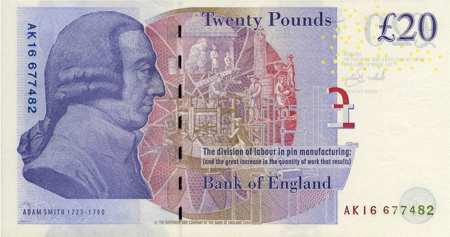
Adam Smith's very own Lehman Crisis


It's interesting to see how after a credit crisis, economists start to take money and banking a bit more seriously. Adam Smith, who experienced his very own credit crisis -- the collapse of the Douglas Heron and Co, or the Ayr Bank, on June 22, 1772 -- is no exception. His views on money and banking became much more nuanced after that event.

Ayr Bank had been founded in 1769 in the Scottish town of Ayr. It expanded to Edinburgh and Dumfries, and in only a few short years it had succeeded in wrestling a significant chunk of Scottish banking business from incumbents the Bank of Scotland and the Royal Bank of Scotland. By 1772, according to Checkland, the Ayr Bank supplied 25% of Scotland's bank notes and deposits. In early June 1772 one of Ayr's largest customers, Alexander Fordyce, skipped London for Paris to avoid debt payments. A run on the Ayr Bank began that precipitated the bank's failure by the end of the month.

Upon observing the bank run, David Hume writes from Edinburgh, Scotland to his friend Smith on June 27, 1772:
We are here in a very melancholy Situation: Continual Bankruptcies, universal Loss of Credit, and endless Suspicions. There are but two standing Houses in this Place, Mansfield’s and the Couttses: For I comprehend not Cummin, whose dealings were always very narrow. Mansfield has pay’d away 40.000 pounds in a few days; but it is apprehended, that neither he nor any of them can hold out till the End of next Week, if no Alteration happen. The Case is little better in London. It is thought, that Sir George Colebroke must soon stop; and even the Bank of England is not entirely free from Suspicion. Those of Newcastle, Norwich and Bristol are said to be stopp’d: The Thistle Bank has been reported to be in the same Condition: The Carron Company is reeling, which is one of the greatest Calamities of the whole; as they gave Employment to near 10.000 People. Do these Events any–wise affect your Theory? Or will it occasion the Revisal of any Chapters?

Of all the Sufferers I am the most concern’d for the Adams, particularly John. But their Undertakings were so vast that nothing coud support them: They must dismiss 3000 Workmen, who, comprehending the Materials, must have expended above 100.000 a Year. They have great Funds; but if these must be dispos’d of, in a hurry and to disadvantage, I am afraid the Remainder will amount to little or nothing.
Hume asks if these events affect Smith's theory, the Wealth of Nations having not yet been published. In a letter to William Pulteney dated September 1772, a few months after the bank crisis, Smith notes that the events had indeed delayed the finishing of his book, which otherwise would have been completed that winter. When it was eventually published in 1776, Book II, Chapter II of the Wealth of Nations would include a long description of the Ayr crisis (though Smith never mentions the bank by name, most probably to protect those involved, see below).

Personal issues arising from bank failure also delayed publication of the Wealth of Nations. In the letter to Pulteney, Smith disavows any financial involvement in the crisis but notes that:
Tho I have had no concern myself in the Public calamities, some of the friends for whom I interest myself the most have been deeply concerned in them; and my attention has been a good deal occupied about the most proper method of extricating them.
According to Antoin Murphy and John Rae [biographer of Smith], the friends to whom Smith refers to probably included Smith's patron, the Duke of Buccleuch. The Duke was one of Ayr Bank's largest shareholders, and the source of Smith's £300 a year pension. Murphy intimates that as adviser to the Duke, Smith would have been privy to much of the gritty details of the bank's demise, as well as advising Buccleuch in the ongoing legal proceedings against the shareholders and directors of the bank. No doubt Smith had plenty to reflect on, including the fact that he might lose his pension.

There is also an odd letter from Hume to Smith, dated October 1772, in which Hume refers to Ayr banknotes in Smith's possession:
I ask’d the Question you proposd; and was told by Sir William Forbes, that tho’ they did not commonly take the Air Notes, yet he woud upon your Account: You may therefore send them over by the first Opportunity.
Not only did the collapse of Ayr put Smith's benefactor in financial trouble, but it seems that Smith himself was in possession of a few Ayr banknotes. Could it be that Smith himself was burned by the Air collapse, only to be helped out by William Forbes, an Edinburgh banker who had survived the crisis and generously agreed to take the notes off of Smith's hands? Or was Smith simply using his connections to help out a London-based friend who was stuck with Ayr Bank notes?

In any case, Smith's views on banking were inevitably modified by a crisis. According to Murphy, Smith became more conservative monetary theorist relative to his pre-1772 stance. Here is a quote from Smith's earlier Lectures on Jurisprudence, about six years before the crisis, in which he pooh-poohs the danger of banking crisis.
The ruin of a bank would not be so dangerous as is commonly imagined. Suppose all the money in Scotland was issued by one bank and that it became bankrupt, a very few individuals would be ruined by it, but not many, because the quantity of cash or paper that people have in their hands bears no proportion to their wealth. Neither would the wealth of the whole country be much hurt by it, because the 100 part of the riches of a country does not consist in money. (1766)
In The Wealth of Nations, Smith's benign view of banks was modified. No doubt influenced by his first hand experience of the Ayr collapse, Smith realized that the ruin of banks could have far greater consequences than he had earlier assumed. He went on to describe a set of guidelines that banks might use to avoid bankruptcy. Bankers, Smith wrote, should always verify that the bills of exchange upon which they issued credit (bills were a common collateral security accepted by banks) had arisen as the result of solid transactions between "real creditors" and "real debtors". Fictitious bills of exchange -- bills whose provenance was obscure and were usually issued by those whom Smith called "projectors", or speculators, and accepted (or co-signed) by collaborating projectors -- were to be treated with skepticism. The blogosphere's very own David Glasner describes this set of rules in this paper.

Like Smith, modern day economists are busily reappraising pre-2008 modes of thought, much of which abstracted from money and banking altogether. They have much to reflect on too. If Smith were alive today, he'd no doubt wonder why banks had lent on such unverifiable collateral, most of which in his eyes would appear to be entirely fictitious.


1: Much of this blog post is indebted to Antoin Murphy's chapter on Adam Smith in The Genesis of Macroeconomics.
2. For a full account of the demise of the Ayr Bank, here is the 1778 inquiry into the affair , or The Precipitation and Fall of Mess. Douglas, Heron and Co, Late Bankers in Air With the Causes of their Distress and Ruin Investigated and Considered. They sure loved long names back then.

Thursday, March 21, 2013

Open mic night on interest rate spreads

Ok, readers. Here's a chance for you to flex your muscles. The following chart shows various short-term interest rates:


Why are these rates all so different? Can the differentials between them be arbitraged away? What sorts of institutional rigidities might be preventing arbitrage? For instance, we know certain institutions like Fannie Mae and Freddie Mac can't get interest on reserves held at the Fed. What other sorts of fine details might be important? Or are the differentials between these various rates not currently open to arbitrage? Can they be explained by term risk? How much do other sorts of risk, like liquidity risk, counterparty risk, default risk etc drive spreads?  A few specific questions:

a) The DTCC Treasury General Financial Collateral (GCF) repo rate used to trade at or below the fed funds rate. The Treasury GCF repo rate is a collateralized rate. Since collateral reduces risk, it makes sense it would trade below the fed funds rate. But why is the riskier rate now below the safer rate?

b) Why does the Fed funds rate generally trade above the t-bill rate? There's presumably less term risk in the FF rate, which would imply a lower Fed funds rate. Does interbank risk account for the higher fed funds rate?

c) Is it a risk-free trade to fund oneself in the fed funds market and invest the proceeds overnight at the interest rate?

d) Why would banks hold t-bills at all if they can simply keep reserves at the Fed for a superior return of 0.25%? The credit risk seems similiar: as a bank, you're exposed to the Fed in the case of reserves, and the Treasury in the case of bills.

e) Sometimes the 4-week t-bill yield crosses over the 3-month. Why? The credit risk is the same, and presumably bills are equally liquid. Are these inversions purely related to expected changes in yields?

Data, ideas, links,etc all much appreciated. I'm sure I'll have more questions in the comments, or if you have other interesting observations, go for it.

[Update 22/03/2013: I reinputted the Treasury GCF rate since my original data was off]

Monday, January 28, 2013

Meandering from MMT and the platinum coin to the Bank of Canada and central bank floor systems


This post may get a bit rambling. It's an attempt to tie together a couple of different strands that I've been thinking and reading about.

Modern monetary theory (MMT) in a nutshell, at least as far as I see it, goes something like this. Back in the 1990s a couple of clever guys came up with the idea of a government-provided jobs guarantee. They realized that this program would be seen by the public as an expensive boondoggle requiring sky-high taxes and huge debts. Could they outflank these criticisms by finding another way to fund the jobs guarantee?

To find the funds the early MMTers worked backwards through the labyrinthine relationship between the Federal Reserve and the Treasury. What they claimed to have discovered at the end of their trek was certainly shocking. The US Treasury, they said, funds itself not by the conventional route of taxes and bonds, but by creating and directly spending fiat (i.e. inconvertible) money. Furthermore, it is not only the government's prerogative, but its obligation to spend this money into existence, since people need a stock of fiat money to pay their taxes. Bonds, contrary to what most of us think, are not a sign of government indebtedness—rather, they drain spending.

This bit of monetary jiu-jitsu is powerful because it has the ability to disarm people's instinctual aversion to expensive social programs. If all it takes to fund a jobs guarantee is that the government spend money, and debt and taxes are not the great evils we have been trained to think, then why resist it?

Most governments don't create fiat money—their central banks do. For a government to have this power, it needs to be able to force its central bank to add new money to the government account. One way to do this is for the government to print up a bond and give it to the central bank. The central bank then credits the government's account for the full amount of the bond, and now the government can spend, say on a jobs guarantee. Alternatively, the transaction can be completed without the transferral of the bond—just have the central bank automatically credit the government's account prior to spending. When the government can require its central bank to create money on its behalf, we say that they are effectively consolidated into one entity.

The earliest MMT tome, Wray's Understanding Modern Money, is very insistent on the consolidated nature of the Fed-Treasury:
"The important thing to notice is that the Treasury spends before and without regard to either previous receipt of taxes or prior bond sales."

"...permanent consolidated government deficits are the theoretical and practical norm in a modern economy... Further, government spending is always financed through creation of fiat money - rather than through tax revenues or bond sales."

"While it appears that the Treasury 'needs' the tax revenue so that it can spend, that is clearly a superficial view... The government certainly does not need to have its own IOU returned before it can spend; rather, the public needs the government's IOU before it can pay taxes."
Now as their critics were quick to point out (see Lavoie, for instance), the relationship between Fed and Treasury is such that the two are not consolidated. The Treasury cannot ask the Fed to credit its account, nor can the Treasury print up a bond and give it to the Fed in exchange for spending power. The only way the Treasury can spend is by moving previously acquired funds that are held in the private banking system into its Federal Reserve account—and the only way it can acquire these funds is through taxes and bond issues. Using the Fed to print money and fund a jobs guarantee program is impossible.

The MMT wish, it would seem, was the father to the thought—Wray's 1998 tome was too hasty in consolidating the Fed and Treasury. MMTers are left with an intriguing theory of how modern money works, yet their theory corresponds to no underlying reality. That doesn't mean that MMT is without some merits. MMTers are hackers. In their efforts to reverse engineer the Fed-Treasury nexus in order to fund their pet project, they've come across plenty of interesting minutiae about monetary operations. MMT papers and blogs go into these details and are worth reading if you want to hone your understanding of the monetary system [just take anything they say about consolidation with a grain of salt].

Has the lack of overlap between Wray 1998's theory and reality stopped MMTers? Not at all. When your theory doesn't describe reality, don't bother changing your theory—change reality so that it conforms to your theory. Enter the platinum coin.

The idea of issuing a trillion dollar platinum coin rose to prominence with the onset of yet another US debt ceiling crisis. The MMT blogs hummed about the coin, a huge coin crescendo grew on Twitter, and the issue went all the way to the White House, which demurred. My hunch is that beating the debt ceiling is only a tertiary motive for MMTer excitement over the platinum coin. Far more important to them is that the platinum coin, if implemented, will effectively consolidate the Fed and Treasury, finally redeeming Wray 1998. This opens to door to their beloved jobs guarantee.

I'm not sure how MMT will evolve, but one thing we'll probably see more of is platinum coin-style activism. Though the rest of world has moved on from the coin, the MMT blogs are still buzzing about it. I'm sure more clever ways to hack the Fed-Treasury nexus will be found, thereby giving the Treasury other routes by which to force Bernanke or whomever follows him to print dollars on demand. These hack-arounds will be publicized. Perhaps a political movement will form. This wouldn't be unique. All sorts parties have formed around monetary ideas—Greenbackism, Free Silver, and Social Credit.

I've always wondered why MMTers ignore Canada. Of all the major central banks, the Bank of Canada conforms most fully to the MMT ideal. Consider this—the Bank of Canada routinely buys bonds directly from the government. The Fed, ECB, and other central banks can only buy government debt on secondary markets. This degree of consolidation goes beyond the ability to participate in bond auctions. The BoC is permitted to lend directly to both the Federal and provincial governments without requiring any security whatsoever. Section 18(j) of the Bank of Canada Act says that the Bank may
make loans to the Government of Canada or the government of any province, but such loans outstanding at any one time shall not, in the case of the Government of Canada, exceed one-third of the estimated revenue of the Government of Canada for its fiscal year, and shall not, in the case of a provincial government, exceed one-fourth of that government’s estimated revenue for its fiscal year, and such loans shall be repaid before the end of the first quarter after the end of the fiscal year of the government that has contracted the loan. 
The US Treasury was once allowed to go into overdraft at the Fed, but this hasn't been permitted since 1981. And even when it could have its account credited, overdraft loans were quite limited in size and duration.


The Bank of Canada is engaged in a very MMT-like operation right now. As I wrote in an earlier post, the Federal government is currently implementing what it calls a prudential liquidity management plan. The BoC typically buys 15% or so of bonds auctioned off by the government. It does so on a non-competitive basis, meaning that it pays the average of all competitive bids submitted to the auction. The traditional 15% allocation is enough to ensure that maturing government debt held in the BoC's portfolio is replaced. In late 2011, the government asked the Bank to fund its prudential liquidity plan by raising its allocation at government bond auctions to 20%. Because this larger allocation is more than enough to make up for maturing debt, the BoC's balance sheet has been growing quite fast. At the same time, the government's account at the BoC, which usually hovers at around $2 billion, now clocks in at $11.5 billion, and by 2014 or so, should rise to $20 billion. Below is a chart of the Bank of Canada's balance sheet. Note the large jumps in government bond holdings (red) and deposits (bottom green).


MMTers might not agree with the prudential liquidity plan, but it surely represents the sort of consolidation they are so anxious to see in the US.

So what happens when the Federal government begins to spend down its prudential balances held at the BoC? Private banks will quickly realize that they have far too many clearing balances and will try to get rid of them. Canada's overnight lending rate will collapse below its target rate. In order to bring the rate back up to target, the BoC can do any number of things.

1) Sell assets from its existing portfolio, thereby withdrawing excess clearing balances.
2) Issue Bank of Canada sterilization bills, which banks will purchase directly from the BoC with excess clearing balances.

Alternatively, the BoC can work together with the government:

3) Ask the government to issue more bonds, depositing the proceeds at the Bank of Canada. Bonds here are fulfilling the money-draining purpose that MMTers like to emphasize.
4) Ask the government to increase taxes, depositing the proceed at the BoC. Just like bonds, taxes would be draining previously spent money.

Finally, the BoC can simply leave this spending unsterilized.

5) Rather than withdraw (i.e. sterilize) balances, let the excess supply drag the overnight rate to the deposit rate. All clearing balances now earn the deposit rate.

The BoC currently maintains a corridor system. During the day, private Canadian banks make and receive hundreds of thousands of payments. By lunch time on a normal day there will be a number of debtor and creditor banks. Debtors can settle with a creditor by borrowing clearing balances from the BoC on a collateralized basis and transferring these balances to their creditor. By the end of the day, the BoC will have typically swallowed up large amounts of collateral as it creates and lends whatever quantity of intraday clearing balances that deficit banks require.

Banks who have borrowed balances to fund a deficit are free to maintain these positions overnight, but are dissuaded from doing so because the rate which they must pay to the BoC, the bank rate, is 0.25% above the market overnight rate. Nor do surplus banks wish to keep the quantities of clearing balances they have received at the BoC overnight, since the deposit rate is 0.25% below the market rate. As a result, those banks holding clearing balances are incentivized to transfer them to those banks that are in debt to the BoC. This transfer allows the deficit banks to pay back their intraday debts to the BoC and get their collateral back. In short, BoC balances are not attractive to maintain so they reflux back to the Bank of Canada. A good visual aid is to think of the central bank as a blowfish: it blows up during the day and sucks itself back in at night when it isn't needed.

If it turns to this last solution, the Bank of Canada will be throwing away its corridor system and adopting a floor system. Steve Waldman generated plenty of discussion on his recent series of blog posts on floor systems. As the Federal government spends down its $20 billion prudential balance at the BoC, all private banks will end up holding excess clearing balances. There is no way for them to contract among each other to remove this excess. Only one option remains to the banks—hold these balances overnight and receive the deposit rate. The Bank of Canada would be a permanently inflated blowfish.

If it adopts a floor, the BoC wouldn't be the first. The Federal Reserve stumbled its way into a floor system in 2008 by injecting so many reserves that it was unable to sterilize them. But a floor system is by no means universally accidental. The Reserve Bank of New Zealand chose to adopt a floor in 2006. When it maintained a corridor, the RBNZ began to notice signs of stress in the banking system that it traced to insufficient liquidity. Evidence included delayed or 'just-in-time' payments, failed settlement, collateral hoarding, and increasing use of the bank's overnight lending facility.

Between July and October 2006, the RBNZ moved to a fully "cashed up" system by injecting $7 billion worth of settlement cash on which it paid interest. Banks had typically required $3-5 billion worth of intraday credit in order to meet their payment requirements. Now that there was a permanent $7 billion worth of balances, there was no longer any need for banks to get intraday loans from the RBNZ, nor scramble for collateral to qualify for these loans. Banks ceased waiting till the end of the day to make payments. The time of day when 50% of all payments were completed was moved up by two hours compared to when the corridor system was in place. (See the RBNZ's account of this here.) Flattening out settlement over a trading day can be desirable since settlement delays, especially if they spread from participant to participant, can be costly.

The Bank of Canada has toyed with an RBNZ-style cashed up system. In response to the credit crisis, in May 2009 the BoC injected $3 billion of excess settlement balances into the clearing system, pushing the overnight rate down to the Bank's deposit rate. This excess was removed in June 2010, a year later. We know from a presentation by former Deputy BoC Governor David Longworth that much like New Zealand, Canadian payments tended to be made earlier in the day during the period between May 2009 and June 2010.  If the Federal government's prudential balances at the BoC are spent down, a decision to use the occasion to move to a floor system rather than sterilizing this spending would not be without precedent or merit.

[If you're interested on this subject, this paper relates the US experience with excess reserves. Much like Canada and New Zealand, US payments after the onset of excess reserves were more evenly distributed throughout the day.]

Back to MMT, where this whole ramble started. Much a large corporate conglomerate, MMT might benefit from being dismantled. Beholden to the jobs guarantee division, the monetary division has made unrealistic claims about the nature of consolidation. Now it is turning to monetary activism. The monetary division would be less conflicted, and therefore be taken more seriously, if it was spun off from its parent. As separate corporations, the jobs guarantee folks could focus on lobbying governments like Canada to use their central banks to fund social programs, freeing the monetary folks to focus on how monetary systems actually work. Why not deconsolidate MMT?

Friday, January 25, 2013

Bitcoin is an amoeba, central banks are blowfish


When my mother asked me yesterday if I was still buying the bit points, I took it as a sign that it was time for another bitcoin post.

One of the most popular reasons for owning bit points—sorry, bitcoin—is that the supply of coin is fixed whereas the supply of central bank money can be increased ad infinitum. Like an amoeba colony nearing population saturation, the bitcoin supply is growing at a decreasing rate as it approaches the magic 21 million number, the ceiling specified by designer Satoshi Nakamoto. Bitcoin advocates believe that this controlled supply effectively grounds the price of bitcoin while leaving the value of central bank money to flap in the wind.

But this ignores the mirror image of this argument. Yes, a central bank can rapidly increase the supply of notes and reserves. But blowfish-like, a central bank can just as quickly suck this supply back in—indeed, a central bank can go to the extreme of extinguishing every last liability it has ever issued. Bitcoin, on the other hand, can never be destroyed by its issuer—it has no issuer. The implications of this for the values of bitcoin and central bank money are important. I'm going to use someone else's model to show why.

Mencius Moldbug has a recent post called How Bitcoin Dies. If I'm not mistaken, he's making reference to Adam Ferguson's book When Money Dies (pdf), an account of the Weimar inflation. In any case, I agree with much of what Moldbug (his real name?) writes. Bitcoin's value is highly tenuous, and it wouldn't take much of a shock to send it to 0. I'm going to borrow Moldbug's model of a bitcoin economy and use it to explain a central-bank economy. This will help us to see the core difference between the stabilities of these two exchange media.

Moldbug starts out by imagining that there are 2 types of bitcoin users. First, there are "speculators" who hold bitcoin over time, hoping to earn a return. The second type of user, the "exchangers," only hold bitcoin for brief moments to engage in daily transactions, selling all coins to speculators at the market close. Only speculators, therefore, hold bitcoin overnight, presumably selling it back to exchangers the next morning.

If we abstract a bit from this, what Moldbug is really talking about is the two famous "functions" of money, that of serving as a store-of-value and a medium-of-exchange.

Now if speculators all flee the market at once, then desperate exchangers have no one to sell to come evening time. Bitcoin's overnight price falls to 0. Since bitcoin no longer has any purchasing power, the next day exchangers will find their bitcoin useless as an exchange media. Bitcoin becomes just bits. What might lead to this result? Moldbug hypothesizes that a government closure of the various bitcoin exchanges would spook speculators, causing them to all exit and drive the price down to 0.

I want to show why the same thing can't happen to central bank money. During the day, banks in an economy need large quantities of central bank balances for clearing and payments purposes. A central bank provides these balances to banks in return for collateral. At the end of the day, what do the banks do with these unwanted balances? Well, let's say that they sell them onwards to speculators to hold overnight. Speculators accept the trade because they think they can make a return. The next day the banks repurchase these balances in order to use them for their daily payments. This is very much like the stable bitcoin economy described above.

What happens when the speculators suddenly exit the market? Banks now have no one to sell their clearing balances to at the end of the day. As in our bitcoin case, won't the value of balances fall to 0? No. The issuing central bank will offer to buy all of the balances back.* With what? With the collateral that was originally used to buy them. Unwanted clearing balances will therefore be slurped right back up by the central bank. So long as the central bank holds adequate collateral, it will be able to suck every single clearing liability it has issued, contracting its balance sheet to 0.

This, in short, is why the bitcoin price is highly unstable whereas the price of central bank liabilities is highly stable. All that underpins the value of bitcoin is the presence of a few speculators in the market—whatever random event causes these speculators to depart will be the end of bitcoin. In the case of central bank money, the original issuer is committed to repurchase whatever is unwanted, even if speculators scramble to leave.

In real life, speculators typically don't hold central bank clearing balances overnight. Central banks usually repurchase all clearing balances back at the end of the day, returning the collateral to the banks so they can use it for the next market day. Central banks are like blowfish.** They blow themselves huge during the day in order to accommodate the needs of banks for clearing balances, then suck themselves tight at night when they aren't needed. Bitcoin is like a slowly growing amoeba. It can't contract itself when it needs to.
______________________________________________________________________________

PS: What about gold? If speculators all leave the gold market, demand will still be anchored overnight by those who desire gold for ornamentation, dental, and manufacturing purposes. Thus, when the market reopens next day, exchangers will find their gold still has a positive value, although probably far less than the night before.

Disclaimer: I am long bitcoin. Why? I'm curious about bitcoin and the best way to learn is by doing. Secondly, I'm speculating that before it hits $0, it could hit $50. There are a lot of people out there who don't yet realize that they'll be buying over the next months. Keynes's beauty contest and all.

*Central banks are required to ensure that the value of clearing balances stay moored to basket of consumer goods, or a CPI target. They typically do this by setting the overnight bank rate. If no one wants to contract to hold reserves overnight, the interest rate will collapse. The central bank will have to conduct open market sales - basically repurchasing clearing balances with collateral - in order to reduce the supply of clearing balances until the overnight interest rate has returned to its prior level. In any case, that's why a central bank needs to "suck" the money supply back in.

** I'm borrowing the imagery from Alex Tabarrok's 2008 post, although he uses a bullfrog.

Sunday, January 20, 2013

I must be a dummy for not understanding the shortage of safe asset argument


I've never understood the global shortage of safe asset meme. I'm willing to be educated.

I know that Ricardo Caballero and Gary Gorton have written about the safe asset shortage problem. In the blogosphere it pops up in David Beckworth and David Andolfatto, and the folks at FT Alphaville can't talk about much else.

First, there seems to me to be definitional issues. What is a safe asset? Beckworth, for instance, describes them as "those assets that are highly liquid and expected to maintain their value." But liquidity and riskiness are separate concepts. There are many financial instruments that are very liquid yet risky—take the S&P mini futures contract, the most liquid futures contract in the world. There are many low-risk instruments that are illiquid—a 5 year non-cashable Canadian GIC being a good example. How are we to reconcile these oppositions into one definition?

Second, it seems to me that the concept of a safety is misspecified. How do we go about classifying safety? Is it a spectrum, or are there discrete categories of safety? If a spectrum, how are we supposed to measure degrees of safety or the lack thereof? Where do we get this safety data? Next, how do we get economy-wide gradiations of safety data?

If, on the other hand, assets are to be categorized into discrete buckets of safe and non-safe, how can anyone possibly know what asset goes in each bucket? Take a vote? Whatever Gorton says? Best 4 out of 7 rock paper scissors? At what point did Italian debt go from the safe into the non-safe bucket? Or the Zim dollar? The whole process seems ad hoc and impossible to empirically verify.

But ignore all these epistemological points for now.

Let's deal first with the word shortage. If society faces a shortage of safe financial assets, won't the prices of those safe assets immediately rise and thereby remedy the shortage?*  If so, where's the problem?

Imagine a basic economy in which gold is the only safe asset and everything else is risky. There's a sudden demand for safety which means that a shortage of gold simultaneously appears in individuals' portfolios. What happens? The shortage can't be filled by gold production, supply is more or less fixed. So the gold price immediately triples. There's now enough gold to satisfy everyone's demand for safe assets.

A big part of the safe asset shortage meme seems to apply specifically to collateral. In our simple economy, if for some reason the gold market is broken, just convert risky assets into safe collateral by requiring a slightly bigger haircut than before. This is RebelEconomist's point here. Next, recruit formerly uncollateralized risky assets like pianos and grandfather clocks into serving as collateral and slap a bigger hair cut on them. Do this until the demand for collateral is met. End of story.

What does a shortage in financial asset markets even look like? I've seen shortages at Toys R Us when some new item arrives and the store manager hasn't properly anticipated demand. Lineups and unhappy customers are the result. But has anyone ever seen a lineup at the bid-ask spread for AAPL? The idea is odd. If you want to buy AAPL now, just take whatever is on offer at 601. Then take whatever is on offer at 602. Then 603. Repeat until you've bought every share that has ever been issued. The same with t-bond markets. Your demand will never go unsatisfied. No shortage here.

But maybe I'm putting too much weight on the word shortage. Maybe the problem is not a shortage per se, but the underlying increase in preferences for safety. If  people's taste for risk changes, market prices adjust to a new equilibrium in order to satisfy those tastes. Why must this new distribution of prices be considered an aberration? Does the safe asset problem apply equally when people express their demand for more safety by purchasing fire extinguishers, guns, and home alarm systems? Would we then be talking about a shortage of safe consumables?

And lastly, back to the epistemological issue. I don't think we can get proof that we've got too few safe assets because we haven't properly specified the concept of safety, which means we don't have good data. Without good data, we can't be confident in any pronouncements concerning safe asset shortages.

So tell me why I'm a dummy.

[Update: David Beckworth responds]

*put aside the idea that some of those assets are "money", and therefore may be sticky.

Saturday, October 6, 2012

The world of monetary affairs in the 1920s and 30s: a complex affair

Bob Murphy asked whether Lionel Robbins was right in saying that central bank policy in the late 1920s and early 1930s was a complete reversal of traditional central bank doctrine.

A blogger named Lord Keynes, (perhaps the ghost of Keynes? ), takes exception to this idea, noting somewhat dramatically that Murphy is "dead wrong" and "utterly absurd".


These sorts of us vs. them dramatics would be best left to the likes of professional sports casters (economic history is not a competition), but I'm going to look past the silly theatrics so as to delve into what is a very interesting issue.

The nub of the debate, in my view at least, boils down to the definition of traditional central banking doctrine. My conclusion, which I'll get around to explaining, is that compared to the 1800s, central bank policy between 1929-1932 was probably a complete reversal. But compared to Fed policy through most of the 1920s, the Fed's policy during the Depression was similar. One major categorical difference between 1923 and 1932 was the broad powers provided by the Glass Steagall Act. More on that later.

First, what is it that Lionel Robbins said? Here is a snippet:
Now in the pre-war business depression a very clear policy had been developed to deal with this situation. The maxim adopted by central banks for dealing with financial crises was to discount freely on good security, but to keep the rate of discount high. (Robbins, The Great Depression (pdf), Pg 72)
What Robbins is enunciating here is basically the classical advice of Walter Bagehot. In a crisis, central bankers should accept all collateral in return for loans, but should only do so at a penalty rate. (The latter is what Robbins is referring to when he says that a central bank must "keep the rate of discount high"). By penalty rate, Bagehot meant that central bank should only lend at some interest rate above the current market rate. In modern parlance, this is like saying that the central bank must force borrowers to take a haircut on their collateral.

A Bagehotian central bank is an extremely passive one. As a pure lender, it must wait for banks to come to it, as opposed to a buying central bank which can initiate transactions on its own behalf. Furthermore, a Bagehotian central bank can't influence banks to borrow at its discount window by lowering its own rate below the market's, since it must lend at a penalty rate. It can drop its rates to some low level, but only after the market has done so.

Walter Bagehot
The sort of central banking that Robbins would contrast to the traditional Bagehot view is the post-WWI central banking practice that first arose in the US in the early 1920s. How was it different? Here, for instance, Allan Meltzer describes a New York Fed governor Benjamin Strong's position in 1921 on lending at a penalty rate:
He [Strong] believed the correct policy was to lend freely at a penalty rate, and he again cited Bagehot's rule. In July he continued to favor a penalty rate in principle, but recognized that the principle had to give way. He told [Montagu] Norman that money conditions "hardly justified.... making a further reduction." There were other considerations, however that made classical methods "not always the wisest," and he added, there were "political considerations brought about by the change of administration". History of the Federal Reserve, Vol 1, pg 125-126
By the early 1920s, due to a combination of factors, some of them political, others technical, the Fed had effectively stopped discounting at a penalty rate.

At the same time the Fed had begun to use open market operations in monetary policy, not just discounts. Daniel Kuehn touches on this here. Open market operations were not entirely unknown to Bagehotian central banks. But they were a sideshow to discount window lending. The thinking behind the Fed's unveiling of open market operations can be found in the Fed's 1923 Annual Report, in which the Riefler-Burgess doctrine (a term coined by Meltzer) was first described.

The idea behind Riefler-Burgess was that if the Fed embarked on a campaign of open market operations, member banks would have more reserves and could borrow less at the discount window. This would lower their borrowing costs and allow them to expand their lending, thereby buoying the economy. Rather than constantly varying discount rates, often a politically unpopular option, the Fed could simply engage in an activist open market sales/purchases program so as drive banks to, or pull banks away from the discount window, and thereby slow or spur on the economy. As Meltzer points out, discount rates now played second fiddle to open market operations:
The Riefler-Burgess doctrine is ambivalent about the role of the discount rate. At most, it has a supporting role; at worst, it has little supplementary effect. Strong, who used the doctrine as a guide to policy, was ambivalent about the independent effect of discount reate changes. ibid. Pg 264
The result of all this was that by 1923, the Federal Reserve was no longer Bagehotian. Rather than a passive wallflower that stepped in only rarely, it actively participated at all points in an economy's trajectory.


The upshot is that when Lionel Robbins describes the Federal Reserve open market purchases of $410m from October 1929 to December 1930 as breaking with tradition (pg. 73), he is right... since the tradition he is referring to is Bagehot's and not the more recent 1920s Riefler-Burgess tradition. At the same time, Lord Keynes isn't wrong to point out that Fed policy in the Great Depression was similar to Fed policy during the 1920s, insofar as they both relied heavily on open market operations.

 As Lord Keynes points out in his post, there is certainly a quantitative difference between Fed policy in 1923 and 1932. See the chart below of Fed government bond holdings and bankers' acceptances, the former of which shows a terrific spike in 1932. In this post, I called the 1932 event QE0. The Fed was permitted to buy bankers' acceptances in the open market, but usually just set a fixed rate and let sellers come to it.


There is an important qualitative difference between 1923 and 1932. The difference is this. Before 1932, all Federal Reserve notes had to be backed 40% by gold and 60% by “eligible paper”. The latter was made up primarily of commercial paper. The passage of the Glass Steagall Act in February 1932 allowed government securities to be eligible, and therefore dramatically increased the ability of the Fed to engage in QE with government debt. Prior to then, the government could only engage in QE with government debt to the extent that it already had excess gold and eligible paper. It was constrained. The effects of this constraint, and its removal, is best seen in the chart by the orange line, which shows the Fed's government bond-to-gold ratio. Having never risen above 20%, the passage of Glass Steagall allowed the ratio to rise to  60% in 1934.

In a nutshell, the Fed could never have done what it did in 1932 in 1923.

Friday, December 30, 2011

Asset shortages, scarcity of safe collateral

Have commented on a few blogs that bring up the meme of collateral shortages.

Commodity money: It's back! (and it sucks) at Macromania
Is the Fed our savior in financial regulation? at Marginal Revolution
Why the Global Shortage of Safe Assets Matters at Macro and Other Market Musings

The idea of a scarcity of shortage of safe assets is nonsensical to me.

I just don't think this can be a real issue. If the quantity of "safe assets" somehow collapses, then the prices of remaining "safe assets" will rise to meet the market's demand for safe collateral and stores of value. You can't have shortages in financial markets. Do you think you can?

and

The idea that there can be a shortage of good collateralizable financial assets sounds fishy to me. Prices for those assets will simply rise until their price is sufficient to meet the demand for good collateral. The same with an excess demand for money - prices will simply fall to meet that demand.

Saturday, December 17, 2011

ECB and NCBs again

Tyler Cowen has another post on the ECB financing sovereign governments via loans... It is finally being recognized that the eurozone made a major policy breakthrough:

My thoughts:

I don’t think the key here is arbitrage and government monetary financing. It’s about a slow bank run that has been enveloping Southern Europe for a few years now. The mechanism which governs intra-Euro payments requires Greek/Italian etc banks to “solve” for the bank run by submitting collateral to their national central bank in return for settlement balances. Much of this is done overnight or on a weekly basis. By establishing 3 year operations, the ECB is telling the banks and the rest of the world that they will continue to meet the demands of anyone running on the Southern European banks for the next 3 years. That sort of commitment to the system might be large enough to stop the bank run.

It’s similiar to how, in the old days, banks suffering bank runs would often bring out all their cash and gold from the vaults and put it on display behind the bank teller so that depositors, seeing the actual backing assets, would turn away. The ECB is putting its cash on display.


Relevant link: see this older post

Sunday, December 11, 2011

ECB, NCBs, collateral, capital key, Target2, and intra-eurosystem credit

Two comments on The Money View. One on Perry Mehrling's The IMF and the Collateral Crunch and the other on Daniel H. Neilson's Is there an ECB?

Neilson links to the erroneous Tornell/Westerman piece. My comments on this are in a previous post. In short, Karl Whelan's Worse than Sinn clarifies the issue. Sterilization by the Bundesbank is not happening. 

Merhling and me discuss the nature of the transactions conducted between borrowing NCBs and the lending ECB.

Perry, I can't find any explicit reference to whether intra-Eurosystem credits are collateralized or not.

But I still think not. Collateral is posted by a borrower to a lender to protect the lender should the borrower default. Then the lender can collect the collateral instead.

But ECB losses are dealt with in a specific way. See bottom of http://www.ecb.int/ecb/orga/capital/html/index.en.html

In short, if the ECB suffers a loss on a loan to an NCB then that loss is allocated to all NCBs according to the ECB's capital key.

The March 2011 Bundesbank report describes this:

"An actual loss will be incurred only if and when a Eurosystem counterparty defaults and the collateral it posted does not realise the full value of the collateralised refinancing operations despite the risk control measures applied by the Eurosystem. Any actual loss would always be borne by the Eurosystem as a whole, regardless of which national bank records it. The cost of such a loss would be shared among the national banks in line with the capital key."
So it would be redundant or unecessary for an NCB to post collateral to the ECB for ECB credit, since in the case of non-payment the ECB has a claim on all NCBs to make up the loss.

That being said, I don't think this necessarily changes the thrust of your post.