Friday, June 5, 2015
Why bitcoin has failed to achieve liftoff as a medium of exchange
It's pretty simple, really. For any medium of exchange to displace another as a means for buying stuff, users need come out ahead. And this isn't happening with bitcoin.
We can break any exchange medium's user base into consumers and sellers. Now we know that sellers love bitcoin—they've been adopting it at a blistering pace, from Amazon to Microsoft to CVS. No wonder when we consider the cost savings they enjoy. A merchant is required to pay around 1.5-2.0% for each credit card transaction. Bitcoin payment processors like Coinbase, Bitnet, and Bitpay charge just 0.5% while simultaneously absorbing all of merchant's forex risk. A retailer with $1 million in sales that converts all of its shoppers from Visa/Mastercard payments to bitcoin has just earned themselves $10,000. It's a no-brainer.
While sellers are jubilant, consumers aren't. Tim Swanson shows that bitcoin payments haven't budged in over a year with bitcoin processor Bitpay's transactions volume amounting to a piddling $57.5 million or so in 2014 (not including precious metals and mining). Bitpay controls at least a third of the payments market. That's what failure looks like, folks.
I think that this aborted takeoff can be blamed on the fact that the dominant consumer payments medium, the credit card, leaves the consumer with significantly more resources after each payment than bitcoin does. Consider the fact that consumers are always paid in U.S. dollars (or whatever their respective national currency happens to be). At the same time, sellers price their wares in dollars and accept payment in that unit, the dollar being both the dominant unit of account and medium of exchange. This is highly convenient to consumers. If someone wants to buy an annotated hard cover edition of War & Peace for $100, they never have to leave the dollar ecosystem.
Paying in bitcoin, however, means that the consumer must endure the cost of exiting the dollar ecosystem and entering the bitcoin ecosystem. One portion of this cost is comprised of the fixed non-recurring expense of learning how to set up the dollar-to-bitcoin portal. The next portion has to do with the commission that a bitcoin exchange will extract from the consumer for buying bitcoin, around 0.5%. At the same time, a consumer will have to pay an additional cost as they reach across the spread between the bid and ask price in order to amass the requisite bitcoin. Finally, consumers must bear the cost of coping with the incredible volatility of the stuff. In order to preserve the U.S. dollar purchasing power of the bitcoin up to the point of purchasing the $100 edition of War & Peace, the consumer needs to buy insurance. Either that or bear ghastly bitcoin exchange rate risk.
You can see why credit cards come out ahead. They are easy for the consumer to setup, they do not extract a foreign exchange commission, nor do they force users to bear any exchange rate risk. Let's work out the numbers. If a consumer earns $100 in salary and want to buy War & Peace for $100, a credit card provides them with enough purchasing power to consummate the deal. However, if they try to buy that same item with bitcoin, they won't be able to afford it. Assuming it costs 50 cents to buy bitcoin and 50 cents to hedge the price risk until the point of consummation, they need to earn at least $101 to afford War & Peace. It's out of reach.
There are ways to modify this setup so that War & Peace is brought back into the reach of the bitcoin paying consumer. Let's assume that bitcoin advocates are right and that the total resource cost of maintaining a bitcoin-based payments network is cheaper than running the credit card network by a significant wedge. The above calculations show us that, at the moment, consumers don't enjoy any of this wedge. In order to induce consumers to make the leap from credit cards, bitcoin sellers and payments processors have to share the savings with them.
Sellers can provide part of this inducement by introducing a lower U.S. dollar sticker price for bitcoin payments. Here's how it works. Our seller maintains their offer to sell War & Peace at $100 for credit card users but drops the price by seventy-five cents to $99.25 for bitcoin users. Let's further assume that the seller pays $2.00 in fees to the credit card network but only 50 cents to its bitcoin payments provider. Despite having discounted War & Peace's bitcoin price, the seller still comes out ahead for each switch from from credit card to bitcoin payments. Each bitcoin sales nets them $98.75 ($99.25 minus 50 cents), but each credit card payment only nets them $98.00 ($100 minus $2). Since they earn an extra 75 cents if they use the bitcoin payments ecosystem, sellers still have an incentive to adopt bitcoin payment.
The subsidy provided by the retailer reduces the consumer's overall cost of using the bitcoin ecosystem. As before, our consumer earns $100. Given the reduced $99.25 sticker price, a 50 cent fee to buy bitcoin, and a 50 cent fee to buy insurance, their net cost has fallen to $100.25 from $101. Its still out of their reach, but not by as much.
The bitcoin payments processor can join the merchant in providing consumers with an inducement. Say that for each transaction the processor pays the consumer a cash reward of 25 cents out of the 50 cents they earn from the retailer in fees. Let's rework the numbers. Given the $99.25 sticker price, a 50 cent fee to buy bitcoin, a 50 cent fee to buy insurance, and a 25 cent rebate, the consumer's net cost has fallen to $100. Paying for War & Peace with bitcoin is now competitive with a credit card. Only now does it makes sense for a consumer to make a leap from the credit card rails onto the bitcoin rail. If merchant and processor can afford to add even more inducements, consumers will switch to bitcoin all the faster.
As an aside, some readers may have noticed I haven't included credit card rewards (i.e. points, air miles, and cash back) into my calculation. I'm making what I think is a pretty fair assumption that no one gets something for nothing. Those running the credit card system fund the rewards they pay to consumers by charging merchants a higher fee. To preserver margins, merchants will build this fee into the U.S. dollar price of the products they sell. This means that the value of rewards that the average card payer earns is entirely canceled by the higher price premium, effectively driving their benefit to zero.
Back to bitcoin. Inducing participation from the consumer isn't a technical problem, it's coordination problem, one that bitcoin entrepreneurs haven't seemed to figure out yet. As far as I can tell, retailers are not providing visible bitcoin price discounts in U.S. dollar terms, nor are payments processors like Bitpay and Coinbase providing consumer's with rewards. By focusing on offering merchants a superior product and omitting the consumer side of the equation, bitcoin entrepreneurs are trying to lure the cat into the door whereas a true tipping point requires going after the tiger.
Alternatively, they may not be going after the tiger because they can't. The ability of bitcoin payments processors and retailers to induce participation from consumers depends on the size of the wedge. If a bitcoin payment system does not provide any resource cost savings, then there is no kitty from which to buy consumer participation. In which case, long live Visa and Mastercard.
There is a misguided view out there that the problem of coaxing consumers into the bitcoin loop will solve itself as bitcoin's volatility disappears and trading costs fall, thus reducing the average consumers' costs of engaging with the cryptocurrency. See the founders of Coinbase here, for instance. This view is wrong. Take trading costs. Even if bitcoin trading commissions fall to zero, there will always be a bid ask spread that consumers will have to endure in order to get bitcoin, and therefore some disincentive to switch away from cards.
As for volatility, the only way bitcoin will ever shake it's toing and froeing is if it is pegged to the dollar by some powerful organization. Not likely. Nor will increased participation flatten out bitcoin's screaming ups and downs. Unlike stocks, gold, or U.S. dollars, bitcoin lacks a non-monetary stabilizer (see here and here). Put differently, its price is indeterminate. More buyers and sellers participating in bitcoin markets will not change this fundamental fact. So contrary to hopes that Bitcoin will become more cuddly, its future is destined to be a frenzied one. Unless consumers are compensated for bearing this volatility, or shielded from it, they'll keep using cards. If they can, retailers and payments processors should be trying their best to subsidize these costs. Without such subsidies, bitcoin is unlikely to ever achieve liftoff.
I started to write this post a few days ago. This is a snippet of the original: "Bitcoin's inability to achieve mass consumer adoption is a good indicator that it will never take off." So you can see that I've changed my mind in writing this post.
Tuesday, May 26, 2015
Alberta Prosperity Certificates and a Greek parallel currency
This post is about the Alberta Prosperity Certificate, one of the world's stranger monetary experiments. Issued in late 1936 and early 1937 by the newly-elected Alberta government, these monetary instruments are the largest-scale example of Silvio Gesell's "shrinking money," or stamp scrip, in action. Gesell, a German business man and self taught economist, had written a treatise in 1891 in which he described a currency that depreciated in value, thus preventing hoarding and encouraging spending.
To make this more interesting, let's jump forward in time. In 2014, Greece's Finance Minister Yanis Varoufakis wrote a blog post that described a new Greek financial instrument that could be used to make payments while circulating in parallel with the already-existing euro. Varoufakis's post, combined with constant rumors that Greece may be planning to issue its own parallel currency in order to make internal payments,* means that a revisitation of Alberta's early dalliance with scrip, which circulated concurrently with Canadian dollars, is more relevant than ever. The attempt by Albertan authorities to issue scrip 80 years ago would end in failure; most of the paper refused to stay in circulation. Understanding why this happened provides some insights into what sorts of conditions might promote the success of a Greek parallel currency—or its downfall.
Virginius Frank Coe
The best source on Prosperity Certificates is a 1938 survey by Virginius Frank Coe, an American economist who visited Alberta in August 1937, five months after the program had been abandoned. Coe's life is interesting enough to deserve its own tangent. An economist educated at the University of Chicago, Coe would go on to hold a number of important positions in various U.S. government institutions both during and after World War II, including monetary research director at the Treasury Department. This brought him into the orbit of Harry Dexter White, then the Assistant Secretary of the Treasury and the architect of the Bretton Woods agreements. Coe himself was a representative at Bretton Woods and would go on to become secretary of the International Monetary Fund in 1946, nine years after having written his Prosperity Certificate paper.
Readers of Benn Steil's The Battle of Bretton Woods will know that much of the evidence incriminates Harry Dexter White as spying for the Soviets, an accusation White himself denied. The same sources who named White as a Soviet agent also fingered Coe, and in 1952 Coe was forced to resign from his post at the IMF. He would appear in front of the McCarran Committee later that year, pleading the fifth in response to all questions posed to him, and would later face Senator Joseph McCarthy. His passport revoked, and unable to find work in the U.S., Coe headed to China to serve as an adviser to Mao until his death in 1980.
Coe's Prosperity Certificate paper betrays the author as someone with a strong interest in alternative monetary systems. While we can't know for sure if his interest in alternative systems extended as far as being a Soviet mole, we shouldn't let this possibility detract from what is otherwise an excellent account of this early Canadian monetary experiment.
Alberta and Social Credit
Coe describes an Alberta electorate that is facing the same economic backdrop as Greece's voters did prior to the recent election of Syriza. Just as Greeks had endured seven years of famine prior to the 2015 election, Albertans going into the 1935 election had been beset by seven years of distress associated with low farm prices and bad crop yields. The incumbent United Farmers of Alberta government was not willing to implement the more drastic policies that the Albertan electorate demanded, says Coe. Into the void stepped William Aberhart, a pastor and newly-recruited believer in the tenets of Social Credit. Dreamt up by British engineer C.H. Douglas, the idea behind Social Credit was to create a more equal society by augmenting consumers' purchasing power via the payment of a national dividend. Aberhart formed the Alberta Social Credit party in 1935 and won the election a few months later. In electing Syriza, the Greeks, like the Albertans before them, have entrusted their future to a party of political novices.
Reading Coe, one gets the sense that the Aberhart government stumbled into Prosperity Certificates rather than purposefully selecting them as a policy. Gesell's dated stamp scrip was a rival monetary reform to Social Credit, not a complement. Why turn to a non-Social Credit policy? It seems that several months after coming to power, the new Social Credit government was already splintering as one faction had grown impatient with Aberhart's inability to implement economic changes. Coe, speculating that the decision to implement dated stamp money was a token gesture to demonstrate forward momentum and heal internal rifts, says that "any one of a number of plans would have done as well." If a non-Social Credit monetary scheme such as Gesell money were to fail, at least a Social Credit policy option still had a kick at the can. The implication that the government didn't put much thought into the design of the certificates finds some confirmation in the fact that the Free-Economy League, an organization formed by Gesell, published a criticism of the Alberta government's procedure for creating Prosperity Certificates and predicted their failure.
How the certificates worked
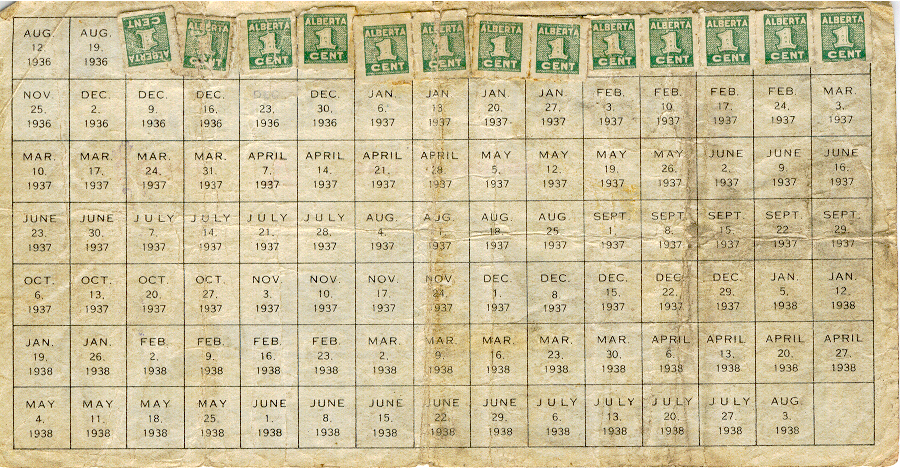
Here's how Alberta's stamp scrip worked. In early August 1936, when the program debuted, an unemployed Albertan was paid, say, a $1 certificate for each $1 worth of road maintenance work rendered. This certificate was to be redeemed by the Alberta government two years hence, or in August 1938, for $1 in Canadian dollars. However, redemption required that the certificate have 104 stamps affixed to it (see figure above). Each week during that two year period, the owner of the certificate was to buy a government stamp for 1 cent from an approved stamp dealer and glue it to the note.
The necessity of buying stamps created a fairly onerous fee on cash holdings. As such, any laborer who received the scrip from the government was unlikely to hoard it, preferring instead to spend it on, say at a retailer, who in turn would only accept scrip as payment for goods and services if the correct number of stamps has been affixed. In order to avoid the cost of buying the next weekly stamp in order to keep the scrip current, the retailer themselves would quickly offload it to their suppliers and so on.
The 1 cent stamp fee was collected by the Alberta government and held as a reserve for redemption in two years. With 104 cents being collected over each $1 certificate's life time, this meant that the scheme was entirely self financing. The extra four cents represented a profit to the government.
Failure
We know that the Prosperity Certificate scheme didn't work. The certificates began to be paid to unemployed Albertans in August 1936 for roadwork rendered in July. According to Coe, the maximum amount of outstanding certificates in circulation in August and early September was $239,391 (around $9 million in current dollars). However, by mid-September 1937, just one month after the program's debut, over 60% of the certificates outstanding, or $144,280 out of $239,391, had ceased to circulate.
Where had they gone? The government now held them. The reason for this development was a last minute decision by Aberhart to offer monthly redemption of certificates at par in Dominion currency (i.e. $1 in certificates for $1 in Canadian bills). This short-circuited the original two-year life of the certificates. Rather than continuing to pass the scrip along to the next Albertan, Albertans leapt at the government's offer and converted en masse when the first redemption date presented itself in early September.
In the end, the government might as well have paid for work rendered using Canadian dollars, since the net effect of paying in either Certificates or Canadian dollars was the same. As Coe says, "the dated stamp scrip was in the end little more than a small nuisance." Subsequent issues of scrip were small relative to the original August 1936 issue and the government officially ended the program in April 1937.
"The problem of the wholesalers"
In the planning stages of the program, government officials ran into what Coe refers to as the "problem of the wholesaler." The first to receive the certificates would be farmers on relief, who in turn would make payments to retailers. The payments by retailers would primarily flow to Albertan wholesalers whose dominant payments were to manufacturers and others outside the province. However, those outside the province would not accept Prosperity Certificates, requiring instead hard currency, or Canadian dollars. The Albertan wholesaler would be left holding the bag, so to say, having acquired the entire issue of Prosperity Certificates with no outlet. According to Coe, wholesalers and large retailers were vocal in their opposition to the plan, which they expressed through trade associations and in the press.
One way of solving the wholesalers' problem would have been to establish an exchange market such that wholesalers could sell certificates in order to buy the necessary hard currency and thus fund out-of-Province imports. Banks would normally be an important party to the creation of such a market. Irving Fisher, who wrote a book on stamp scrip, entitled one paragraph "Have at Least one Bank." But the banks who operated in Alberta refused to participate in the Prosperity Certificate scheme—no wonder given that one of the Social Credit party's planks advocated the removal of the "banking monopoly" on the issuance of credit. The tenets of Social Credit thus interfered with the execution of Gesell money, impeding the latter's success.
Even if such a market were to be created, chances are that it would have priced the Certificates at a large discount to Canadian dollars given the onerous fee on certificates relative to Canadian notes and the inferior credit of their issuer. After all, by then the Alberta government had defaulted on its international obligations whereas the Federal government's credit was still good. Such a discount would have been at odds with the Alberta government's policy of using a dollar's worth of certificates to buy one Canadian dollar's worth of labour. If the certificates were trading at 69 cents on the dollar in the wholesale market, workers paid in scrip would be loath to accept them at face value, for if they did, they would probably have problems passing them off at retailers for that amount.
In the end, the government's solution to the problem of the wholesalers was to allow wholesalers (and even retailers) to benefit from free monthly redemption at par. As I noted earlier, this resulted in most of the certificates being returned for redemption just a few weeks after having been issued.** Rather than bad money driving out the good, a garbled version of Gresham's Law had taken hold in Alberta, which Coe describes thusly: "Bad money obviously does not drive out good money when the government is willing to redeem the bad money in good money."
This garbled version of Gresham's law is a phenomenon I've described before to explain a number of monetary puzzles including the failure of the Susan B. Anthony dollar, the European Target2 bank runs of 2011-12, the proliferation of credit cards, and the zero-lower bound problem. See here and here.
What about Greece?
Alberta in 1936 and Greece in 2015 are in similar situations. Both are non-currency issuers within a larger monetary zone, in Alberta's case the Canadian dollar zone and in Greece's case the Eurozone. Both have awful credit. Neither is part of a larger fiscal union. In Greece's case, the mechanism hasn't yet been created whereas in Alberta's case, the Social Credit party was at such odds with the Federal government and the rest of Canada that it could not expect much help.
I'd argue that anyone planning to introduce a Greek parallel currency to circulate alongside euros faces the same problem that Alberta faced; the so-called problem of the wholesalers. If the Greek government starts to pay employees and contractors in Greek parallel IOUs denominated in euros, and employees buy stuff at stores with those IOUs, and stores purchase inventory from wholesalers, these wholesalers will need a mechanism to offload their parallel note surpluses in order to get euros to buy foreign imports. The IOUs can either find their own price, in which case they will most likely trade at a large and varying discount to euros, or the Greek government can offer one-to-one convertibility. They can do this by either redeeming IOUs directly for euros or allowing one euro worth of taxes to be paid with an equivalent number of IOUs.
Neither solution is ideal. If the IOUs trade at a variable discount to euros, then their ability to serve as a competing medium of exchange will suffer. People always prefer to trade using the medium in which a nation's prices are expressed, or, put differently, the medium which functions as a unit of account. For example, people see benefit in the fact that one euro will always discharge a euro's worth of Greek debt or a buy a euro's worth of Greek olive oil. But as long as Greek IOUs trade at a varying discount to euros, it is impossible to know ahead of time how many IOUs will discharge a euro's worth of debt or buy a euro's worth of oil, given that the euro will surely remain Greece's unit of account. This would hinder the IOU's ability to function as a currency. The fact that people prefer to accept stable exchange media in trade to unstable media is one of the reasons that bitcoin hasn't caught on.
So rather than serving as a competing medium of exchange, the parallel IOUs will probably function as illiquid and highly risky speculative fixed income securities. In order to compensate recipients of IOUs for this lack of liquidity, the Greek government will have to issue the IOUs at a larger discount to par than they would for an otherwise liquid equivalent, thus increasing the government's financing costs.
This lack of liquidity militates against one of the key selling points of a Greek parallel unit, which is to finance the government by displacing some of the existing circulating medium of exchange, euros, from citizens' wallets. Preferably, unwanted euros would trickle back to the European Central Bank to be cancelled, reducing the ECB's seigniorage but augmenting the seigniorage of the Greek state as Greek IOUs rush in to fill the void. However, if the new Greek parallel unit cannot compete with the euro's liquidity, then there will be very little 'space' for Greek IOUs to occupy in Greek portfolios, and little relief for beleaguered government finances.
If the Greek government tries to promote the liquidity of its parallel currency by having the units trade at a fixed one-to-one rate with euros, then the same garbled version of Gresham's Law that took hold in Alberta would overwhelm Greece. In Coe's words, the Syriza government's willingness to buy bad money, or parallel currency units, from the public with good money, or euros, will promote mass conversion into euros and thereby drive all the bad money from circulation. Greek parallel units will cease to exist.***
In sum, anyone planning a Greek parallel currency faces a conundrum. In order to pay its bills the government can do little more than introduce a volatile asset that trades at varying discount to euros. This asset's volatility and relative illiquidity won't make it very popular with its recipients. An attempt to render that asset more acceptable in trade by setting a one-to-one conversion rate to the euro will result in a short-circuiting of the scheme as everyone races to redeem IOUs. The issuance of parallel currencies seems like a hard battle to win.
*There are a number of plans including that of Biagio Bossone & Marco Cattaneo, Thomas Mayer, and Robert Paranteau
** Compounding the problem was that redemption at face value put a premium upon redemption, says Coe. "The holder who redeemed received face value; the person who did not redeem ran the risk of losing 1 per cent of the face value if he failed to pass the certificates within the next few days, and more for longer periods. This premium placed upon redemption could only have been eliminated by redeeming the certificates at a discount of more than 1 per cent-say, 2 or 3 per cent." So the government accidentally created an even greater incentive for certificate owners to redeem.
*** This is particularly damaging in Greece's case at will result in a perpetual draw down in the state's euro balances. These reserves are vital since the Greek government needs to service its (existing or renegotiated) Euro debts to the IMF and pay external suppliers, and can only do so with hard currency.
Thursday, May 14, 2015
Greece and IMF SDRs—Gold Next?
The FT makes a hullabaloo out of Greece using special drawing rights (SDR) to pay the IMF earlier this week, referring to the step as "unusual." Zero Hedge predictably grabs the baton and runs as far as it can go with the story.
It's a good opportunity to revisit the SDR, a topic I last wrote about back in 2013.
The FT claims that the payment of SDRs to the IMF is "the equivalent of taking out a low-interest loan from the fund to pay off another." Here the FT has committed cardinal error #1 when it comes to understanding how SDRs work—SDRs are not lent out by the IMF.
I like to think of the SDR mechanism as comprised of 188 lines of credit issued to each of the IMF's 188 members. These lines of credit are denominated in SDR and apportioned according to each countries' relative economic size. Any line of credit needs a creditor. In the case of SDRs, who fills this role? Why, the 188 members of the IMF do. The SDR system is a mutual credit system, or what I referred to in my older post as the world's largest Local Exchange Trading System, or LETS. Where does the IMF stand in all this? It is simply an administrator of the system. So by paying the IMF in SDRs, the Greek government isn't taking out a low-interest loan from the IMF—rather, it's drawing down on the credit provided to it by 187 other countries. As for the IMF, it isn't getting another Greek-issued debt instrument. Rather, it is getting a mutual liability of 188 nations.
The second sin in the FT's article is the assumption that SDRs are "rarely tapped" and that therefore, Greece is doing something unusual in "raiding" its SDR account. As a quick glance to the data shows, that's simply not the case. The chart below (apologies for its extreme height, but it's the only way I can visualize the data) shows that over time, countries have tended to spend down their SDR lines of credit. Any nation to the left of the 100% line (and illustrated in light blue) has drawn down on their credit line while those to the right (illustrated in darker blue) have accumulated SDR surpluses. Most countries lie to the left of the line. Greece, which after this week's transaction has just 5% of its total line of credit undrawn*, joins Macedonia, Iceland, Hungary, Serbia, Ukraine, and Romania near the low end of the range, many of whom drew down their balances to deal with the after-effects of the credit crisis.
![]() |
| Data Source |
Nor is the FT article right in implying that it is unusual for countries to pay the IMF in SDRs. Consider that since the SDR's inception in 1969, 204 billion SDRs have been issued to 188 member nations. Logic tells us that each of these 204 billion SDRs must be owned by some combination of member nations, right? Not quite. The 188 nations collectively own only 189 billion SDRs. Who holds the missing 15 billion SDRs? Fifteen institutions, or proscribed holders, have been granted the ability to buy and sell SDRs in the secondary market, including the Arab Monetary Fund, the Bank for International Settlements, and the European Central Bank. Together they own about 1.2 billion SDRs. But the real sop here is the IMF itself, which owns around 13.5 billion SDRs. Because IMF members can use SDRs in transactions involving the IMF, namely the payment of interest on and repayment of loans (see here), the IMF has become the second largest owner of SDRs (after the U.S.).
So in general, the SDR mechanism has been characterized by steady drawdowns of SDR lines of credit by member nations, with surpluses accumulating to the IMF. Far from being unusual, Greece's decision to pay the IMF in SDRs is pretty much par for the course.
One thing I find interesting is that the SDRs that Greece used to pay the IMF are the property of the Bank of Greece, Greece's central bank, and not the Greek government (see here). This means that BoG Governor Yannis Stournaras had to willingly open his pockets to the Greek government to facilitate the IMF payment. In doing so, the central bank has accepted a Greek government-issued liability to pay back SDRs rather than the actual SDRs. As a claim on 187 nations, the latter is surely preferable to the former, which is a claim on a failing nation.
So what about the BoG's other larger unencumbered asset, its gold? According to its most recent balance sheet, the Bank of Greece now owns €5.4 billion of the yellow metal, or 3.62 million ounces. For more on Greece's gold, Ronan Manly has the details. Having just given up his SDRs, would Stournaras be willing to render this gold up to the Greek state in return for a gold-denominated IOU with finance minister Yanis Varoufakis's signature on it? If so, the Greek government could sell this gold on the market for euros to pay the IMF. Settling scheduled June and July payments would be a breeze. This would no doubt be a stain on the BoG's independence, but with the Eurogroup turning the screws, all chips may be in play.
*I'm assuming that Greece paid 517 million SDRs to the IMF, worth 650 million euros at current SDR-to-euro exchange rates.
Monday, May 11, 2015
No Eureka moment when it comes to measuring liquidity
Measuring liquidity is a pain in the ass.
The value of a good, say an apple, is easy to calculate; just look at the market price for apples. Unfortunately, doing the same for liquidity is much more difficult because liquidity lacks its own unique marketplace. Liquidity is like a remora, it never exists on its own, choosing instead to attach itself to another good or asset. For instance, a bond provides an investor with both an investment return in the form of interest and a consumption return in the form of a flow of liquidity services. Since the price of this combined Frankenstein reflects the value that an investor attributes to both returns, we can't easily disentangle the value of the one from the other.
Here's a symmetrical (and equally valid) way to think about this. If liquidity is a good then illiquidity is a bad, where a bad is anything with negative value to a consumer. This bad doesn't exist on its own but, like a virus, infects other goods and assets. While all goods and assets are plagued by a certain degree of illiquidity, determining the price of of this nuisance—the amount that people will pay to rid themselves of an asset's illiquidity—is difficult because the price of the compound entity combines both a flow of illiquidity disservices as well a flow of positive investment returns.
The only technique we currently have to back out liquidity valuations (or illiquidity penalties) from market data is to find the price or yield differential between two similar instruments, this gap indicating the value that the market ascribes to liquidity (or the negative value of illiquidity). Think identical twin studies in the life sciences. To get a clean differential, the two financial instruments must be "twins," issued by the same entity and having the same maturity. That way any differential between them can't be attributed to credit or term risk, the lone remaining factor—liquidity (or illiquidity)—being the culprit.
The best example is the on-the-run vs off-the-run Treasury spread, the difference in yield between newly-issued 10-year Treasuries and 30-year Treasuries that have 10 years left till maturity. The credit quality and term of these two issues is precisely similar, yet the yield of a newly-issued 10-year Treasury is typically 10 basis points below that of an "off-the-run" equivalent. This gap represents the extra bit of value that investors will pay to enjoy an on-the-run Treasury's liquidity (or, alternatively, the negative value of the illiquid "bad" embedded in an off-the-run Treasury). Assuming that a new bond worth $1000 has a 1.9% yield while an equivalent off-the run issues yields 2.0%, investors are valuing the extra bit of liquidity provided by the on-the-run issue at around $1 per year for each $1000 that they invest.
The first problem with this technique will be familiar to anyone who has tried to conduct studies using twins separated at birth; its very difficult to find twin assets. The second problem is that even if we succeed in locating twin assets, a comparison of them will only reveal the degree to which investors prefer, say, an on-the-run bond's liquidity to that of an off-the-run bond. In other words, it provides us with a relative value. But if we want to find the absolute value that investors place on an on-the-run issue's liquidity (or the absolute disvalue that they place on an off-the-run issue's liquidity), we're left empty-handed. Sean Connery may be cooler than Johnny Depp, but what if we want to calculate Sean Connery's total amount of coolness?
Here's an out. Unlike human identical twins, financial twin assets can be easily manufactured. Create a market in which identical duplicates of existing assets trade. This solves the first of these two problems; rarity.
As for the relative value problem, we can solve it by manufacturing these twin assets in a way that allows us to measure absolute liquidity (or absolute illiquidity). Just create an infinitely liquid twin. An infinitely liquid good can be traded frictionlessly and instantaneously for any other good. The premium at which the manufactured twin trades above the original asset represents the penalty applied to the illiquid original. We thus have a measure of absolute illiquidity; specifically, we have backed out the total amount of compensation that investors require for bearing the illiquid "bad" bound up in a given asset.
In practice, what would these infinitely liquid twins look like? Imagine that a risk-free institution, say a government-backed bank, creates deposits that are denominated and redeemable in Microsoft shares. The bank would pay interest at the same rate that Microsoft pays dividends. Since the purchasing power of these deposits would fluctuate in line with the price of underlying Microsoft shares, the Microsoft deposit would be an exact replica of a Microsoft share. One difference remains: Microsoft shares trade on just one market—the stock market—whereas Microsoft deposits, like bank deposits, have the potential to trade in all markets. Imagine buying an ice cream cone with 0.055 Microsoft deposits. The premium at which Microsoft deposit will trade is an absolute measure of the penalty investors expect to incur for enduring the illiquid "bad" attached to Microsoft shares. Problem solved, right? We've go a clean measure of illiquidity.
Not quite. While infinite liquidity is a nice idea, it's impossible to create. Bank deposits are highly liquid, but not infinitely liquid. Just try purchasing something at a garage sale with a bank card. Second, even if a bank begins to offer Microsoft deposits, there's no guarantee that merchants who already accept dollar-denominated deposits will accept Microsoft-denominated deposits. The upshot is that Microsoft deposits won't be able to serve as an ideal benchmark since they themselves are destined to be tarred by the same illiquidity as Microsoft shares.
We need a cleaner foil against which to compare Microsoft shares. Fortunately, there's an alternative to manufacturing an infinitely liquid twin—just fabricate its exact opposite, a perfectly illiquid twin. A term deposit is a great example of a perfectly illiquid asset; its owner keeps the instrument in their possession until it reaches maturity. During the interim they cannot trade it to anyone else. The difference in price between the original asset and its completely illiquid twin is a measure of the absolute value that investors ascribe to the liquidity embedded in the original asset.
In practice, imagine that our risk-free banks creates 1-year Microsoft term deposits. One deposit represents an irrevocable commitment to earn Microsoft dividends over the course of a year, the deposit maturing in one year with the paying-out of a Microsoft share. Investors facing the choice between purchasing a Microsoft term deposit and an actual Microsoft share will earn the same dividends and capital gains, but will have to weigh the disadvantages of being locked into the deposit versus the benefits of easily liquidating the exchange-traded share. As such, investors will probably only purchase Microsoft term deposits at a slight discount to the price of a fully-negotiable Microsoft share. After all, if you're going to commit yourself to owning Microsoft for one full year, you need to be compensated for your pains. This discount represents the absolute value of a Microsoft share's liquidity.
Voilà , we've unbundled the value attributed to an asset's flow of liquidity returns from its value as a pure financial IOU. We can do this for all sorts of assets. But it's a pain in the ass to do, since it requires the creation of an as-yet non-existent class of financial assets.*
Why bother decomposing an asset's financial return from its liquidity return? Assets provide both an investment return and a consumption good in the form of liquidity, but no one is entirely sure how to apportion prices among the two. Liquidity is static, it muddies many of the supposedly clear signals we get from market prices. Unbundling the liquidity return from the investment return could make the world a much more efficient place. People would be able to see how much they are paying for each of these two returns, thus potentially improving the way that they choose to allocate their resources. What was once static becomes just another signal.
PS: Apologies to long-time readers, who will have already read much of the above points in previous posts. I'm hoping a restatement may provide a different approach to thinking about liquidity.
PPS: The post resolves the problem mentioned in the last three paragraphs of Liquidity as Static.
*Interestingly, a limited market in twins already exists. In addition to providing chequing accounts, banks also provide term deposits. The yield differential between the two represents the absolute value of the liquidity services provided by a chequing deposit. The majority of assets, however, have not yet been twinned---think equities, bonds, bills, mortgage-backed securities, derivatives, and more.
Monday, May 4, 2015
Is the U.S. dollar in the midst of the longest Wile E. Coyote moment ever?
It would be wrong to blame the economics blogosphere's failure to foresee the 2008 credit crisis on complacency. Better to say that bloggers were distracted. Instead of sifting through sub-prime and CDO data, they were grappling with an entirely different threat, the impending Wile E. Coyote moment in the U.S. dollar. The perpetual racking-up of ever larger debts by the U.S. to the rest of the world for the sake of funding current consumption, and the eventual dollar collapse that this implied, was believed to be tripping point numero uno at the time. Look no further than Paul Krugman, who in September 2007 (in just his fourth blog post) had this to say:
The argument I and others have made is that the U.S. trade deficit is, fundamentally, not sustainable in the long run, which means that sooner or later the dollar has to decline a lot. But international investors have been buying U.S. bonds at real interest rates barely higher than those offered in euros or yen — in effect, they've been betting that the dollar won’t ever decline.
So, according to the story, one of these days there will be a Wile E. Coyote moment for the dollar: the moment when the cartoon character, who has run off a cliff, looks down and realizes that he’s standing on thin air – and plunges. In this case, investors suddenly realize that Stein’s Law applies — “If something cannot go on forever, it will stop” – and they realize they need to get out of dollars, causing the currency to plunge. Maybe the dollar’s Wile E. Coyote moment has arrived – although, again, I've been wrong about this so far.He wasn't alone in this belief.* As we all know, the U.S. did eventually run off a cliff—but it wasn't the cliff that everyone expected. Instead of a dollar crisis, we had a financial and banking crisis. As for the dollar, it has since raced to its highest point in more than a decade.
Since 2008 the ensuing slow recovery has dominated the blogosphere. And now we are hearing about an impending secular stagnation, a new macroeconomic dystopia that has been manufactured by many of the same folks who contributed to the debate surrounding the econ blogosphere's first great macroeconomic bogeyman, U.S. dollar imbalances.
Before allowing the sec stag story to scare our pants off, shouldn't we be asking what happened to the first bogeyman? Given the econ blogosphere's silence on the topic of U.S. dollar imbalances, one could be forgiven for assuming that these imbalances had been resolved. But they haven't. Sure, the U.S.'s current account deficits aren't as high as before. But the stock measure of U.S. indebtedness, its net international investment position (NIIP), continues to fall to increasingly negative levels. Ten years ago, when bloggers were focused on the issue, the U.S. owed $2 trillion more than foreigners owed it, about 15-20% of GDP. The NIIP now clocks in at 39% of GDP, or $7 trillion. See chart below. So if anything, the stock measures that worried so many economists in 2005 have only gotten worse.
What I have troubles understanding is why folks like Larry Summers are having so much success selling the world on their newest bogeyman—secular stagnation—when they have never properly atoned for the bland ending to their first story. Why has growing U.S. international indebtedness never led to a U.S. dollar collapse as predicted? What mistakes did these prognosticators make? Or should we think of the the dollar's Wile E.Coyote moment as just an extended one—for the last ten years the greenback has been hanging in air, not realizing that it's been slated for a collapse. Reading through old blog posts and articles written circa 2006, the dollar's blithe disregard of its eventual demise was often met by invocations of Stein's law: "If something cannot go on forever, it will stop" or Rudi Dornbusch’s first corollary of Stein’s Law: “Something that can’t go on forever, can go on much longer than you think it will.” It could be that the doomsayers still invoke these quotations, but surely there's a statute of limitations on invocations of Wile E. Coyote.
If the creators of the first bogeyman are just the victims of awful timing, then the net stock data on which they initially based their initial pessimism has only worsened. This means that they should be doubling down on their warnings of impending dollar doom. Instead, we get a steady stream of warnings over a totally different macroeconomic disaster; secular stagnation.
The other side to the story is that maybe we aren't in the midst of the longest Wile E. Coyote moment ever. Maybe the U.S. dollar bears were wrong about imbalances all along.
The fact that foreigners are willing to perpetually buy U.S. financial assets and fund a reckless U.S. consumption binge seems, on the surface, to be a violation of the eternal rule of quid pro quo—an even exchange of one thing for another. In return for a mere promise of distant consumption, Americans are getting valuable foreign labour and goods.
But what if something is missing to this story? Consider that a financial asset isn't a mere IOU. Rather, it is an IOU twinned with a durable consumption good. This very special good is called liquidity. Workers in the financial industry incur a significant amount of time and energy in fabricating this component. They expend this effort because people will pay good money to consume liquidity. Just like having a fire extinguisher or a revolver on hand provides a measure of relief, the possession of liquidity provides its owner with a stream of comfort.
Unfortunately, liquidity is never sold as a stand-alone product. Like a room with a view—you can't buy the view without also getting the room—people who want to own liquidity must simultaneously buy the attached financial asset.
It just so happens that the Yankees are the world's leading manufacturer of liquidity premia. This means that foreigners may be gobbling up such incredible amounts of American financial assets not because they have an urge for U.S. IOUs per se, but because they desire to consume the liquidity premia that go along with those IOUs. The U.S.'s NIIP, which is supposed to include only financial assets, is effectively being contaminated by consumption goods. Specifically, some portion of U.S.'s liabilities to the rest of the world is actually comprised of accumulated exports of liquidity premia. Rather than classifying these liquidity services as a stock of financial assets/liabilities, they should be reclassified as a flow of liquidity services and moved to the current account side of the U.S.'s balance of payments, along with the rest of the U.S.'s goods & services exports. This would have the effect of making the U.S.'s NIIP much less abysmal then it appears. Rather than Americans living beyond their means, this allows us to tell a story in which foreign goods and services are being bartered for liquidity premia which, like machines or wheat or apple pie, require the toil and sweat of American laborers to produce. This isn't an extravagant privilege, it's honest quid pro quo.**
We can argue about the size of the liquidity premia that the U.S. exports. On the one hand, these premia may outweigh the value of goods & services that the U.S. imports, indicating that rather than being profligate, Americans are tightwads. Or this number may be relatively small, indicating that while Americans are less spendthrift than is commonly assume, they still aren't models of prudence.
I'm not sure if the creators of the blogosphere's first great bogeyman would agree with any of this, since not only have they gone silent on the topic—they've switched to talking about a new bad guy.*** Interestingly, if exports of liquidity premia explain why the U.S.'s negative NIIP is not a catastrophe in the making but a stable equilibrium, those same liquidity premia can explain some of the stylized symptoms of so-called secular stagnation—namely persistently falling interest rates.
Liquidity is static, it interferes with many of the supposedly clear signals we get from data. If liquidity led economists astray in the last decade by creating what seemed to be ominously extreme dollar stock imbalances, it may be leading them astray this decade by creating what seem to be ominously low real interest rates. The last thing we want is a repeat of the previous decade in which economists missed out on the big one because they were so focused on what, in hind sight, seems to have been a bogus threat.
*Here is DeLong. It was one of Brad Setser's favorite topics. Non-bloggers including Rogoff and Summers also questioned the ability of the U.S. to generate perpetual current account deficits.
** The idea that the U.S. is exporting something unseen in the official data isn't a new idea. In this 2006 paper, Ricardo Hausmann and Federico Sturzenegger were one of the first to discuss the idea of "dark matter." This stuff is comprised of U.S. exports of expertise and knowledge, liquidity services, and insurance services. Ricardo and Hausmann believed that dark matter increased the value of U.S. assets held overseas, but it seems to me that dark matter, namely liquidity premia, does the opposite: it decreases the value of U.S. liabilities to foreigners.
*** At the time, Krugman, Setser, DeLong, and Hamilton criticized the dark matter idea. Buiter, publishing through Goldman Sachs, also criticized the idea here.
Friday, April 24, 2015
Plumbing the depths of the effective lower bound
| Unfathomable Depths by Ibai Acevedo |
Denmark's Nationalbank and the Swiss National Bank are the world's most interesting central banks right now. As the two of them push their deposit rates to record low levels of -0.75%, they're testing the market's limit for bearing negative nominal interest rates. The ECB takes second prize as it has been maintaining a -0.2% deposit rate since September 2014.
At some point, investors will flee deposits into 0%-yielding cash. This marks the effective lower bound to rates. Has mass paper storage begun? The last time I ran through the data was in my monetary canaries post, which was inconclusive. Let's take a quick glance at the updated data.
To gauge where we are relative to the effective lower bound, I'm most interested in the demand for large denomination notes, which bear the lowest costs of storage. Once a central bank reduces its deposit rate so deep into negative territory that the carrying cost of deposits exceeds the cost of storing a nation's largest value banknote, then it has hit the effective lower bound. Small denominations notes, which have higher storage costs, are not a pivotal part of the picture given the ability of note holders to freely convert low value notes into higher ones.
European Central Bank
The ECB issues the €500 note, which has the second highest purchasing power out of the world's currency notes. I've charted the quantity of €500 euro notes in circulation below, as well as the percent change in the value of all euro denominations:
After declining through 2012 and 2013, we saw a sharp rise in demand for €500 notes, particularly in December 2014 and the first few months of 2015. The red line illustrates the general demand for all denominations of euro cash. Over the last four months the seasonally-adjusted growth rate of banknotes outstanding has risen to its highest level in the last five years.
It's hard to determine how much of this increase can be attributed to the ECB's negative rate policy, initiated when Mario Draghi brought the deposit facility rate to -0.1% in June and -0.2% in September, and how much is due to the Greek fiasco. Growing fears that Greece will either leave the euro or impose capital controls have led to a steady jog out Greek banks. There are two escape routes: Greek's can convert their deposits can into German deposits or into cash.
In an interesting article, Bloomberg's Lorcan Roche Kelly backs out the Greek-specific demand for European cash. Read it for the full details, but the shorter rendition is that a line item on the Bank of Greece's balance sheet allows us to see how many banknotes Greeks are demanding in excess of the Bank of Greece's regular allocation. Kelly finds a large spike beginning in December and extending into 2015, which we can attribute to the bank jog. I've recreated the chart below:
| Source: Bloomberg, data to end of March |
The approximately €12 billion jump in Greek cash demand corresponds nicely with the recent €7.2 billion spike in €500 notes in circulation across the entire eurozone. The upshot is that a large chunk of the rise in €500 notes over the last few months is probably due to a run on Greek banks, not an escape from negative-yielding ECB deposits. Remove the run and the rise in demand for €500 notes would have been unremarkable, indicating that the eurozone is still far from hitting the effective lower bound.
Swiss National Bank
Because Swiss banknotes are not a direct escape route from the ongoing Greek bank run, SNB cash data should provide a clearer signal of the whereabouts of the effective lower bound than ECB data. The SNB issues the world's most valuable banknote in terms of purchasing power; the 1000 franc note. Below I've plotted the yearly percent change in demand for both the 1000 note and Swiss cash-in-general to the end of February.
There's been slight pickup in the demand for Swiss cash, but nothing dramatic. Its worth pointing out that Swiss paper currency has historically played a safe haven role. Demand tends to spike during episodes of uncertainty, including the 2008 credit crisis and the 2011-12 period, when it seemed like the euro could be torn apart. This means that it is difficult to be sure how much of the recent pickup in demand for Swiss cash stems from the SNB's -0.75% deposit rate and how much is due to fear of a Greek government default, which would create havoc in world markets.
Danmarks Nationalbank
Our final canary is the Danmarks Nationalbank. Unlike the demand for Swiss paper francs, the demand for Danish paper krone does not usually spike during times of crisis. For instance, during the 2008 credit crisis demand remained muted. This leads me to believe that demand for paper krone provides the clearest indicator yet of the presence (or not) of the effective lower bound. I've charted the year-over-year change in Danish currency in circulation.
In the 55 days that have passed since the Danmarks National bank reduced its rates to -0.75% (February 5), there has been a sustained rise in the demand for cash, as the red data indicate. But I don't think we can describe it as anything out of the ordinary, at least not yet.
Interestingly, in late March the Nationalbank granted Danish banks some wiggle room by providing them with greater access to the Bank's 0% current-account facility. This small adjustment would have reduced Danish banks' incentives to emigrate from -0.75% deposits into cash. Was the central bank's decision to provide this wiggle room a response to private data showing that it had hit the effective lower bound? Who knows.
It may be worth noting even if a central bank finds itself at the effective lower bound, it can forestall the demand for large denomination notes by using moral suasion. Willem Buiter mentions this possibility in his recent note High Time To Get Low, but maintains we have no evidence of this sort of pressure. I'm tempted to agree with him. If either the Danish or Swiss central bankers have put informal embargoes on cash, we would have known about it by now.
The use of moral suasion to prevent large denomination banknote storage would effectively freeze the quantity of high value notes in circulation. In such a scenario, we'd expect the 1000 Sfr note to rise to a slight premium to face value, say 1050 Sfr in bank deposits for each 1000 Sfr in banknotes. Traders would be willing to pay this premium as long as the storage costs on high value notes are lower than the -0.75% penalty set by the SNB on deposits, thus allowing them to earn an excess return on their note holdings. As long as moral suasion remains successful in choking off Swiss banks' demand for cash, each subsequent cut by the SNB into ever deeper negative territory would drive the premium on notes higher. (Assiduous readers will recognize this as the second of three ways for a lazy central banker to escape a liquidity trap.)
In sum, we probably haven't hit the effective lower bound yet. Stay tuned.
Friday, April 17, 2015
John Cochrane is too grumpy about negative rates
John Cochrane has written two posts that question the ability to implement negative interest rates given the wide range of 0%-yielding escape hatches available to investors. These escapes include gift cards, stamps, tax & utility prepayments, and more. In a recent post entitled However low interest rates might go, the IRS will never act like a bank, Miles Kimball and his brother rebut one of Cochrane's supposed exits; the Internal Revenues Service. I've responded to Cochrane's other schemes here.
Think of Cochrane's exits as arbitrage opportunities. As nominal rates plunge into negative territory, the public gets to harvest these outsized gains at the expense of institutions that issue 0% nominal liabilities. The Kimballs' point (and mine here) is that because these institutions will lose money if they continue to issue these liabilities, they will implement policies to plug the holes. Cochrane's multiple exits aren't the smoking gun he takes them to be.
In a new post, Cochrane tries to salvage his argument by making an appeal to symmetry. He points out that in the symmetrical case—a world with positive inflation and higher nominal rates—we don't actually observe people adopting the sort of behavior that Miles believes they would adopt in a negative rate world. So in practice, Cochrane doesn't believe that removing cash in order to implement negative interest rates will work.
This is a fair tactic to take. In general, people should demonstrate similar behavior whether nominal rates are positive or negative. However, is it true that in an environment with positive inflation and high nominal rates, institutions issuing liabilities (or those purchasing those liabilities) allow themselves to be systematically made the targets of arbitrage?
Take Cochrane's main example; gift cards. As I described here, once rates fall deep into negative territory, retailers will simply stop issuing gift cards since they won't care to earn a negative spread. Cochrane's appeal to symmetry implies that gift card issuers behave differently when rates are positive. Well let's imagine that rates are at 5%. An issuer of 0% gift cards is certainly not setting itself up to be arbitraged—in fact, given that it is funding itself at 0% in a 5% yield environment, it will be earning an excess return on each card issued. Nor will the liability-using public choose to subject itself to the money-losing obverse side of the trade. People can simply choose to avoid investing in 0% gift cards in favor of a 5% alternative. Likewise for the other liabilities that Cochrane mentions. Rather than prepaying taxes and earnings 0%, the public will pay at the last moment and harvest a 5% return until then. Instead of delaying the cashing of a check, they'll deposit it the day they receive it in order to earn interest.
So when interest rates are positive, people will try to avoid behaviour that allows them to be taken advantage of, whether they be an issuer or buyer or liability. Symmetrically, it follows that this same behaviour should prevail when rates are negative.
In his post, Cochrane seems to be changing the subject of the conversation from arbitrage to the indexing of contracts. His point is that during periods of positive inflation and high interest rates, nominal payments were not indexed to the nominal interest rate. His example is the IRS, which does not offer interest for early payment when market interest rates are high. Factually he is right. But this criticism is besides the point. The IRS doesn't offer interest to those who pay their taxes early because prepaid taxes aren't the government's main form of funding, treasury debt is. If the government's main form of financing *was* to offer savings accounts to tax payers, then you can be sure that those accounts would have to promise nominal payments that rise in line with the market's nominal interest rate—otherwise no one would open an account and the government would suffer a cash crunch. Nor would the government offer an excess nominal rate, since every American would exploit the situation and open an account—at the government's expense.
No one wants to be the dupe and end up on the wrong side of an arbitrage. If anyone is arguing for asymmetry, it is Cochrane. He needs to explain why liability issuers and users would exhibit such a degree of irrationality as to allow themselves to be exploited as rates fall into negative territory, but so rational as to avoid being exploited at positive rates.
Monday, April 13, 2015
A libertarian case for abolishing cash
Last week Citi's Willem Buiter published a note on the three ways to get rid of the effective lower bound to nominal interest rates, one of which is to abolish cash. He goes on to say that
politically, the abolition of currency would run into opposition from some of the legitimately cash-dependent poor and elderly, from those for whom the anonymity of cash is desired because they are engaged in illegal activities and from libertarians. The first constituency can be helped, the second can be ignored and the third one should take one for the team.I think that Buiter is wrong to characterize libertarians as necessarily opposed to the abolition of cash. Their take on cash is probably (or at least should be) a bit more nuanced. Since libertarians generally advocate government withdrawal from lines of business like health care or liquor retailing, an exit of central banks from the cash business should be a desirable outcome.
What Buiter is advocating is a bit more extreme than just government exit, however. An across-the-board banning of cash would not only take the government out of the cash business but also prevent individuals and businesses from entering the product niche. The participation of the private sector in the provision of cash isn't just science fiction. Historically, commercial banks were intimately involved in the production of paper currency. In modern times, the majority of banknotes that circulate in Scotland are issued by three private banks—the Bank of Scotland, the Royal Bank of Scotland, and the Clydesdale Bank, while in Hong Kong, the major commercial banks are charged with issuing currency.
Buiter would probably object to private banknotes. After all, if private banks are able to issue negotiable bearer instrument that pay a zero nominal interest rate, a central banker will continue to be plagued by the problem that he/she can't reduce interest rates below zero—instead of fleeing into 0% government paper, the public will hide in private banknotes. It's the same liquidity trap as before, with private currency in the place of central bank currency.
However, there would be one key difference. Private banks must abide by the Darwinian calculus of profit and losses, central banks don't have to. Take a world with privatized cash. A recession hits and the rate of return on capital falls plummets. At the same time, the central bank drops its deposit rate deep into negative territory. As a private bank tries to match with deposit rate reductions of its own, say to -2%, customers will convert negative yielding deposits into the bank's higher-yielding 0% bank notes. The bank, whose survival depends on a healthy spread between the rates on borrowing and lending, faces a sudden spike in borrowing costs to 0%, the rate on their cash base. Spreads will shrink, even invert. Bankruptcy looms.
In order to avert this disaster, private issuers will quickly institute limits on their cash business. This could involve adopting any one of Buiter's three remedies: 1) cancel their note issue; 2) impose a fee on cash, or; 3) remove the fixed exchange rate between deposits and cash. Thus,the lower bound probably wouldn't be a problem in a banking system characterized by privatized paper issuance. The necessity of maintaining a spread would force private banks to rapidly innovate any one of these three escapes come recession and negative nominal rates. Upon recovery, they can remove these limitations and continue with their regular cash business.
Imagine that private banks all choose the first option when nominal rates fall below zero, cancellation. With cash no longer in existence, banks will have succeeded in restoring their margins to health. The population, however, will have effectively lost their ability to make anonymous transactions. This puts a libertarian in a tough philosophical position. On the one hand, a cashless world poses a serious threat to personal liberty. John Cochrane calls it an "Orwellian nightmare," and Chris Dillow has referred to banning cash as "a grossly illiberal measure - the banning of capitalist acts between consenting adults."
On the other hand, if cash threatens a bank's existence, no libertarian would advocate the use of force to prevent said bank from exiting the business of cash provision. Capitalistic acts cannot be forced upon non-consenting adults, or, put differently, Jack's desire for anonymity-providing products doesn't justify Jill being put into chains in order to provide those products. Therefore, a withdrawal of cash by banks as nominal rates fall below zero, and the loss of anonymity that comes with it, is consistent with libertarianism.
So oddly, Buiter's proposed end point—a cancellation of cash in order to rid the world of the lower bound—is very similar to what a libertarian end point could look like. Both institutions will elect to withdraw cash from circulation because it interferes with their institutional prerogatives. For a central bank, this mission boils down to the targeting of some nominal variable like inflation while in the case of a private bank it is its ability to earn a competitive return. That's not to say that a libertarian ought to support Buiter's abolition, only that the subject is more nuanced than it might seem upon a superficial reading.
As a postscript, it's worth noting that neither Buiter's central banker nor a libertarian's private banker need go as far as abolishing cash in order to remove the effective lower bound. Buiter provides two other options, the best of which (in my opinion) is removing the fixed exchange rate between cash and deposits. Miles Kimball has gone through this option exhaustively. I've outlined some even less invasive, though not as effective, options here.
Related links:
Does the zero lower bound exist thanks to the government's paper currency monopoly? (link)
Is legal tender an imposition on free markets or a free market institution? (link)
Bill Woolsey on how the private sector would withdraw cash at negative rates (link | link )
FTAlphaville: Buiter on the death of cash ( link )
Note: I changed some wording on September 26, 2015. The message remains the same.
Wednesday, April 8, 2015
Liquidity as static
In his first blog skirmish, Ben Bernanke took on Larry Summers' secular stagnation thesis, generating a slew of commentary by other bloggers. If the economy is in stagnation, the econ-blogosphere surely isn't.
I thought that Stephen Williamson had a good meta-criticism of the entire debate. Both Bernanke and Summers present the incredibly low yields on Treasury inflation protected securities (TIPS) as evidence of paltry real returns on capital. But as Williamson points out, their chosen signal is beset by static.
Government debt instruments like TIPS are useful as media of exchange, specifically as collateral, goes Williamson's argument. Those who own these instruments therefore enjoy a stream of liquidity services that gets embodied in their price as a liquidity premium. Rising TIPS prices (and falling yields) could therefore be entirely unrelated to returns on capital and wholly a function of widening liquidity premia. Bernanke and Summers can't make broad assumptions about returns on capital on the basis of market-driven yields without knowing something about these invisible premia. (Assiduous readers may remember that I've used a version of the liquidity premium argument to try to explain the three decade long bond bull market, as well as the odd twin bull markets in bond and equity prices.)
Riffing on Williamson, liquidity premia are a universal form of static that muddy not only bond rates but many of the supposedly clear signals we get from market prices. Equity investors, for instance, need to be careful about using price earnings ratios to infer anything about stock market valuations. The operating assumption behind something like Robert Shiller's cyclically adjusted PE (CAPE) measure is that rational investors apply a consistent multiple to stock earnings over time. When CAPE travels out of its historical average, investors are getting silly and stocks are over- or undervalued.
But not so fast. Since a stock's price embodies a varying liquidity premium, a rise in equity prices relative to earnings may be a function of changes in liquidity premia, not investor irrationality. Until we can independently price these liquidity services, CAPE is useless as a signal of over- or undervaluation, a point I've made before. Hush, all you Shiller CAPE acolytes.
Liquidity also interferes with another signal dear to economists and finance types alike; expectations surrounding future inflation. The most popular measure of inflation expectations is distilled by subtracting the nominal yield on 10-year Treasuries from the equivalent yield on 10-year TIPS. The residual is supposed to represent the value of inflation protection offered by TIPS. But it is a widely known fact that this measure is corrupted by the inferior liquidity in TIPS markets. See commentary here, here, and here. The upshot is that a widening in TIPS spreads—which is widely assumed to be an indicator of rising inflation expectations—could be due to a
Interestingly, the Cleveland Fed publishes a measure of inflation expectations that tries to "address the shortcomings" of rates derived from TIPS by turning to data from a different source: inflation swaps markets. In an inflation swap, one party pays the other a fixed rate on a nominal amount of cash while the other returns a floating rate linked to the CPI. Given the market price of this swap, we can extract the market's prediction for inflation. According to the people who compile the Cleveland Fed estimate, inflation swaps are less prone to changes in liquidity than TIPS yields, thus providing a true signal of inflation expectations.
But how can that be? Surely the prices of swaps and other derivatives are not established independently of market liquidity. After all, like stocks and bonds, derivatives are characterized by bid-ask spreads, buyers strikes, and runs. Sometimes they are easy to buy or sell, sometimes difficult. When I first thought about this, it wasn't immediately apparent to me what liquidity premia in derivative markets would look like. With bond and equity markets, its easy to determine the shape and direction of the premium. Since liquidity is valuable, buyers compete to own liquid stocks and bonds while sellers must be compensated for doing without them. A premium on top of a security's fundamental value develops to balance the market.
Derivatives are different. Take a call option, where the writer of the option, the seller, provides the purchaser of the option the right to buy some underlying security at a certain price. In theory, the more liquid the option, the higher the price the purchaser should be willing to pay for the option. After all, a liquid option can be sold much easier than an illiquid one, a benefit to the owner. But what about the seller? I risk repeating myself here, but a seller of a stock or bond will require a *higher* price if they are to part with a more liquid the security. However, in the case of the option, the writer (or seller) will be willing to accept a *lower* and inferior price on a liquid option. After all, the writer will face more difficulties backing out of their commitment (by re-selling the option) if it is illiquid than if it is liquid.
This creates a pricing conundrum. As liquidity improves, the option writer will be willing to sell for less and the purchaser willing to buy for more. Put differently, the value that the writer attributes to the option's liquidity and the concomitant liquidity premium this creates drives the option price down, while the value the purchaser attributes to that same liquidity engenders a liquidity premium that drives the option price up. What is the net effect?
I stumbled on a paper which provides an answer of sorts (pdf | RePEc). Drawing on data from OTC options markets, the authors finds that illiquid interest rate options trade at higher prices relative to more liquid options. This effect goes in the opposite direction to what is observed for stocks and bonds, where richer liquidity means a higher price. The authors' hypothesis is that the liquidity premium of an option is set by those investors who, on the margin, are most concerned over liquidity. Given the peculiarities of OTC option markets, this marginal investor will usually be the option writer (or seller), typically a dealer who is interested in reversing their trades and holding as little inventory as possible, thus instilling a preference for liquidity. Buyers, on the other hand, tend to be corporations who are willing to buy and hold for the long term and are therefore less concerned with a fast getaway. The net result is that for otherwise identical call options, the overriding urgency of dealers drives the price of the more liquid option down and illiquid one up.
Anyone who has dabbled in futures markets may see the similarity in the story just recounted to a much older idea, the theory of normal backwardation. The intuition behind normal backwardation is that a futures contract, much like a call option, has two counterparties, both of whom need to be rewarded with a decent expected return in order to encourage them to enter into what is otherwise a very risky bet. If both require this return, then how does an appropriate "risk premium" get embodied in a single futures price?
None other than John Maynard Keynes hypothesized that the two counterparties to a futures trade are not entirely symmetrical. Hedgers, say farmers (who are normally short futures), simply want a guaranteed market for their goods come harvest and are willing to provide speculators with the extra return necessary to induce them to enter into a long futures position. Farmers create this inducement by setting the current price of a futures contract a little bit below the expected spot price upon delivery, thus providing speculators with a promise of extra capital returns, or a risk premium. That's why Keynes said that futures markets are normally backwardated.
Options writers who desire the comforts of liquidity are playing the same game as farmers who desire a guaranteed price. They are inducing counterparties to take the other side of the deal, in this case the liquid one, by pricing liquid options more advantageously than illiquid but otherwise identical options. And while I don't know the peculiarities of the various counterparties to an inflation swap, I don't see why the same logic that applies to options wouldn't apply to swaps.
So returning to the main thread of this post, just as the signals given off by TIPS spreads are beset by interference arising from liquidity phenomena, the signals given off by inflation swaps are also corrupted. A widening in inflation swap spreads could be due to changing liquidity preference among a certain class of swap counterparties, not to any underlying change in inflation expectations. Its not a clear cut world.
What about the most holy of signals given off by derivative markets: the odds of default as implied by credit default swap spreads? A CDS is supposed to indicate the pure credit risk premium on an underlying security. But if the marginal counterparty on one side of a credit default swap deal is typically more interested in liquidity than the other counterparty, then CDS prices will include a liquidity component. According to the paper behind the following links ( pdf | RePEc ), it is the sellers of credit default swaps, not the buyers, who typically earn compensation for liquidity, the theory being that sellers are long-term players with more wealth than buyers. The paper's conclusion is that CDS spreads cannot be used as frictionless measures of default risk.
Liquidity is like static, it blurs the picture. The clarity of the indicators mentioned in this post—Bernanke & Summers' real interest rates, stock market price earnings ratios, inflation expectations implied by both TIPS and swap markets, and finally the odds of default implied in corporate default swap spreads—are all contaminated by liquidity premia that vary in size over time. Models created by both economists and financial analysts contain abstract variables that map to these external data sources. I doubt that this data is irrevocably damaged by liquidity, but it may be warped enough that we should be wary about drawing strong conclusions from models that depend on them as input.
Before I slide too far into economic nihilism, there may be a way to resuscitate the purity of these indicators. If we can calculate the precise size of liquidity premia in the various markets mentioned above, then we can clean up the real signals these markets give off by removing the liquidity static.
One way to go about calculating the size of a liquidity premium is by polling the owners of a given security how much they must be compensated for doing without the benefits of that security's liquidity for a period of time. Symmetrically, a potential owner of that security's liquidity is queried to determine how much they are willing to pay to own those services. The price at which these two meet represents the pure liquidity premium. Problem solved. We can now get a pure real interest rate, a precise measure of inflation expectations, a true measure of credit default odds, or a liquidity-adjusted price-to-earnings multiple.
Unfortunately, its not that easy. The only way to properly discover the price at which a buyer and seller of a particular instrument's liquidity services will meet is by fashioning a financial contract between them, a financial derivative. These derivatives will trade in a market for liquidity or 'moneyness' that might look something like this. And therein lies the paradox. Much like the option and CDS of our previous example, this new derivative will itself be characterized by its own liquidity premium, thus impairing its ability to provide a clean measure of the original instrument's liquidity premium. We could fashion a second derivative contract to measure the liquidity premium of the first derivative contract, but that too will be compromised by its own liquidity premium, taking us down into an infinite loop of imprecision.
So... back to economic nihilism. Either that or a more healthy skepticism of those who confidently declare the economy to be in stagnation or the stock market to be a bubble. After all, there's a lot of static out there.
Note: David Beckworth has also written about the difficulties of using bond yields as indicators of secular stagnation. (1)(2)(3). And now Nick Rowe has a post on secular stagnation and liquidity.
Subscribe to:
Posts (Atom)