Wednesday, October 23, 2013

Was coin debasement always bad?

Dante's 8th level of hell, which housed counterfeiters, among others. Illustration by Doré

In this post I'll argue that debasement wasn't necessarily a bad thing. Periodic debasements initiated by a prince may have been a wise solution to a certain set of problems imposed on an economy by the nature of coins.*

Debasement is a reduction in the metallic content of a realm's unit of account. Most descriptions of debasement focus on the prince's role in the affair. This is usually a sordid story. The prince would have his mint surreptitiously reduce the amount of silver it put in coin. Next he and his friends would bring some quantity of silver bullion to be coined at this new rate, then quickly spend the coins before the public had the chance to learn about the debasement and defensively raise their prices. The prince and his gang gained at the expense of others.

But the prince was rarely the only debaser. Much like the prince, the public actively tried to improve their position by reducing the silver content of coin. They did so by clipping and counterfeiting coin. The latter is self explanatory. In the former, a clipper used scissors to remove small bits off the edges of each coin he or she received before passing them off. The clipped bits could be melted down and turned back into new coins, earning the clipper a good return.

Though clipping and counterfeiting were fraudulent, the public also engaged in non-fraudulent debasement by contributing to the natural wearing-out of coin. The constant passage of coins from hand to hand, clinking together in pockets and purses, etc steadily reduced the metallic content of coin below its stipulated amount.

To simplify matters, let's assume that the royal mint adopted the practice of milling the edges of coin. A clipp'd coin would quickly be outed if its milled edge was scarred, and therefore would cease to circulate. And say that the prince outfitted the mint with good technology and skilled engravers so as to prevent counterfeiting. Having removed the influence of clipping and counterfeiting, this leaves a natural rate of debasement of a realm's silver coinage due to wear & tear of, say, 1% a year.

Two stylized facts about the medieval economy. Mints fixed the number of coins they would cut from a given weight of silver brought to it by any member of the public. A merchant's pound of silver, for instance, might be coined by the mint into 240 pennies so that each penny held 1/240th a pound of silver. The mint, in other words, set the standard. The second stylized fact is that silver coins usually circulated by tale, not by weight. Just as in modern times, shopkeepers accepted coins by looking at their face in order to ascertain their value, not by weighing them on a scale.

So why might princely debasement be a boon in this environment? A perverse interaction between the mint's fixed standard and the constantly deteriorating coinage might emerge. As the coinage was debased by regular and legitimate public use, prices in terms of the unit-of-account would slowly be bid up. Each year a given coin, which now contained less silver, would buy less consumption than before. The twin demands of a higher price level and population growth required that more coin be produced to satisfy the population's expanding transactional demand.

However, our first stylized fact interfered with this process. Any silver brought to the mint would be turned into new coins at the fixed standard of 1/240th pounds of silver per penny. This meant that new coins would effectively contain more silver in them than already-circulating coins which, having undergone a few years of wear and tear, might contain by then only, say, 1/300th pounds of silver.

Once coined, the new and heavier coins *should* have commanded a premium in the market thanks to their higher silver content. Shopkeepers, for instance, might have quoted a higher price in terms of old coins and a lower price in new coins. However, as per our second stylized fact, coins in medieval times circulated by tale, not weight, and therefore a buyer could not get a better price when paying with new coins.

The inability of new coins to purchase the correct market equivalent in goods meant that they were artificially undervalued. All new coins that were brought into circulation would quickly be hoarded, melted down, and sent overseas where the silver therein could purchase a more appropriate real quantity of goods. The effect this had was that no new coins were put into circulation. It made no sense for a member of the public to bring silver bullion to the prince's mint to be coined since the resulting coin would always purchase less than it would have if left in raw bullion form.

This is Gresham's law. The bad, or artificially overvalued silver coin, pushes the good, or undervalued silver coin, out of the realm.

Since citizens no longer saw it fit to bring their silver to the mint to get coin, coin shortages would develop. To meet transactional demand, existing coins would exchange at ever higher velocities, but this would only debase them further, exacerbating the problem.

One answer to this problem would be for the prince to change the mint price in order to encourage people to once again bring silver bullion to the mint. For this to happen, the old standard of 1/240th a pound of silver per penny had to be reduced to a rate equivalent to the silver content of existing circulating coinage. In essence, to relieve the shortage of coin the prince needed to debase the standard. By reducing the amount of silver in a newly minted coin to, say, 1/300th pounds of silver, citizens would once again find it worthwhile to return to the mint. Since new coins now contained the same silver quantity as old coins, they would circulate together with their older counterparts rather than be subject to Gresham's law.

As long as the prince periodically debased the standard in order to keep up with the natural wear & tear of coins, then the supply of coin would be kept in line with the demand. Princely debasement could be a solution to a very real problem. To say that it could be a good solution, however, doesn't mean that all debasements were benevolent and/or beneficial.**

My justification of princely debasement of coinage as good policy in some way parallels the modern justification for fiat debasement as good policy. Sure, we can always attribute certain malign motives to central bank debasement. A central bank might surreptitiously monetize a government's debt at subsidized prices to help it pay for wars, thus causing high inflation. But there are some very good reasons to ensure that currency is constantly falling in purchasing power. The higher the rate of inflation, the lower the chance of running into the zero-lower bound. And if nominal wages are sticky downwards, then a positive inflation rate will ensure that wages adjust more easily on a real basis should the necessity arise. That debasement could be simultaneously both a good and predatory policy makes it a somewhat difficult topic to unpack.


* Much of this post echoes a comment left by Mike Sproul in my last post on medieval coinage.

**We shouldn't idealize princes as wise monetary doctors. Munro has noted that while princely debasement may have helped solve coin shortages, the motives for debasement were usually personal gain. In medieval times, a large component of a prince's revenues came in the form of seigniorage from his mint. If the standard was kept too high relative to the ever-deteriorating silver content of circulating coin, the mint would do no business and this would impair the prince's revenues. By periodically reducing the standard, the prince could ensure that business would return to the mint and seigniorage restored.

Friday, October 18, 2013

Fama vs Shiller on the 1987 stock market crash


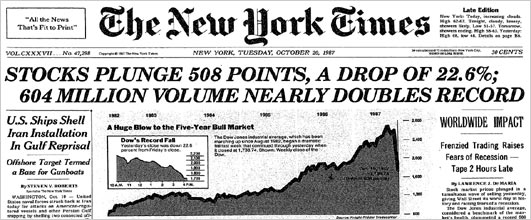
Tomorrow marks the twenty-sixth anniversary of the 1987 stock market crash. On October 19, 1987 the Dow Jones Industrial Average fell 22.6%, the largest one-day decline in stock market history. The best explanation for the decline, and the least well-known one, was put forth by economist Robert Shiller. This post gives a quick rundown of Shiller's work on understanding crash phenomena, in particular the famous 1987 event.

Eugene Fama, who along with Shiller and Lars Hansen shared the Nobel Prize this week, had very different reaction to the event than Shiller. In an essay penned not long after the crash, Fama, a true believer in the efficient market hypothesis, did his best to square the event with theory. The crash, wrote Fama,
has the look of an adjustment to a change in fundamental values. In this view, the market moved with breathtaking quickness to its new equilibrium, and its performance during this period of hyperactive trading is to be applauded. [Perspectives on October 1987, or What Did We Learn From the Crash? 1988]
Fama's effort to justify the crash as a rational response to economic news falls flat. A 22.6% decline requires something cataclysmic, but no significant events preceded the crash. Sure, there was a skirmish in the Persian Gulf with an Iranian oil station, a new tax proposal in the House, and a sell signal from guru Robert Prechter, but none of these events were capable of moving markets more than a few points.

Robert Shiller, on the other hand, gathered data. The day after the crash, he sent out questionnaires to hundreds of investors. Among other questions, Shiller asked: "Which of the following best describes your theory about the decline: a theory about investor psychology, or a theory about fundamentals such as profits or interest rates?" 67.5% of individual investors and 64% of institutional investors said the crash was about market psychology. When Shiller asked what major news stories people in his survey were reacting to during the day of the crash, the most popular stories were those about past price declines themselves, not fundamental news. Noted Shiller:
It would thus be wrong to say, as many have done, that the market drop on October 19, 1987 ought to be interpreted as a statement of public opinion about some fundamental economic factor, e.g., that there is a lack of confidence in the White House or Congress. At best, any such opinions probably played a role in the crash mainly as they affected the vague intuitive assessments people under great stress made about the tendency of prices to continue or reverse, or about how other investors will react to the current situation.
Put differently, the crash was a purely psychological phenomena.  When it comes to explaining the 1987 stock market panic, Fama and Shiller couldn't have been further apart.

 -----

Let me take this post on a personal tangent and then I'll circle back to Shiller. I first got interested in the 1987 crash back in the late 1990s when I was a student. Fearing that equity markets were getting overextended, I started to mine 1980s price data for clues about what might happen. I discovered that the visual overlay of movements in market indexes in the late 90s was eerily similar to that of the 80s. In October 1999 I went short, sure that we were on the verge of repeating the 1987 crash. At first the markets moved a bit lower. But a week or two later prices found their footing. I didn't know it then, but the bull move that followed would be the last spurt higher before tech mania would be pricked in early 2000. Unable to stomach the losses, I covered my shorts and went back to my studies.

Though I lost money in the debacle, I did gain what I thought was an interesting idea. If enough traders like myself drew analogies to a historical crash, our combined trades -- executed on the same day -- might result in the self-realization of that crash, even though nothing had fundamentally changed about the economy. This idea jived with an observation that many market watchers had made about the 1987 crash: it was eerily similar to the 1929 crash. Wrote George Soros:
Technically, the crash of 1987 bears an uncanny resemblance to the crash of 1929. The shape and extent of the decline and even the day-to-day movements of stock prices track very closely. -The Alchemy of Finance
Both crashes were preceded by multi-year bull markets. They each occurred on a Monday near the end of October, the first crash hitting 55 days after its bull market peak, the second 54 days. In addition to similar timing, the breadth of their declines were almost the same. The 1929 crash resulted in a 23% fall over two days, the 1987 in a 22.6% fall. I append a chart below:


Could it be that the 1987 crash occurred because traders were using the same backward-looking strategy I had when I went short in 1999? The process might have worked something like this, I reasoned: the peaks and troughs in 1987 began to randomly align with those in 1929. Backward-looking traders began to notice this alignment. A feedback loop may have emerged in which scattered fears of a recurrence of 1929 resulted in trades that pushed prices down, in turn rendering the analogy between the two periods ever more clear. A final trigger, say an anniversary date, might have been sufficient to complete the loop, resulting in a realization of the 1929 crash in 1987.

Reading through accounts of the 1987 crash, I found ample evidence of traders basing their strategies on 1929 analog models. In a famous but hard-to-come-by documentary filmed prior to the crash, 1980s wunderkind Paul Tudor Jones explained how he was using a 1929 analog model developed by his research director Peter Borish to put on a large short position in October 1987. The documentary is here, for now at least.* The Friday before the crash, hedge fund giant George Soros received a copy of Tudor Jones's study and showed it to Stanley Druckenmiller, manager of Soros's famous Quantum Fund.** On the morning of the crash, the Wall Street Journal published a chart of stock price in 1987 superimposed on stock prices leading up to the crash of 1929. News of the analog was spreading across Wall Street, and by Monday, October 19, enough momentum may have built for the analog to self-realize itself.

Paul Tudor Jones circa 1987

The 1929-87 event taught me that investor's minds don't react passively to underlying fundamental phenomena. Investors create stories that, when acted upon by enough people, actually shape the fundamentals. In 1987, a psychological "worm-hole" linked to an event fifty-eight years prior seems to have emerged, leading to the greatest one-day drop in market history. It was a mistake, a mental glitch, or a wrinkle in time.

 -----

Back to Shiller. I later found out that all of this had been anticipated by Shiller long before I was even old enough to buy and sell stock. In his post-1987 survey, Shiller found that 35% of individual investors and 53.2% of institutional investors reported talking of events of 1929 on the few days before October 19, 1987. Memories of 1929 were therefore "integral" in creating the 1987 crash, wrote Shiller:
Investors had expectations before the 1987 crash that something like a 1929 crash was a possibility, and comparisons with 1929 were an integral part of the phenomenon. It would be wrong to think that the crash could be understood without reference to the expectations engendered by this historical comparison. In a sense many people were playing out an event again that they knew well.
Nor was this the end to Shiller's work on crashes. The memory-of-crashes effect would reappear two years later. On Friday, October 13, 1989, a mini-crash occurred, the Dow falling 6.9%. Once again Shiller sent out a questionnaire. The most likely reason for the mini-crash, wrote Shiller, was the fact that the coming Monday was to have been the second anniversary of the 1987 crash.*** The mental image of the two biggest crashes in history possibly happening that Monday would have been sufficient to amplify any random price decline into an all-out panic. Wrote Shiller:
It may be a silly notion, but silly thoughts may have come to the minds of people trying to decide whether to sell as prices plummeted in the last hour of trading. They did not then have all of the reassuring commentary that came later, and they had to act then or risk having to sell on the following Monday. - Fear of the Crash Caused the Crash, NYT, 1989
 -----

In sum, Shiller long ago provided the world with what is probably the best explanation for why the 1987 crash happened when it did, and why it fell so far. Because Fama was so closely wedded to the EMH, his only option was to stay mute on the causes. "What caused this shift in expectations? I do not know" he wrote. Fama gives us a good-enough framework for understanding 99% of market moves. But for the remaining 1%, we really do need Shiller.


* The documentary has an interesting history. See Ritholtz, the WSJ, and Business Insider, among others. Apparently Tudor Jones threatens to sue anyone who puts it up, so getting ones hands on it is challenging. While the documentary is the best place to learn about the 1929 analog model, it also appears in the first edition of Jack Schwager's Market Wizards. But do try to watch the video, it's quite fascinating in its own right.


** Said Druckenmiller: "That Friday after the close, I happened to speak to Soros. He said that he had a study done by Paul Tudor Jones that he wanted to show me. I went over to his office, and he pulled out this analysis that Paul had done about a month or two earlier. The study demonstrated the historical tendency for the stock market to accelerate on the downside whenever an upward-sloping parabolic curve had been broken – as had recently occurred. The analysis also illustrated the extremely close correlation in the price action between the 1987 stock market and the 1929 stock market, with the implicit conclusion that we were now at the brink of a collapse. I was sick to my stomach when I went home that evening. I realized that I had blown it and that the market was about to crash." - Market Wizards, Jack Schwager (1988)

*** The 1929-87 analog revisited markets once again in 1997. On Monday, October 29, 1997, the Dow went into a freefall, eventually tumbling 7% . See my explanation of the 1987-1997 analog here

PS: If market's plunge this coming Monday, you know why.  ;) 

Tuesday, October 15, 2013

Medieval QE

Hand operated rolling mill, for putting the edge impression on to coins

I've been reading about the medieval monetary system lately. What a fascinating and complex mechanism, and a good reminder that we should not be using the word medieval as a synonym for primitive or unenlightened. Medieval coinage, I've come to discover, is also a highly confusing subject. A quote that John Munro attributes to Karl Helleiner seems apropos: "There are two fundamental causes of madness amongst students: sexual frustration and the study of coinage."

Studying odd, imaginary, or historical monetary systems is rewarding not only because of the aha! moment that understanding provides, but also because of what these systems reveal about our modern one. Readers may have noticed that for the last two months I've been posting rather obsessively on monetary policy, a topic I've typically avoided. Here's my attempt to combine monetary policy and medieval coinage into one post, hopefully as a useful way to consolidate all my points in an interesting way.

In medieval days, mints were generally owned by a prince. A mint-master was put in charge of coining silver bullion into coin (gold and copper were also coined, but for simplicity I'll focus on silver). The prince set the official rate at which the mint-master could convert raw silver into a specific coin. For instance, one pound-weight of silver might be coined into 240 silver pennies, each with 1/240th a pound-weight of silver in them. Under the principle of free coinage, anyone could bring raw bullion, plate, jewelry, and foreign coin to the mint to be converted into coin of the realm.

Coins were far more convenient in trade than raw silver because they saved transactors from the laborious process of weighing and assaying silver powder or ingots. Because of this superior marketability, coins usually traded at a premium to an equivalent amount of raw silver. A coin with 1 gram of silver therein, for instance, might exchange in the market at a price of 1.1 grams of pure silver bullion. Munro refers to this premium as the agio.

The existence of an agio represented a potential arbitrage opportunity for the public. A merchant need only buy raw silver, bring it to the mint to be coined, and leave with the same weight of silver, but now in coin form and capable of purchasing, say, 10% more goods. He could then buy more bullion with this new coins, repeating the process and earning a 10% risk-free return each time.

While coinage was free, it was not gratuitous. The mint-master required a certain amount of silver as payment for the use of his time, minting tools, and wages for his employees. Since silver was usually mixed with base metals like copper to produce the final coin, the mint-master also required compensation for supplying the baser metals. This fee was called brassage. The prince exacted a fee too, or a tax. This was called seigniorage.

These costs restricted the opportunities for arbitrage. If the brassage and seigniorage costs were higher than the agio, the public would avoid the mint altogether since the transaction would result in a loss in purchasing power. Better to keep their silver in bullion form or search for a mint that produced identical coin at less cost.
However, as long as the agio was more than brassage and seigniorage, citizens would continue to bring bullion to the mint and enjoy a small return.

This process had a natural limit. Much like the water-diamond paradox (which tells us that the usefulness of something does not necessarily equate to a higher price) the fact that coins were more useful than raw bullion in transactions didn't mean that people would always pay to enjoy that benefit. As the public flocked to the mint, a coin glut would develop. The marginal value that the market placed on coin-as-transactions-medium would deteriorate, driving the agio down to the twin costs of brassage and seigniorage. Put differently, an increase in coin supply would push the marginal value of coin towards the cost of production. Just as water is extremely useful but essentially free, the marketability value of coins -- though still useful -- could be had at no cost once the quantity of coin was sufficiently plentiful.

Let's bring this back to monetary policy. The initial agio of coin over silver is very much akin to the liquidity premium I've mentioned in previous posts. The existence of an agio, or liquidity premium, is justified by the convenience, moneyness, or non-pecuniary return on a medium-of-exchange. As the supply of coin is allowed to increase, all other things staying the same the market's marginal valuation of this non-pecuniary return will fall, as will the associated agio/liquidity premium.

A modern central bank keeps the supply of reserves artificially tight and restricts competition. In doing so, it creates a positive marginal non-pecuniary return on reserves (or a convenience yield, see here). This drives the market value of reserves above the price at which they would otherwise trade were they subject to competition. In other words, a central bank creates a permanent agio.

In order to execute monetary policy, central banks will typically massage this agio. By emitting a small amount of reserves or sucking them in, a central banker can alter the marginal valuation that the market places on the convenience of reserves. This pushes the agio higher or lower. Any change in the agio translates into an economy-wide change in the price level.

Bringing this back to a medieval setting, imagine that the prince ceases free coinage (much like how a modern central banker would restrict reserve supply and competition). From time to time the public might be allowed access to the mint, and in limited numbers, but usually the mint would be closed to business. The supply of coin, therefore, is henceforth restricted. The ensuing lack of transactions media will cause a large agio to emerge as the market value of coin rises relative to bullion. I'm assuming here that counterfeiting is too dangerous to justify. If not, counterfeiters will be motivated to establish black market mints once the agio significantly exceeds brassage.

The prince is now in the same position as a modern central banker. By bringing a bit of silver bullion to the mint, turning it into coin, and spending it, he can increase the quantity of coin in the economy and thereby decrease the marginal non-pecuniary return on coin. The agio would thereby shrink, pushing the market value of coin down, or the price level up.   After all, the economy's unit of account in the medieval period was determined by a given link coin, usually the penny, so any change in the penny's value resulted in an economy-wide change in prices.

Both the prince and a central banker face a limit to the effectiveness of expansionary monetary policy. Once a prince has issued enough coin to drive the agio down to zero via mass "coin quantitative easing", further coin emissions will have no effect on the price level. A coin will now be worth no more than its intrinsic silver value. Nor can it fall to a discount to its silver content, since the public would simply buy coin and melt it into bullion until the discount has been removed. As for a modern central banker, once QE has reduced the convenience yield provided by reserves across the entire curve to zero, then further reserve emission cannot push the price level down any further. The agio has disappeared. In the same way that coin falls to its silver content, reserves will have fallen to their intrinsic "backing" value -- and will go no lower.

The prince still has an alternative. He can engage in outright debasement. By reducing the intrinsic silver content in coin, the price level will once again start to rise. Likewise, a central banker might attack the intrinsic value of central bank liabilities by destroying assets, or purchasing assets at bloated prices, or engaging in helicopter drops. Princes did in fact tend to reduce the price level via debasement and not by manipulating the agio, although they usually did so as a way to earn higher revenue, not to help the economy. No doubt due to the irresponsibility of the prince's who preceded them, modern central bankers are legally prohibited from outright debasement. Manipulating the agio on reserves, or playing with the interest rate on reserves, are the only tools left to them.


Most of the actual facts about medieval coinage in this post come from John Munro's Warfare, Liquidity Crises, and Coinage Debasements in Burgundian Flanders, 1384 - 1482 (RePEc) and The Coinages and Monetary Policies of Henry VIII (RePEc), among other papers. Munro shouldn't be blamed for mistakes in my theorizing, nor the analogy to modern central bank QE. 

Wednesday, October 9, 2013

Toying with the monetary transmission mechanism


Does it matter what the Fed buys? ...from whom? ...or how? I don't think so.

The Fed currently buys and sells government-issued and guaranteed securities from designated primary dealers. It does so publicly and transparently. In the case of QE, it announces ahead of time the quantities it will purchase. Prior to 2008, it announced that it would conduct enough purchases to drive the fed funds rate up or down by x%.*

But let's modify the monetary policy transmission mechanism a bit. Say that a few years from now the Fed decides to buy and sell bitcoin, bitcoin claims, and other cryptocoins instead of government securities. Rather than executing these trades through a select posse of firms, it'll transact broadly with Joe Public. And rather than announcing purchasing intentions, it will carry them out surreptitiously. Big as these changes may seem, altering the route won't impede the transmission of monetary policy. Whether it quietly buys bitcoin from the public or pre-announces government bond purchases with primary dealers, the Fed will still continue to keep a firm grip on the economy's price level.

There are a few ways for a hypothetical bitcoin transmission mechanism to work. Here's one way. Say the Fed wants to loosen policy and push prices up by, oh, 5%. Fed officials fan out across the US, looking for local bitcoin over-the-counter exchanges. Bitcoin OTC markets exist on street corners, in coffee shops, houses, cafés, public libraries, city parks, and bars. These informal OTC exchanges are where Joe Public congregates to truck and barter bitcoin. Once located, the Fed officials begins to write out cheques to OTC traders in exchange for bitcoin at the going market price. The Fed now has bitcoin on the asset side of its balance sheet. OTC traders have Fed cheques which they proceed to deposit at their local bank.**

So far the Fed's purchases haven't had an effect on the price level — neither the price of bitcoin nor the price of goods have budged. Note that even if Fed officials accidentally nudge bitcoin OTC prices up a bit through their buying, arbitrageurs will quickly counterbalance this by routing sales away from centralized bitcoin exchanges like Mt-Gox (assuming it still exists in a few years) to OTC markets, driving OTC prices back to their fundamental value.

The OTC traders' Fed cheques having been deposited in the banking system, banks proceed to load them into Brinks trucks for delivery to the local district Fed for clearing and settlement. During the clearing process, a large settlement imbalance in favor of private banks emerges, an imbalance that has arisen thanks to the Fed's cheque-writing campaign. The Fed settles its debts by crediting the reserve accounts of creditor banks with newly created deposits.

Only now is our bitcoin transmission mechanism poised to push prices higher. Banks collectively find themselves with an excess stock of reserves. But there is no place for this excess to go. Within the next few hours, banks will madly compete to get rid of their reserves. They'll do so by buying up financial assets like bonds, stocks, MBS, and bitcoin from other banks.*** As a result of their combined efforts, the prices of all these assets will quickly rise. Put differently, the purchasing power of reserves will fall. This decline will only stop when the purchasing power of reserves has fallen to a low enough level that they are once again willingly held by bankers. While this will happen very fast with financial asset prices, stickier prices like goods and labour will take longer to adjust upwards.

In a nutshell, that's how the Fed's bitcoin purchasing policy succeeds in increasing the price level. And if the Fed falls short of hitting its 5% growth target, it need only send out more officials to write more checks for more bitcoin until it hits its mark.

Let's make a few changes to our transmission mechanism. To streamline the process, the Fed decides to funnel purchases to a select number of bitcoin dealers rather than spraying them broadly. Should the Fed require it of them, these chosen dealers are required to quote the quantity of bitcoin they are willing to sell and at what price.

Does the decision to funnel purchases rather than spray them change anything? Not at all. Fed cheques are still deposited by bitcoin sellers at their banks and these checks are settled with reserves. Whether funneling or spraying, banks still end up with an excess reserve position which they will try to rectify by simultaneously buying up assets. The only resolution to this will be a quick rise in prices. A primary bitcoin dealer system, it would seem, is no different a transmission mechanism than our earlier broad Joe Public approach.

The Fed may even require that bitcoin dealers hold inventories of government bonds and submit bond quotes from time to time in addition to bitcoin quotes. Even if the Fed decides to purchase bonds rather than bitcoin, nothing about the transmission mechanism changes—Fed cheques still result in excess reserve positions at banks, and these can only be equalized by a rise in prices. But now we're back at our current system in which primary dealers sell bonds to the Fed.

The Fed may even start to publicly announce its intentions to make bitcoin purchases rather than surreptitiously writing checks. Anticipating that they will soon be inundated with excess reserves upon hearing the announcement, banks won't wait for the reserves to arrive before trying to offload them. Rather, they'll sell immediately. This will quickly push asset prices higher. Smart speculators and investors, anticipating that forward-looking bankers will quickly spend their reserves after the Fed announces its intention to buy bitcoin, will try to beat the bankers to the punch by purchasing assets the moment an announcement is made.

So when the Fed's purchasing intentions are announced, market prices adjust even before the Fed carries out the actual purchases. Without an announcement, however, the cheques must physically enter the economy and cause a reserve imbalance before prices begin to adjust, a process that will only start a day or two after and will proceed in a jagged manner.

The upshot of all this is that it doesn't matter what the Fed buys, nor from whom. Monetary policy works irrespective of the route. As for the "how",  the Fed's decision to publicize their intention to make bitcoin purchases rather than quietly writing out cheques has the effect of dramatically speeding up what would otherwise be a circuitous transmission process.


* For simplicity, I'll be assuming a world in which the Fed doesn't pay interest on reserves.
** Even if OTC traders don't accept cheques, they'll accept bank notes, and the same analysis applies.
*** In addition to purchasing financial assets, banks will try to lend them away to other banks in the interbank market, receiving the overnight interest rate in return. This will cause the interbank lending rate to fall. 

Friday, October 4, 2013

What happens when stock markets die?


What effect does a stock market listing have on the value of equity? Companies can always choose to issue shares privately rather than list them on public centralized exchanges. That the world's biggest corporations are all publicly-listed implies some sort of advantage to being listed.

To answer this question, it helps to see what happens to listed share prices upon the sudden dissolution of a stock market. The cryptocoin universe has just provided us with a great natural experiment (which, unluckily for me, resulted in a loss). Due to what it called "recent changes in the virtual currency regulatory environment," LTC-Global, a litecoin-denominated stock market, and sister exchange BTC-TC, a bitcoin-denominated exchange, announced that they would be shutting their doors. Both exchanges listed twenty to thirty securities each, including shares, bonds, and ETFs. BTC-TC did ~2,000 BTC in daily volume or ~$350,000, while LTC-Global was doing 5,000 LTC a day in business, or around $10,000.

The fateful announcement was made on the morning of September 23. Trading was immediately halted and order books cleared, presumably to allow investors to digest the information. When trading was re-opened, the immediate reaction of almost all share prices was to plunge in value. Shares continue to trade almost exclusively below their pre-September 23 price. All trading will be halted on October 7. After that point, de-listed companies will have to reconfigure the way by which their shares are traded. They may either relist on another crypto share market (there are a few), they might provide their own venue for trading on their personal website, or they might simply leave it to the shareholders to locate each other and trade over-the- counter, say on forums or message boards.

Here are a few charts showing the reaction of some of the more liquid stocks to the closure. I get them from Coinflow:

Labcoin (BTC-TC):  Labcoin is in the business of manufacturing and marketing cryptocoin mining equipment. It immediately fell from 0.0023 BTC to 0.00025 BTC, or around 90%, soon recovering to 0.001 BTC, about 50% below pre-announcement prices.


Basic Mining (BTC-TC):  Basic Mining units offer a share of revenues earned from a bitcoin mining operation. They stabilized the day after the announcement at around 40% below their previous price.


LTC-Miner (LTC-Global):  The share price of LTC-Miner, a cryptocoin mining farm's value, was halved on September 23.


This event clearly illustrates how an unanticipated de-listing affects a firm's stock price. Despite no change in underlying fundamentals—the earnings of most of the listed cryptofirms would have been unaffected by the stock market's closure—the market value of most firms' shares declined. Alternatively, we might say that the listing of a stock on a stock market would cause a rise in the market's valuation of a firm, despite no improvement in underlying fundamentals.

There are two non-mutually exclusive reasons that might explain the collapse in crypto shares upon the closure of LTC-Global and BTC-TC, a real and a monetary one:

1. Stock markets vet firms to ensure they are legitimate. They also set standards for communication and governance, and this forces firms to be more accountable to shareholders. The graduation of a firm's shares to an exchange like LTC-Global or BTC-TC may be taken by investors as an indicator that the shares are less risky than before, and therefore they can be discounted by a smaller factor. When LTC-Global and BTC-TC were suddenly closed, shareholders had no guaranty that the issuer, no longer under the glare of the public eye, would treat them as fairly as before, and therefore the large selloff. Or put differently, investors chose to suddenly put a larger risk premium on cryptoshares.

2. By bringing together many stocks and investors in one space, stock markets promote the liquidity of shares. Liquidity is its own return. By that I mean that investors "consume" liquidity in the same way that they consume other durable goods that provide protection, say house alarms, guns, or fire extinguishers. Though these goods are unlikely to ever be used, the services they provide are steadily consumed through time in the form of comfort and security. By ensuring liquidity, stock markets increase the non-pecuniary flows of comfort and security provided by listed stock. A liquid share, after all, can be easily sold should some unforeseen arise—an illiquid share can't. All other things staying the same, this improvement in a stock's non-pecuniary yield should result in a rise in its price (see this post for more).

So upon the announced shutdown of LTC-Global and BTC-TC, expectations about future liquidity were reduced, the non-pecuniary return on shares declined, and thus prices fell. The fallback option—that shares trade over-the-counter—results in inferior liquidity since there are significant search and monitoring costs entailed when exchanging stock via forums or email.

One wonders when some bright programmer creates a decentralized ledger to store a stock market's order book. Just like it is impossible to shutdown bitcoin since it doesn't exist in one particular location, it would be impossible for authorities to shutdown a decentralized cryptocoin stock market. Companies operating in the bitcoin universe would flock to list on this market since it would provide them with the most legitimate guarantee of future liquidity, and a higher stock price. All for a juicy fee, of course.

Monday, September 30, 2013

Could Bitcoin kill Fed monetary policy?


While bitcoin could one day kill most of the roles that the Fed plays, monetary policy will probably stay intact. The reason for this, as I'll show, is that the no matter what happens to all its other functions, the Fed will probably continue to define the economy's unit of account.

Let's start in the present day US. Most modern transactions involve transfers of dollar banknotes, reserves, or dollar-denominated bank deposits. A small minority of transactions are made with bitcoin. But these transactions are rarely priced in terms of bitcoin. Rather, a merchant's website will typically display prices in terms of dollars, and then compute the amount of bitcoin that a customer must fork over by referring to the current dollar-to-bitcoin exchange rate. The dollar is very much the the unit of account in the US, not bitcoin.

The first of the Fed's functions to be killed off by bitcoin will inevitably be the issuance of paper banknotes. Bitcoin enjoys all the benefits of cash, on top of which it can be transferred instantaneously over long distances. Bulky hand-to-hand paper simply can't compete. Unwanted notes will reflux back to banks and then to the Fed. From there Fed officials will cancel and destroy them, the Fed's balance sheet shrinking to a fraction of its previous level. Paper dollars will now be extinct, and the Fed much smaller.

Even with its printing presses idled by bitcoin mania, the Fed will still continue to issue reserves. Reserves are used by banks in the interbank market to settle cheques and make large value payments, normal people don't get to own them.

The Fed has traditionally not paid a pecuniary rate of return on reserves. In other words, it hasn't offered interest. Banks have been willing to hold barren reserves because in addition to their usefulness as payments media, the Fed has exercised its monopoly powers to keep their supply artificially scarce. This combination of usefulness and scarcity conspire to produce significant non-pecuniary benefits that bankers will eagerly pay to enjoy. After all, any banker that holds a base level of scarce reserves can rest easy knowing that they are well-prepared for an uncertain future—a banker that forgos them must bear the discomfort of being ill-equipped to deal with unforeseen events.

The Fed can alter the relative scarcity of reserves via open market operations. This in turn either increases or decreases the non-pecuniary return on reserves, or their marginal usefulness.  If increased, the rush to buy reserves causes economy-wide fall in the price level. If decreased, a rise ensues. Thus even though bitcoin has rendered cash extinct, the Fed's power over the economy isn't diminished one iota since prices continue to be priced in the dollar unit of account, and the Fed's artificially scarce reserves are effectively the medium that defines the unit.

But say that bitcoin and a raft of other alt-coins become popular among banks as a way to settle payments among each other. Say these new electronic media are blazingly fast, safer, and far cheaper than the Fed interbank alternative. Banks, their electronic vaults full of bitcoin, no longer want to hold reserves and are lobbying the Fed governor to buy them back with the assets the Fed holds in its vaults. Should this happen, the Fed's balance sheet is set to contract to zero—into irrelevance.

At this point the Fed will have effectively lost its tight grip on the market for interbank settlement media. Reserves will neither be special nor scarce—banks can now hold a wide variety of assets as interbank media. The Fed finds itself powerless. Its traditional tool for manipulating the price level has always been to lever its monopoly power so as to fiddle with the relative scarcity—or specialness—of highly-liquid reserves. But this tool is gone. It can't do anything to control the price level. As for the media it once issued, both cash and reserves have lost their distinct characteristic as "money". They are no longer the most liquid assets in the economy, having been displaced by cryptocoin.

However, this ignores the fact that even though reserves have lost all their monetary usefulness in the face of cryptocoin competition, the Fed still has one other tool at its disposal—it can start to pay a pecuniary return, or interest, on reserves. By raising or lowering the interest rate it offers, it can either entice or repel banks to hold more or less reserves at any given price level. Since the economy's prices continue to be expressed in terms of the dollar, the Fed can now manipulate the economy-wide price-level by jacking up or reducing interest on reserves. Even if there are only a piddling $20 million worth of illiquid reserves outstanding, the Fed can still get a bite on the macroeconomy by changing rates.

So to sum up, though cash has gone the way of the dodo bird, and the Fed has lost its clearinghouse monopoly, and bitcoin is gushing everywhere, the Fed can still exert itself over the economy because it issues the one special asset that defines the unit of account—reserves.  Monetary policy can still exist in a world without central bank money.

The Fed would only become truly powerless when economic actors choose to price their goods in terms of cryptocoin. At that point, Fed reserves will have lost all their traditional uniqueness—they will be just one fixed-income asset among a sea of many millions of fixed-income assets. The economy's unit of account will be BTC, and the economy-wide price level will now be driven by the vicissitudes of the demand and supply of bitcoin. But a switch in the unit is unlikely since the network effects generated by centuries of tradition are in the dollar's favor. For the time being, bitcoin is just too volatile to be used for price expression.

The Fed needn't worry about becoming irrelevant. Hell, it might even learn a bit from the competition along the way.


Along these lines, give Michael Woodford's Monetary Policy in a World Without Money a read. Written in 2000, Woodford tries to answer whether the "development of 'electronic money' poses any threat to the ability of central bankers to control the value of their national currencies through conventional monetary policy." Nine years before bitcoin even arrived on the scene, academic scribblers like Woodford were already mulling over its potential effect on Fed policy. How's that for forward guidance?

Monday, September 23, 2013

Ghost Money: Chile's Unidad de Fomento

Santiago skyline

This post continues on the topic of the separation of the medium-of-exchange function of money from the unit-of-account function. My previous post discussed how the medieval monetary order was characterized by both a medley of circulating coins and one universal £/s/d unit of account. This post introduces a modern example of medium-unit divergence: the Chilean peso and Chile's Unidad de Fomento. I'll explain how the Chilean system works and end off by asking some questions about the macroeconomic implications of this separation, specifically what happens at the zero lower bound.

Like most modern currencies, the peso is issued by the nation's central bank; the Banco Central de Chile. Local banks offer peso-denominated chequing and savings accounts. Chileans use these pesos as the nation's medium-of-exchange. They pay their bills with pesos, settle rent with it, and buy food with it.

The differences between Chile's monetary system and those of other nations only emerges when we begin look at the unit in which goods are priced. Most nations have one unit-of-account, but Chile has two. While many Chilean prices are expressed in terms of the peso, or P, a broad range of prices are expressed in an entirely different unit, the Unidad de Fomento, or UF. Real estate, rent, mortgages, car loans, long term gov securities, taxes, pension payments, and alimony are all priced using UF. As examples, this real estate website sets prices in UF terms, and this car rental business levies insurance in UFs. On the other hand, wages, consumer good prices, and stock prices are expressed in peso terms.

So what is the UF? The UF was introduced in 1967 by the Chilean government, though it only came into wide use as a unit-of-account in the 1980s. There are no UF coins or notes circulating in the Chilean economy. Rather, the Unidad de Fomento exists as a purely abstract, or indexed, unit-of-account, totally divorced from any media-of-exchange. Goods and services quoted in terms of the UF can only be purchased with an entirely different medium — pesos.

The UF is defined as the amount of currency units, or pesos, necessary for Chileans to buy a representative basket of consumer goods. The amount of pesos in one UF, or the peso-to-UF exchange rate, is calculated daily, and is published on the Banco Central's website. The daily value is interpolated from the previous month's consumer price index, or the Indice de Precios al Consumidor (IPC). If you go to this website, you can see the current peso-to-UF rate and how it has been adjusted over the last week.

This all sounds quite odd, so let's use an example to get a better idea for how the system functions. When a Chilean seller prices something in UF, they are indicating that they expect to receive a fixed quantity of CPI basket-equivalents as payment. For instance, say that a landlord advertises an apartment in downtown Santiago at a monthly rate of 10 UF. A potential renter, curious about the price, checks the UF-to-peso exchange rate at the central bank's website. He sees that today's rate stands at 23,000. Using a cellphone app (in real life, the rate will probably not be a convenient round number), he multiplies 10 UF x 23,000 P/UF to arrive at the current monthly rate in pesos, or 230,000P (this is about US$450). Deciding that the price is good, the renter signs a lease and starts to pay UF-denominated rent each month in pesos.

Say that the Banco Central adopts an easy money policy and six months later the Chilean peso's purchasing power has fallen by around 10%. Rent is still priced at 10 UF. But now the peso content of the UF has risen —after all, it takes about 10% more pesos to buy the same consumer basket. The computed rate on the central bank's website is now 25,000 P/UF. The monthly amount in pesos that the renter must make out to the landlord now comes out to 250,000P (10UF x 25,000 P/UF), up from 23,000. However, while the rent payment is nominally higher, the payment's UF value is constant. In other words, the transaction represents the exact same quantity of CPI baskets as six months before.

It works the same way when the with a tight money policy. Imagine a 10% peso deflation. The UF sticker price stays constant while the conversion rate to pesos on the central bank's website falls by 10%. Rent is nominally lower in peso terms but in terms of representative consumer baskets it has stayed constant.

The UF/P system is similar in many ways to a partially dollarized economy in which the US dollar has been adopted as the unit in which to price long term contracts while the local currency is used to price current goods and services. What makes Chile different from partially dollarized economies is that the dollar tends to circulate along with the local currency as a medium-of-exchange. Thus there are two different units-of-account corresponding to two different media-of-exchange. Chile's UF, on the other hand, is a purely abstract unit with no corresponding medium of its own.

Irving Fisher was skeptical of medium-unit divergence and declared so in his 1913 paper The Compensated Dollar:
Not only would the multiple standard necessitate much laborious calculation in translating from the medium of exchange into the standard of deferred payments, and back again but, if, as has been suggested, the employment of a multiple standard were at first optional, the result would be that many business men whose prosperity depended on a narrow margin between their expenses and receipts would be injured rather than benefited by having one side of their accounts predominantly in the actual dollar and the other in the ideal unit.
Fisher went on to propose his compensated dollar scheme, which was essentially a combined unit-of-account/medium-of-exchange dollar. The real purchasing power of the compensated dollar would stay constant over time, much like the UF/peso combination, but without the necessity of imposing the laborious calculations involved in medium-unit divergence. That Chileans did choose to adopt a somewhat laborious mechanism that involves conversion from/to pesos to/from the ideal UF demonstrates the degree to which they were willing to free themselves of the burdens imposed by the 1970s inflation of the peso. The practice of publishing the UF-to-peso rate on a daily basis—which began in 1977— may have also encouraged UF adoption. Prior to then, the UF had only been calculated monthly.

While the idea of separating the unit from the medium is not a common one, when it does arise it tends to have been inspired by the desire to avoid the deleterious effects of inflation. Widespread use of the UF, as pointed out earlier, came about as a response to 500%+ peso inflation of the 1970s. Robert Shiller, the most vocal modern advocate of unit/medium separation, has also been motivated by concerns over the deleterious effects of inflatio. Shiller believes that because people tend to succumb to money illusion when dealing with inflationary episodes, the adoption of indexed units-of-account may be the most palatable way to reduce the problem.

Just as interesting, however, is the idea of separating the unit-of-account and medium-of-exchange to help cope with deflationary episodes and the zero-lower bound problem

First, let's set up a hypothetical scenario without the UF and a combined peso unit-of-account and medium of exchange. Say the Chilean economy suddenly collapses. Pessimistic Chileans expect to earn a negative return on projects and investments. Peso cash provides a superior return in this environment since it pays 0%—hardly great, but 0% is better than -x%! Peso prices need to fall dramatically in order to restore equilibrium. Put differently, the value of the peso needs to rise to a level at which it is expected to decline at the same rate as all other projects and investments. Yet peso-denominated sticker prices are rigid, preventing the necessary adjustment. What should be a short period of sharp adjustment turns into a long painful period of high unemployment and idle resources.

Now let's assume that all prices are expressed in UF while actual transactions are conducted in pesos. The same shock hits the Chilean economy. Once again the negative yield on projects and investments is overwhelmed by the 0% yield on peso cash. Peso prices need to fall dramatically in order to equilibrate the peso's return with all other yields. As before, sticker prices are rigid.

Here's the difference between our first and second scenarios. In a world with an ideal unit-of-account and no related medium-of-exchange, it really doesn't matter that prices can't adjust. This is because prices are no longer expressed in terms of 0%-yielding peso cash. Rather, they are expressed in terms of UF. Because the UF lacks a physical counterpart, there are no equivalent UF instruments that might also hit the zero-lower bound. The peso's outsized 0% return relative to all other negative yielding assets, which before was the root of the problem, will be quickly equilibrated as the peso-to-UF exchange rate published on the central bank's website jumps higher.

So a shock to an economy in which a combined medium-of-exchange and unit-of-account prevails can quickly become a tragedy. The 0% nature of the former interferes with the stickiness of the latter. But when the medium-of-exchange is divorced from the unit-of-account, the 0% nature of the former will quickly be resolved since stickiness is now in terms of an ideal unit, and not in terms of pesos.

Medium/unit separation, it would seem, could be yet another foolproof way of escaping deflation and the zero-lower bound.


References:
1. Robert Shiller, Indexed Units of Account: Theory and Assessment of Historical Experience, 1997. [RePEc]
2. Robert Shiller, Designing Indexed Units of Account, 1998. [RePEc]
3. Robert Hall, Controlling the Price Level, 2002. [RePEc]
4. Stephen Davies, National money of account, with a second national money or local monies as means of payment: a way of finessing the zero interest rate bound, 2004

Tuesday, September 17, 2013

Woodford's forward guidance—why not use forward contracts instead?


...once the supply of reserves is sufficient to drive the short-term riskless rate to zero..., there is no reason to expect further increases in the supply of reserves to increase aggregate demand any further... Once banks are no longer foregoing any otherwise available pecuniary return in order to hold reserves, there is no reason to believe that reserves continue to supply any liquidity services at the margin; and if they do not, the Modigliani-Miller reasoning applies once again to open market operations that increase the supply of reserves, just as in the model of Wallace.
-Michael Woodford, 2012.  

On a whim, I wrote an email to Michael Woodford last week. Woodford, a macroeconomist at Colombia University, is the authour of Interest and Prices (pdf), an important contribution to modern monetary policy. I'll be the first to admit that I haven't been able to work my way through his book—too few words and too many equations. But I have read two excellent papers by him. The first is Monetary Policy Without Money, which I'll touch on in another post, and the second is a well-known paper that he presented at Jackson Hole in 2012 entitled Methods of Policy Accommodation at the Interest-Rate Lower Bound. If you're interested in monetary policy and you haven't read it yet, you really should.

My email, affixed below, had to do with the above quote from his second paper:
Dear Professor Woodford,

I have read your paper Methods of Policy Accommodation at the Interest-Rate Lower Bound several times and it has taught me quite a bit.

One question:

In Section 3.1 (Effects of Targeted Asset Purchases in Theory), you point out that once the supply of reserves is sufficiently plentiful, banks no longer forgo a pecuniary return that would otherwise be provided by reserves (ie a marginal convenience yield). This is the point at which the overnight interest rate hits the lower bound, additional reserve additions are irrelevant, and the Modigliani-Miller result applies.

It seems to me that the overnight rate doesn't shadow the general convenience yield on reserves per se, but rather it shadows the 24-hour convenience yield on reserves. Just like there is a term structure to bonds, there is a term structure to the convenience yield on reserves. In addition to a 24-hour convenience yield, there is a 1 week, 1 month, 1 year yield, each point allowing us to construct a convenience yield curve.

Although the overnight yield may be zero, convenience yields further down the convenience yield curve may still positive. Banks hold reserves not only to enjoy their overnight convenience, but also to enjoy expected flows of future convenience. This would seem to imply that the present discounted value of future flows of convenience can be positive even when the overnight convenience yield is zero.

Which would indicate that even when we are at the lower bound for overnight rates, purchases are not necessarily subject to the Wallace irrelevance critique insofar as they specifically target positive yields further down the convenience yield curve. If purchases today can reduce convenience yields tomorrow, the present discounted value of future flows of convenience will be reduced. Overnight purchases won't suffice since they only target overnight convenience yields. Open-ended outright purchases might not work if there is no commitment to avoid unwinding these purchases in the future. Perhaps long term repo operations that target the distant end of the convenience yield will be most effective in avoiding the irrelevance criticism. Repos precommit a central bank to avoid unwinding at a future point in time, thereby reducing future convenience yields and, as a corollary, the present value of total convenience flows.

Does that make any sense? I am curious what your thoughts on this are.

Cheers,

JP Koning
Frequent readers will notice that my letter was just a summing up of my three recent posts on the convenience yield.* If you've already read those three posts and reached your quota, don't bother reading further, since much of what I'm going to write follows in that general theme.

Surprisingly, Woodford got back to me. I'm not going to publish his response, but in brief he doesn't think that there should be a convenience yield curve. Woodford told me that he thinks reserves are an overnight asset, not a long-term asset like, say, Treasury bills, and an overnight asset doesn't supply a convenience yield for longer than 24 hours.

I agree with Woodford that the convenience yield supplied by a short-lived asset is negligible. No one holds a stock of ripe avocados because they might serve as convenient medium of exchange 30 days from now.

But reserves aren't avocados. They are infinitely-lived instruments that can be perpetually held without the necessity of paying storage fees. This means that even when overnight yields have hit 0% (as indicated by an overnight fed funds rate of zero) reserves still supply current reserve-owners with a positively-valued marginal convenience yield over longer time frames than the 24-hour window. The implication of this is that although central banks may no longer be capable of manipulating the 24-hour convenience yield lower, they may be still be able to conduct targeted financial transactions, or balance-sheet policy, that change distant parts of the convenience yield curve. This gives a central bank plenty of traction at the zero lower bound. After all, a reduction in the future convenience flows thrown off by reserves will reduce the present value of all convenience flows. The expected return on reserves having been reduced, reserves will be spent away in the present and this will stimulate today's inflation and/or real activity.

QE—what Woodford refers to as balance sheet policy—is a fairly blunt tool when it comes to reducing distance convenience yields.** This is because a one-time expansion of the central bank's balance sheet can be easily reversed at a future point in time by sucking reserves back in. Financial markets may therefore view QE as fleeting. If so, distant convenience yields will not budge much and, as a result, inflation and real activity will remain unaffected.

Rather than engaging in crude QE when the overnight rate hits zero, a central bank might enter into a more focused form of balance sheet expansion. Five-year repos, for instance, may be sufficient to ensure that excess reserves stay in the system for an extended period of time. Even more effective would be a policy of entering into forward contracts with banks. These transactions would commit the central bank to purchasing assets at various points in the future, thereby ensuring a series of large balance sheets down the road.

For instance, if the Bank of Canada faced the ZLB and wanted to reduce the future convenience yield on reserves after, say, 2015, it could contract with commercial banks to purchase assets at various dates in 2016, 2017, and 2018. It would enter into as many of these forward contracts as necessary to guarantee today a sufficiently large supply of reserves tomorrow. Unlike crude QE, forward contracts are irreversible. The permanency of these transactions should be sufficient to reduce the future convenience yield on reserves, thereby diminishing their expected return in the present and stimulating current spending.

A policy of using forward contracts to reduce the distant convenience yield on reserves could be a substitute for Woodford's verbal forward guidance. Rather than specifying in words the future time path of interest rates, the central bank need only add a sufficient amount of forward contracts to its balance sheet in order to ensure that it hits its targets (an inflation target, a nominal GDP target, whatever). The upshot is that balance-sheet policy needn't die at the zero-lower bound. Concrete actions that guarantee to alter the size of a central bank's future balance sheets and convenience yields can be just as effective as Woodford's carefully crafted wording.

In any case, I'm not holding my breath for Woodford to get back to me on that, he's a busy guy.


*Interestingly, Woodford uses the term convenience yield in his paper, too.
** Miles Kimball has equated balance sheet policy at the ZLB to using a massive fan to move the economy.

Friday, September 13, 2013

Separating the functions of money—the case of Medieval coinage

Florentine florin

Last year Scott Sumner introduced the econ blogosphere to what he likes to call the medium-of-account function of money, or MOA, defined as the sign in which an economy's sticker prices and debts are expressed. Here and here are recent posts of his on the subject.

I think Scott's posts on this subject have added a lot of depth to the interblog monetary debates. However, I've never been a big fan of Scott's terminology. As I've pointed out before, what Scott calls MOA, most modern economists would call the unit-of-account function of money. Older economists like Jevons and Keynes[1] referred to the unit-of-account as the money-of-account, and modern economic historians also prefer money-of-account. Terminological differences aside, in today's post I want to focus on what I'll call from here on in the unit-of-account function of money.

Scott's UOA posts often emphasize the idea of separating the unit-of-account function from the medium-of-exchange. This isn't a new approach. Back in the 1980s, a trend in monetary economics began whereby economists began to dissociate the various bundled functions of money into constituent components. In fact, a few contributors to the modern econ blogosphere were participants in what was then called "New Monetary Economics", or NME, including Tyler Cowen, Bill Woolsey (pdf), Scott, and Lawrence White (pdf). White, it should be noted, was a critic. Cowen doesn't blog much about NME these days, his last post on the subject was in 2011, but I'm sure every time he goes to a restaurant he can't help but wonder what the world might be like if the menu prices were in different units than the media he expected to pay with. Here is an old Cowen paper (with Krozner) on NME that is worth reading, as well as the bibliography which serves as a good jumping off point to understand more about NME.

But let's turn to an actual example. The separation of the medium-of-exchange from the unit-of-account envisioned by NME isn't mere speculation. Indeed, such a separation has been very much the norm over the last thousand years or so. The medieval monetary system operated with what was essentially a number of heterogeneous media of exchange and an independent unit of account.

Medieval Europe was politically fragmented and many different mints issued coins. Einaudi (pdf) tells us that some 22 gold coins and 29 silver coins (most of them foreign) circulated in the Duchy of Milan alone in the 18th century. This does not include the many varieties of copper coins that would also have been current. Weber (pdf) describes Basel in the 1400s, which had a heterogeneous coinage acquired through trade that included florin and ducats from Italy, and German rhinegulden, along with the local silver penny.

Because most of these coins had different metallic content, and the market value of coins was determined to a large extent by the quantity of metal therein, would this not have caused a terrific amount of confusion? Silver and gold traded at a constantly fluctuating ratios, contributing to the calculational morass. How could shopkeepers and shoppers keep track of the prices at which transactions were to be consummated with such an incredible variety of ever changing units?

The answer is that prices were expressed in terms of a universal unit of account. The name for this unit was the pound, or in French, the livre. The pound (and livre) were further divisible into 20 shillings (sous) and each shilling into 12 pence (deniers). A pound was therefore divisible into 240 pence. Prices and debts were recorded not in terms of individual circulating coins, but in terms of this pound unit of account. Indeed, pound coins never actually existed in Medieval Europe, the pound being a purely abstract accounting unit.

According to Einaudi, local mint officials maintained a list of coin ratings whereby each coin in local circulation was rated at a certain amount of £/s/d. Officials determined the rating by assaying the quantity of gold or silver in each coin. Thus a shopkeeper need only list the price for, say, a horse in terms of the universal unit of account, say 1 pound 6 shillings. A buyer need only look at the 1£ 6s sticker price, determine what sorts of coins he had in his pocket, refer to their public ratings, and compute the proper number of coins to hand over as payment.

Over time, the precious metals content of coins would deteriorate as people 'sweated' coins, filed them, clipped them, or bathed them in aquafortis [2]. The price ratio of gold to silver would often change subject to the whims of market demand as well as mine supply. Sometimes a sovereign might call in an existing issue of coins and reissue them with more or less precious metals therein. When the metallic content of a given coin was changed, or when the market silver-to-gold ratio fluctuated, local mint officials would quickly account for this change by re-rating the altered coin in terms of the £/s/d unit of account.

The advantage to shopkeepers with this system is that they needn't update their sticker prices. After all, via constant re-ratings, the prices of coins were made to fluctuate around the unit of account. For example, if the Spanish doubloon was re-rated due to a debasement in its gold content, our horse-seller could keep his 1 pound 6 shilling price constant, and need simply ask for more doubloons [3]. In this way, the chaos of the medieval coinage system was rendered orderly by a universal £/s/d unit of account.

There is one important issue I haven't dealt with. What defined the medieval pound unit of account? Anyone who's read my old post will know that this question boils down to this—what was the medieval medium of account? The unit of account is always defined in terms of something else, a medium of account, and it is this MOA (which is different from Sumner's MOA) that anchors the price level.

Although city states never minted pounds (and only rarely shillings), they did mint their own pennies. Weber (pdf)(RePEc) and Spufford hypothesize that these pennies served as a foundation, or "link" coin. The penny unit of account was set equal to the penny coin, either spontaneously or via enactment, and thereafter any alteration in the silver quantity of the penny link coin modified the unit of account.

To illustrate, if the sovereign reduced the amount of silver in the local penny, the penny's linkage to the unit of account meant that the penny-as-unit of account now contained a smaller quantity of silver. The pound unit of account (a multiple of 240 pennies) by definition now also contained less silver. So a debasement of the link penny coin meant that all £/s/d sticker prices would need to be raised by shopkeepers if they desired to preserve real purchasing power [4]. In modern days, we call this inflation. Nor was princely debasement of the link coin the sole cause of medieval unit-of-account inflation. After many years of passing from hand to hand, link coin's naturally wore out, and therefore a steady inflation in prices resulted.

A debasement in a foreign penny circulating locally, however, would have no effect on the local unit of account, insofar as the foreign penny didn't serve as the link coin. Rather, a debasement of a foreign penny would result in that particular coin being re-rated in terms of the unit of account. £/s/d sticker prices would stay constant.

In some cases, however, foreign pennies were the link coin, so changes to the silver content of the local penny would have no effect on the price level. Inflation or deflation were imposed exogenously. Even more interesting, in a few rare cases the precious metal content of a famous coin of a previous era that no longer existed was used as the link coin. Monetary historians such as Munro call these "ghost monies". The advantage of having a ghost link coin rather than a current coin is that the unit-of-account could now stay constant over time, preserving the real value of debts and contracts.

To sum up, the medieval unit of account, as we already know, was £/s/d. We also know that there was no single medium of exchange, but a chaotic mix of coin media of exchange. The MOA was a single "index" coin, usually the locally-coined penny, but at other times a foreign coin or an antiquated "ghost coin". While link coins would come and go over the centuries, the £/s/d unit of account stayed constant.

At what point in history did the unit of account and medium of exchange finally fuse together? Weber (pdf) hypothesizes that the Industrial Revolution brought with it improvements in the quality of coin production. Milled edges prevented filing and clipping. The introduction of steam driven coining reduced minting costs and made it more feasible to replace worn coins. These technological improvements meant that it was now possible for coins to serve as stable units of account. The best evidence that Weber finds for this is the appearance of "value marks", or numbers, on the faces of coins. Medieval coins did not carry numbers on them, only the faces and names of the various personages responsible for their issue. The blank nature of these coins allowed the market to determine their exchange rates in terms of the unit of account. The appearance of value marks in the 19th century indicated that the coinage was now of a high enough quality that a separate unit of account was rendered unnecessary. It was now possible to inscribe the unit of account directly on the coin's face.

As a result of these developments, the modern day individual is incapable of imagining a split between the unit-of-account and the media-of-exchange. But this complex institution is something that our ancestors dealt with on a daily basis. Understanding the medieval monetary system is a great way for us to throw off the cobwebs and understand the difference between media-of-exchange and unit-of-account. After all, who knows what future monetary systems might have in store for us — perhaps another divergence between the two functions? It also crystallizes how important the unit-of-account function is. Whoever controls the unit-of-account controls prices, and therefore monetary policy.


[1] The first line of Keynes's Treatise on Money is: "Money-of-account, namely that in which Debts and Prices and General Purchasing Power are expressed, is the primary concept of a Theory of Money.
[2] Sweating coins involved putting many coins in a sack, shaking the sack, and removing the fine metal grains that shaking had dislodged from the coins. Aquafortis is nitric acid, or HNO3.
[3] The doubloons re-rating due to lower metallic content was called a "crying down" the value of the coin. If the doubloon had been reminted to contain more gold,  its value would have been "cried up". [Editor's Note: this is wrong|
[4] When the link coin's metallic content was debased, this was referred to in the medieval literature as an 'augmentation' or 'enhancement' of prices. When link coin's metallic content was rebased (increased), this was referred to as 'diminution', or 'abatement'. 

Update: By coincidence, Nick Rowe has simultaneously posted on the separation of the functions of money.