Sunday, July 30, 2023

Where now FedNow?

Earlier this month the Federal Reserve introduced its new instant retail payments system, FedNow. This is actually the U.S.'s second real-time retail settlement system. The first, The Clearing House's Real Time Payments Network, or RTP, opened for business back in 2017.

As FedNow and RTP develop over the next few years, a good way to gauge their performance will be to look to the UK, which provides a useful blueprint of a successful rollout of real-time retail payments, one that the U.S. would surely like to emulate. 

The UK introduced its Faster Payments real-time system in 2008, almost ten years ahead of the American roll-out of RTP. Prior to 2008, payments made by U.K. retail bank customers entirely relied on a piece of infrastructure called Bacs, built back in 1968 and originally dubbed the Bankers’ Automated Clearing System. Much like the automated clearing house (ACH) payments, the go-to U.S. option for retail payments, Bacs payments are not immediate, often taking several days to settle.

Below is a chart of the total value of payments processed by Faster Payments and Bacs over time:


As you can see, the value of Bacs payments was advancing at a brisk 10% pace until Faster Payments landed in 2008, at which point they immediately slowed to a lethargic 2-3%, in some years not growing at all. The Faster Payments scheme, which is currently expanding at a healthy clip of 15-20% each year, is set to surpass Bacs by 2025 or 2026.

A steady eclipsing of the slower network is what should ideally happen in the U.S. as consumers switch from ACH over to useful (and often crucial) real-time FedNow or RTP payments. Mind you, we shouldn't expect ACH to be entirely replaced. It's still more efficient to use slower systems to settle non-time sensitive payments.

Unfortunately, the U.S. is already far behind the timetable set by the UK, and is unlikely to catch up.

Let's take a look at RTP, which is now in its seventh year of operations. When the UK's Faster Payments system was in its seventh year, it was already processing around £225 billion worth of payments per quarter, a hefty 20% of the value then flowing through Bacs. Alas, as the chart below illustrates, the blazing-fast RTP network processed $25 billion worth of payments in the first quarter of 2023, just 0.1% of the $19.7 trillion load processed by U.S.'s ACH network. That's next to nothing.

Source: The Clearing House

I don't see why FedNow will prove anymore successful than RTP in driving real-time payments, since it offers no real advantages over its competitor. (In fact, the second network may even slow down the overall growth rate of real-time payments, as I'll show further down.)

I count two reasons why the uptake of real-time payments in the U.S. has lagged U.K., and why this under-performance will only continue, even with FedNow's introduction.

1. The U.S. has over 9,000 banks, thrifts, and credit unions. By contrast, the UK has only 357 banks and building societies. Not only are there fewer UK banks, the UK's top-5 banks are more concentrated, controlling around 60% of all banking assets compared to the U.S. top-5, which control just 50%.

The advantage of having fewer, more concentrated banks is that it makes it easier for the banking system to coordinate a shift onto a new network. When Faster Payments started, for instance, it enjoyed a huge vanguard group with all of the UK's biggest banks participating, including NatWest, Barclays, Lloyds, and HSBC. Not so with FedNow, which has only signed up 41 of America's 9,000 financial institutions, and is missing top-10 banks like Bank of America, PNC, Truist and TD.

(Those with long memories will recall that this vanguard group problem is also why Canada's e-Transfer service has grown so much faster than U.S.'s Zelle.)

2. Further complicating adoption is that fact that while the UK had just one instant network, Faster Payments, the U.S. has two real-time networks, FedNow and RTP. These two networks are not interoperable with each other. A bank that wants to offer real-time payments to its customers may choose to delay incurring the set-up costs of joining either of the two networks, until a definite favorite has emerged. But this collective hesitation will prevent real-time payments from ever being adopted in the first place.

To sum up, the road to real-time settlement systems in the U.S. has been a long one. Whereas the UK introduced Faster Payments in 2008, it took another decade for RTP to be built, and five years on top of that for FedNow. Alas, the path to actual usage of these new real-time systems will be even slower, given the diffuse nature of the U.S. banking system and the hesitation effect that comes with having two competing networks.

Wednesday, July 19, 2023

Elon Musk's understanding of payments dates back to his PayPal days. It needs an update

[This is a republication of my most recent CoinDesk opinion piece.]

You've heard the script before. Migrants need to make payments back home to their family, but cross-border payments are achingly slow, taking days to process. Luckily, revolutionary new technologies like blockchains, stablecoins, and central bank digital currency (CBDC) are on the verge of speeding things up, or so their advocates claim.

Even Elon Musk has joined in. In an interview last month, Musk says that the banking system is "still not real-time" and "quite inefficient," and suggests that his social network, Twitter, may be able to do something about this. His subsidiary, Twitter Payments LLC, just got its first money transmitter license yesterday from the state of New Hampshire, suggesting that he means business. [Note: Twitter Payments now has three more licenses, as illustrated below.]

Twitter Payments LLC's money transmitter licenses, via NMLS


Alas, the script is based on dubious assumptions, and money transfer company Wise (previously Transferwise) is a great example of why. Wise, based in London, now processes 55% of its customers' cross-border payments instantly, up from under 10% back in 2018. Wise doesn't rely on blockchains, stablecoins, or CBDC to get up to speed. It uses boring already-existing architecture.

The Wise example suggests that would-be challengers like Elon Musk's Twitter and advocates of blockchains, stablecoins and CBDCs may need to update their views on the incumbent infrastructure they are looking to displace.

Take Elon, for example, who helped found PayPal in 1999 and therefore knows a little bit about the payments system. In his recent interview, he describes the financial system as a heterogeneous set of databases that "slowly engage in batch processing."

Having subsequently switched his focus from retail payments to rockets and cars in 2000, what Musk seems to have missed is that batch processing of retail payments has been increasingly displaced by real-time processing. Under the older batching systems that prevailed when Elon was still at PayPal, streams of retail payment instructions would be accumulated over the course of the day into a big batch. Come evening-time or the following day that entire mass of payments was cleared and settled. Only then would the money be made available to the recipient.

Batching was efficient, but slug-like.

But then the global payments landscape entered into an era of transformation. Central banks began to build a new generation of payments infrastructure: real-time retail payments systems.

Real-time payments

These new retail payments systems process incoming retail payments on a first-come first-serve basis, and do so instantly. The central banks that offer these systems keep them open through the night and during weekends. Banks and fintechs can in turn plug into these new pieces of public infrastructure in order to offer their customers 24/7 instant payments.

The world's first real-time retail system, Zengin, was built in 1973 by the Bank of Japan, but the movement really only hit its stride in the 2000s as Korea, Mexico, and the UK sped up their capabilities. India and China went real-time in the early 2010s. The U.S. finally got its first instant retail payments system in 2017, with the debut of the Real-Time Payments network, run by privately-owned The Clearing House. It will get its second such system this summer as the Fed introduces its FedNow payments network.

According to a 2021 BIS report, over 60 jurisdictions currently now have real-time retail systems in place running alongside their older batch retail systems. This is up from almost none back when Elon was working in the payments sector.

This new generation of real-time retail payments systems is a big part of why Wise can move 55% of its customers cross-border payments instantly. Here's how it works.

Say a Wise customer in Ireland wants to send 500 euros to a family member in India. First, the money must be moved from the customer's Irish bank account to Wise's account at another Irish bank. In the old days of batch processing, this leg of the remittance would have taken a day or two. Thanks to the European Central Bank's TARGET instant payment settlement (TIPS) system, introduced in 2018, a flow like this can now occur in just a few moments.

Having received its customer’s 500 euros, Wise can now proceed to the next stage: paying out 44,000 rupees to the recipient in India. To do so it will have to transfer funds from its account at an Indian bank to the recipient's bank. In the days of batch processing, that meant adding another day or two of waiting. Nowadays, courtesy of India's Immediate Payment Service (IMPS), when Wise sends 44,000 rupees to the family member's bank account the payment can be processed in a second or two.

In sum, the Irish and Indian legs of a modern remittance can be processed in a few heart beats, much faster than the multiple day lags that dominated 20 years ago.

As more and more countries install real-time payments systems, and as Wise integrates itself with them, the proportion of Wise remittances settled in real-time will move ever closer to 100%.

But blockchain?

None of this is to say that there is no space in the cross-border payments landscape for a Twitter-based payments option, stablecoins, or blockchains. There is! It simply means that the incoming competitors need to update their oppo research. Traditional finance isn't the oaf that it is so often made out to be. It already has the technological capability for doing instant cross-border payments, which means the rebels will have to find other factors to differentiate themselves by.

Nor is this spreading bedrock of real-time infrastructure that I’ve just described at all incompatible with the new entrants. If Elon wants to build an instant Twitter payments network, he'll find the web of central bank real-time systems that have blossomed during his 20-year interlude outside the payments space to be a very useful set of rails on which to build.

As for stablecoins and blockchain-based offerings, they too may find it useful to be integrated into 24/7 central bank instant payments systems. For instance, if a DeFi speculator wants to move $10,000 from their bank into a stablecoin at 11PM on Saturday evening in order to take advantage of a fleeting DeFi arbitrage opportunity, and then move the funds back into their bank account by 11:01 PM, central bank instant payments systems can make this possible.

Let a thousand instant payments options bloom, built on top of central bank instant rails.

Saturday, July 15, 2023

A back-of-the-envelope estimate of the size of the US crypto ETF market

I'm hearing all sorts of silly projections about how big the U.S. market for a physical crypto ETFs will be, and how their eventual approval will drive new bitcoin demand and pump its price into the stratosphere.

To date, the Securities and Exchange Commission (SEC) has refused to give its permission to a physically-backed crypto ETF. As such, the main way for U.S. investors to get exposure to exchange-listed crypto products has been to buy the Grayscale Bitcoin Trust or Grayscale Ethereum Trust, which are closed-end funds, and lack the many of the nice features of an ETF.

Luckily, we already have a good idea about what market demand for physical crypto ETFs looks like. Canada has allowed these products since 2021. According to the Canadian Securities Administrators (CSA), our version of the SEC, the combined value of all listed crypto financial products was C$2.865 billion as of April. Almost all of that (C$2.289 billion) is comprised of physical bitcoin and ether ETFs, with a small contribution from close-end funds and futures-backed products.

Source: CSA

Applying the rule of 10 to this number, the implied total value of all U.S. exchange-listed crypto products, both physically-backed ETFs, futures-backed ETFs, and closed-end funds, comes out to C$28.65 billion, or US$22 billion. The rule of 10 is based on the idea that Canada's population is a tenth the size of the US's, and since Canadians and Americans are quite similar, just multiply Canadian data by ten to get U.S.-equivalents.

The Grayscale Bitcoin and Ethereum Trusts, worth US$13.7 billion and US$3.5 billion respectively, are likely to convert into ETFs if the SEC allows it, so US$17.2 billion of this US$22 billion in theoretical headroom for total U.S. exchange-listed crypto products is already taken. That leaves another US$4.8 billion in theoretical as-yet unused capacity. 

This is hardly a game changer, folks.

If the eventual approval of physical crypto ETFs unleashes US$4.8 billion in potentially new crypto demand from U.S. investors, that is tiny relative to the US$900 billion combined value of bitcoin and ether. And keep in mind that this US$4.8 billion may not necessarily represent new investor buying power, since the introduction of physical ETFs could simply cannibalize existing demand by pulling crypto holders away from storing crypto on exchanges like Coinbase, or from owning it physically.

Monday, July 10, 2023

Will the digital euro be like cash?


The European Union published its proposal for a digital euro late last month, which will be issued by the European Central Bank (ECB) if it goes ahead. There's plenty to digest in the 62-page document, but the one area I want to focus on in this post is privacy.

Digital euros will be permitted to have cash-levels of privacy, says the EU, although only for a certain type of transaction: offline transactions.

An offline transaction is one that doesn't require the internet or any sort of connection to an ECB database. The buyer and seller each carry a local storage device where digital euros are recorded, say a "euro card" with a chip on it, and these devices can talk to each other when in close proximity, the transaction getting settled directly between the two devices. If the electricity is down, no problem. The payment will still go through.

By contrast, for online transactions there will be an ECB database in some Belgian or French data centre where individual balances are recorded. When a buyer and seller transact, the payment request is communicated over the wires to this database and respective balances are updated, much like a debit or credit card payment.

An online transaction can be made anywhere, assuming that the internet isn't down. A person in Holland can use it to buy shoes from a German website, for instance. But these transactions won't be private.

The privacy levels of offline transactions, however, will be comparable to "the use of cash," says the ECB. If you pay me 200 euros using the offline format, the ECB and third party payments services providers will "not gain access to personal transaction data." The catch is that because our local storage devices must sync up, offline transaction can only be made face-to-face, sort of like cash. So no Holland-to-Germany payments.

Who are these payments services providers, and how do they figure into the equation? If you want to get physical cash, one way to do so is to withdraw it from a bank ATM. In that same vein, to get digital euros you can't get them from the ECB, but will have to withdraw them from a payments services provider with whom you have a relationship. That provider may be a commercial bank, but it could even be the post office.

These payments services providers will also be in charge of registering the storage devices that allow for offline payments. The idea behind registration is to prevent people from having multiple storage devices, and thus evading what will surely be personal holding limits on private offline euros.

The proposal doesn't mention what the limits would be. Will there be, for instance, a maximum of 1000 in offline euros allowed on one's Euro Card at any point in time, and perhaps a monthly spending limit of 5000 euros? Lower? Higher?

My thoughts:

It's great to see the EU champion the cause of financial privacy. In consultations with citizens, privacy was considered the most important feature of a digital euro, so the EU is responding to their needs by ensuring that the ECB's role as a financial privacy provider, historically confined to paper money, continues in the digital era.

Privacy is important, but limiting the size of this anonymous financial space is also prudent, in my opinion, in order to reduce the scope for harmful activities, particularly fraud. Maximum offline balances and transaction sizes will be a key part of this delimiting effort. 

But ceilings should not be set too low, since that will make for unusable privacy. The proposal doesn't mention specific numbers for ceilings, but going forward they will be the a key line of contention, with law enforcement no doubt lobbying for the lowest possible allowance for offline euros, and thus a mostly unusable product, and citizens groups pushing for higher limits and usability.

In additional to limits on balances, the EU's proposal uses personal proximity as the way to set out the boundaries to transactional privacy. That is, in an attempt to limit the availability of privacy, and thus its potential danger, it will confine the option to in-person scenarios.

Unfortunately, if only face-to-face transactions can ever be private, then the EU is saying that it is comfortable with a large percentage of Europeans' financial lives being permanently non-private. Having already opened the door to private offline transactions, the EU has tacitly accepted the ECB's responsibility as privacy-provider to the people. Shouldn't its responsibilities extend further than that? In addition of allowing for in-person private payments, why not allow Europeans to make small amounts of private online transactions, too? This category of transactions will only get proportionately larger over time as people increasingly hunker down into their internet lifestyles.

Lastly, is the EU's commitment to offline privacy one that can be trusted? Will there be back doors? Even if there are in fact no back doors, and offline digital euro transaction are truly 100% private, in our post-Snowdon era how can users even be sure of this? The proposal gives no hints at how and why Europeans can build trust in the EU's privacy claims.

Wednesday, July 5, 2023

The strange new world of multifunctional assets


I would never own it, but the cryptocurrency BNB is probably one of the strangest most interesting assets I've ever analyzed. No other asset (perhaps ever?) provides its owner with so much functionality. 

Is the sort of multi-functionality offered by assets like BNB a feature that all assets will have in the future? Is this the dawn of a multi-functional asset world? I'll explore this question at the end of this post.

BNB was issued by Binance, the beleaguered global crypto exchange, through an initial coin offering in 2017. It has around four, maybe five (?) different functions.

1. a medium of exchange


 BNB can be digitally transferred in a P2P fashion to other people. You can use it to buy stuff, send funds to friends or family, or move funds between crypto exchanges. It's like cash, except electronic (and volatile).

2. an investment security

BNB provides yield to its owner, sort of like a stock or bond. Most securities issuers pay securities owners an explicit return in the form of a stream of dividend payments or interest payments, generated out of the issuer's revenues. Rather than paying a return directly, Binance repurchases and cancels BNB using a portion of revenues.* It dubs this process burning, but it's functionally the same thing as paying a dividend.

3. loyalty points

Like the points issued by Starbucks, BNB can be used at the Binance.com exchange to get deals on trading fees and access to other Binance perks and services.

4. a ticket, or commodity

In addition to running a big crypto exchange, Binance controls a "decentralized" blockchain. The only way to use that blockchain is to have some BNB on hand to pay fees. No BNB, no play. So we can think of BNB as a ticket to get network access or, alternatively, a very select sort of commodity. That is, in the same way that the demand for pork bellies is driven by people's desire to consume bacon, the demand for BNB is driven by people's desire to consume the services available on Binance's blockchain.

So BNB is Swiss army-knife asset, with four functions packed into one instrument. There's probably more that I've missed.

The dawn of a multi-functional asset world?

Might this sort of multi-functionality, heretofore confined to the crypto ecosystem, become popular in the regular world? 

Let's imagine what Apple multi-functionality might look like. Apple shares wouldn't just be securities providing a yield. They could also be sent to friends and family as payment, or used to buy apples at the grocery store. They could also be used as loyalty points, say to get perks at the Apple store (i.e. priority in line to see a technician), and as a necessary commodity for accessing certain types of Apple product functionality.

Or, imagine if your Air Canada ticket also provided a flow of dividend payments, like Air Canada shares do. And say that ticket could also be used as a digital medium-of-exchange for buying stuff and/or remitting funds back home to family.

One thing that has historically prevented this sort of multi-functionality is that securities, media of exchange, coupons, loyalty points, and tickets have always existed on separate databases, each with its own set of rules,  none capable of communicating with the other. When you start out from scratch, however, with a single database, as was the case with blockchains, and thus a unified set of rules, then that opens the door to multi-functional assets.

But even if the technological problem is solved (as well as a legion of legal and regulatory issues), there's another key reason that multi-functionality may never become widely adopted. It may not offer end-users an ideal customer experience. The problem is that functions start to interfere with each other, the final result being that the total usefulness of the multi-functional asset is less than the total usefulness of the set of separate assets, each offering its functionality independently.

For instance, if loyalty points are imbued with features that turn them into securities, then they will become much more volatile. For folks who simply want to be able to reliably and consistently consume a given product, these fluctuations will be a turn-off.

Alternatively, if a bundle of features (like p2p transferability and loyalty benefits) are added to an existing security, this will probably increase its price, upsetting many asset managers who don't want those perks, but want to enjoy a stream of dividends at the cheapest price possible.

So even though new technologies may allow for multi-functional assets, a multi-functional world may never actually emerge because people naturally prefer that functions be split apart.


* More specifically, the revenue stream that funds repurchases, or "burns," of BNB comes from user fees levied on users of BSC Chain, Binance's "decentralized" blockchain. There's a formula that calculates how much fees get burned. Prior to this, revenues from Binance.com were used to fund repurchases and cancelleations of BNB.

Thursday, June 29, 2023

There won't be a Blackrock bitcoin ETF, at least not until Binance bites the dust

Back in 2018 I wrote about the controversy over the constant stream of bitcoin ETF denials emanating from the Securities and Exchange Commission (SEC). And my conclusion then was: "further rejections likely." My conclusion in 2023 is the same. Even with Wall Street-giant Blackrock entering the scene with a proposed Nasdaq-listed iShares Bitcoin ETF, nothing has changed: a bitcoin ETF probably probably won't get approved.

The FT says that the big difference this time around is that Blackrock will enter into a "surveillance-sharing agreement with an operator of a United States-based spot trading platform for bitcoin." It's pretty clear that this agreement will be with Coinbase, the U.S.'s largest crypto market.

This may sound convincing, but the idea that Blackrock is the first potential bitcoin ETF issuer to enter into surveillance-sharing agreement with a U.S. exchange is wrong. It's an old tactic, one that hasn't worked to-date.

When the Winklevoss twins famously tried to launch their bitcoin ETF on the Bats BZX exchange many years ago, part of their (modified) proposal involved BZX entering into a surveillance-sharing agreement with the Gemini Exchange, a U.S. crypto exchange. But the SEC didn't see this as adequate in 2018, so it's not apparent to me why that approach would be adequate now.

Let's back up. Why surveillance sharing agreements?

I got into this in more detail five years ago, but here's a quick explanation. When an exchange lists an ETF, particularly a commodity-based one, that ETF is typically underpinned by some sort of commodity, say lumber or copper, that gets traded on another exchange (or set of exchanges). The SEC believes that a mutual agreement to share information between the relevant exchanges is key to preventing fraudulent and manipulative acts. For example, if one exchange serves as a venue for trading bananas, and another exchange wants to list a banana ETF, the SEC will only approve said ETF if the listing exchange shows that it can monitor the underlying spot banana exchange to catch manipulators, the end goal being to protect investors.

The Winklevoss's earlier attempt to prevent manipulation through surveillance sharing with Gemini wasn't deemed sufficient by the SEC, for two reasons. Gemini was neither significant (i.e. "big relative to the overall market"), nor was it regulated as a national exchange.

Fast forward to 2023. In its proposal, Blackrock is essentially swapping out Gemini with Coinbase, by having Nasdaq, the exchange that will list the iShares Bitcoin ETF, share surveillance with Coinbase. But unfortunately for Blackrock, nothing has changed. First, much like Gemini, Coinbase isn't a regulated exchange. Secondly, Coinbase isn't all that big in the global scheme of things, especially compared to global titan Binance, an offshore exchange. So I doubt that a surveillance sharing agreement with Coinbase will get Blackrock's proposal over the line. 


A second tactic that Blackrock is using to get SEC approval is to establish another surveillance sharing agreement with a regulated futures exchange, one that offers bitcoin contracts. As I explained in my 2018 article, this is how the massive SPDR Gold ETF got approved a few decades ago. When trading in a commodity occurs informally, say via over-the-counter markets (as it does with gold), and it's not possible for an exchange that lists an ETF to ink surveillance sharing agreements, then the SEC may accept an agreement with a futures exchange as a substitute, in SPDR's case the NYMEX exchange.

In Blackrock's case, it has chosen to have Nasdaq, the exchange on which it will list, mutully share information with CME futures exchange, which lists bitcoin futures.

At first blush, Blackrock seems on the right track. The CME ticks the "regulated" column, unlike Coinbase. What about the "significant" column? The CME's open interest of around $1.5-2.0 billion is about half of Binance's $3-4 billion in futures open interest (and just a small fraction of the $10 billion combined total of Binance and all other unregulated offshore exchanges), so I'm not sure how the CME will qualify as big enough. (I get this data from The Block.) Put differently, if you wanted to manipulate the price of bitcoin using futures, you'd probably be able to do a fine job of it via Binance's futures market, and so Blackrock's surveillance sharing agreement with the CME just won't be all that effective.

In any case, this particular gambit has been tried before, and it hasn't worked. A parade of ETFs have tried to use a CME surveillance sharing agreement as their ticket to SEC approval, many using in-depth statistical analysis showing why the CME qualifies as "significant," and none have convinced the SEC, so it's not evident why Blackrock is special.

If Blackrock's iShares Bitcoin ETF isn't going to get approved, what needs to happen to get a bitcoin ETF over the line?

In my opinion, the unregulated offshore market needs to die. Much of crypto price discovery (and thus potential manipulation) occurs in offshore markets, both on the spot and futures side. Given the logic that the SEC has used up till now, Binance needs to go bust, and kosher venues need to take its place, before a U.S. bitcoin ETF get approved, because it's only then that a majority of bitcoin trading will migrate to venues that tick both the SEC's "regulated" and "significant" requirements.

Tuesday, June 27, 2023

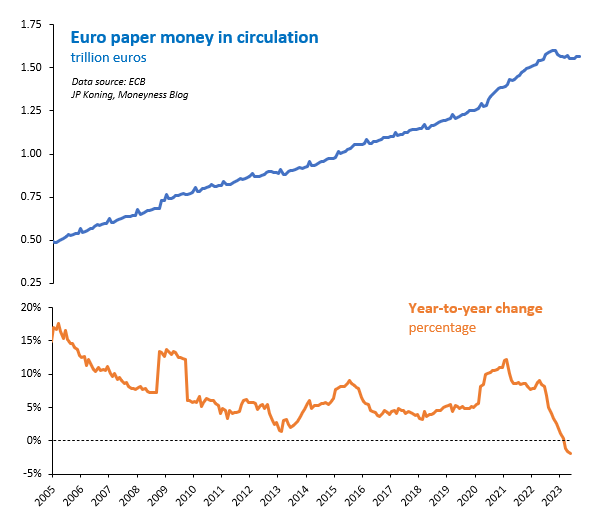
For the first time ever, euro paper money in circulation is shrinking

Why is the paper euro shrinking? Are we at peak cash

To begin with, here is the data, charted: 

As the orange line shows, Europe is experiencing its first year-over-year drop in paper money in circulation. 

While it's tempting to attribute this to paper money's declining role in payments, what I suspect is happening is that as the European Central Bank hikes interest rates, Europeans are redepositing spare cash into the banking system so that they can earn yield. And the net result is less cash in circulation.

Just twelve months ago, the ECB's key interest rate was still in negative territory, sitting at -0.5%. At the time, holding a bit of extra cash under a mattress didn't hurt anyone, since there was no interest to be earned by returning it to one's bank. Then, in four swift moves beginning in mid-2022 (July 27, September 14, November 2, and December 21), the ECB jacked up rates to 2%. As of today its deposit rate is at 3.5%.

Suddenly, owning large chunks of cash under one's mattress had an opportunity cost. Queue a mass reverse bank run, one which involved bringing 0% paper money back to banks, and then to the ECB, in order to convert it into interest-earning assets.

One the best examples of this is from European banks themselves. To satisfy customer withdrawal requests, banks typically keep a reserve of banknotes on hand in their vaults. Historically they've always tried to minimize this stock, since they couldn't earn any interest on notes. But this urge to minimize holdings evaporated with negative interest rates, as the chart below shows. Banks let their vault cash double in size from 2014 to 2020.

When interest rates finally jumped from negative territory back to 0% in late July 2022, the opposite happened. As the chart shows, banks rapidly emptied their vaults and brought their banknotes back to the ECB in order to convert them into central bank deposits, even though those deposits only yielded 0%. Paper money incurs storage costs, so banks will generally prefer a 0% deposit, which doesn't incur storage costs, to a 0% banknote. And now that deposits at the ECB are yielding 3.5%, there's just no contest. Paper money is out, digital money is in.

We can get a broader picture of the rush to redeposit notes by looking at the European Central Bank's banknote flow data, illustrated below. Every month, banks withdraw notes from the ECB (orange line) and return notes to the ECB (blue line), in order to satisfy the public's demand for cash. Banks generally withdraw more notes than they redeposit, the net result being the steadily rising stock of paper currency that we see in the top-most chart. 


On the heels of the ECB's July 27, 2022 rate hike, the ECB experienced its highest rate of note redeposits in almost ten years, coming in at 106 billion in August. Much of that would have been the aforementioned banks returning some 40 billion in vault cash to the ECB. But banks wouldn't have been the only large actors to empty their mattresses.

European retailers probably let themselves get sloppy after 2014, holding a lot of extra cash in their store tills and safety deposit boxes rather than depositing it only to earn a negative return. With rates now positive, these retailers are probably being much more vigilant in sweeping up all spare company cash and redepositing it to the banking system. Other likely culprits include investment companies who, rather rather than holding negative yielding bonds, opted to store as many banknotes as possible, and are now changing their investment strategies.

In sum, the paper euro is shrinking, but it's probably due to higher interest rates, not fewer cash payments. Nor is this peak cash. After an interest rate-induced pause, the upwards rise in paper euros in circulation will probably continue.

Tuesday, June 20, 2023

How is the foreign expansion of Canadian banks going?

With the high profile nixing of TD Bank's purchase of First Horizon Bank last month, I thought I'd take a step back and try to visualize the last few decades of Canadian bank expansion outside of the country.

What I've done is go through the annual reports of the big-5 banks at five-year intervals in order to make a few charts out of each bank's total loan data. More specifically, I measure the big bank's foreign presence by comparing their domestic lending to lending made outside of Canada. For those who don't know, the big-5 are made up of Royal Bank, Toronto Dominion, CIBC, Scotiabank, and Bank of Montreal.

My first chart is the total amount of bank loans issued by the big-5, separated into Canadian loans and non-Canadian loans. (This category that also includes bankers' acceptances.)


Unsurprisingly, both domestic and international lending in 2022 were far higher than in 1995, with international loans rising above $1 trillion in 2022. What pops out is that while lending within Canada has advanced over all periods, there was a decline in big-5 international lending between 2000 to 2005.

In the chart below I've used a logarithmic scale instead of an arithmetic scale in order to better visualize the 2005 blip.


What happened during that period? Canadian banks were damaged by loans they had made in the late 1990s tech craze that soured in 2001 and 2002, particularly in the U.S. As a result of these setbacks, the big banks dialed back their willingness to engage in risk and that's probably why we see a pullback in their foreign lending portfolios.

The next chart shows international lending as a percentage of all big-5 lending. 


This chart further delineates the severity of the 2000-2005 episode. In 2000, international loans constituted more than 25% of the big banks' portfolios of loans. After getting stung in the early 2000s, this proportion plummeted to 18%. It would took twenty years for Canadian banks to rebuild the international side of their loan portfolios back to 25%. By 2022, international loans constituted over 30% of all Canadian bank loans, providing an answer to the title of my blog post: the foreign expansion of Canadian banks is still advancing, and is at its highest peak going back to 1995.

One thing I find interesting is that the big-5 did not contract their foreign loans after the 2008 credit crisis. I suspect this is due to the fact that most Canadian banks that operate internationally tend to focus on loans to foreign businesses and governments, not foreign individuals or consumers, and since much of the fallout in 2008 was on the U.S. residential side of things, Canadian banks escaped mostly unscathed.

In the next chart, I've broken up foreign lending by bank. 


As you can see, TD Bank was the biggest foreign lender in both 2015 and 2022, followed by Scotiabank, which had historically held the crown over the entire 1995-2022 period. Apart from the recent nixing of TD's attempted purchase of First Horizon Bank, TD has executed a very successful push into the U.S. over the last two decades starting with its acquisition of Banknorth in 2005, and now sits as the U.S.'s tenth largest bank.

As for Royal Bank, while it may be Canada's most valuable company by market capitalization, in 2022 it was only a middling foreign lender, hitting the same level of foreign loans as the much smaller Bank of Montreal. The laggard in the group is CIBC. But CIBC was also one of the fastest growers between 2015 and 2022, albeit from a very low base, no doubt helped by its 2016 acquisition of US-based PrivateBank.

As before, here's the same chart as above, but using a logarithmic scale.


A logarithmic scale gives move insight into how leadership in foreign lending has changed since 1995. Of the big five banks, TD was the smallest foreign lender in 1995. Now it leads the pack. As for CIBC, it was one of Canada's leading foreign lenders in 1995, but between 2000-2005 it went cold turkey. Long-time Canadian bank watchers will recall that of all Canadian banks, CIBC was the most aggressive in pushing into the U.S. in the late 1990s, particularly on the investment banking side with CIBC World Markets. But it got caught up in notable failures like Enron and, chastened, retrenched back to the low-risk world of Canadian retail banking.

For my last chart, here is a bank-by-bank breakdown of international lending as a total of all bank lending. 


You can see that Canada's smallest domestic lender, the Bank of Montreal, has spent much of the last thirty or so years as Canada's most international bank, measured in terms of international lending as a proportion of all lending. This is most likely due Bank of Montreal's long and successful presence in the U.S midwest, going back the early 1980s when it bought Harris Bank. Scotiabank has also been a leader in international lending, focusing mostly on Mexico and Latin America.

Royal Bank's lack of focus on international lending can probably be partly blamed on its lacklustre experience with Centura Bank, a franchise it bought back in 2001 and expanded over the next few years with additional acquisitions, renaming it RBC Bank. But Royal's RBC effort never worked out and Royal sold it in 2012.

What to expect in the future? 

Having locked up most of the Canadian banking market, it's all but inevitable that Canada's big banks will continue to push into foreign markets, especially the highly-fragmented U.S. banking market. There will be failures such as the rotten loans made during the late 90s bubble, but as before Canadian banks will learn from these. While TD's acquisition of First Horizon was cancelled, Bank of Montreal's purchase of Bank of the West last year went through, which moves it from 23rd to 13th on the list of biggest U.S banks. 

And there is a giant waiting on the sidelines. Having relaunched its push into the U.S. with its acquisition of City National Bank in 2015, Royal Bank is probably due for another big U.S. takeover.

To conclude, by 2025 Canada's big-5 banks will likely be even more reliant on international loans, with perhaps as much as as 34-35% of all their lending being to non-Canadian sources.

Tuesday, June 13, 2023

The lower limit to silver's usefulness in coinage

A detectorist in Suffolk, England recently found a beautiful halfpenny minted some time between 1625-1649, during the reign of King Charles I. This coin, captured in the video below, illustrates an important feature of coinage: the lower limit to silver's usefulness as a monetary metal.

As you can see, the halfpenny is tiny compared to the fingers holding it, which would have made it difficult to count, handle, and transfer. Storing it away in a pocket or purse would have been a nuissance, since it might have gotten lost in the folds.

The root of the problem is that silver has always had a relatively high value-to-weight ratio, (i.e. it is good at "condensing value," as I once described here) and so attempts to embody lower denomination coins with silver don't function very well, since what is required for low denominations is a material that dissipates rather than condenses. Silver change is just too damn small.

According to the Portable Antiquities Scheme, this particular halfpenny – which is in great shape – weighs 0.27 grams and has a diameter of 10 mm. Compare that to a U.S. dime, already annoyingly small, which weighs 2.3 grams and has a diameter of 18 mm. Doing the calculation for you, a modern dime weighs almost ten times (!) as much as a Charles I halfpenny.

How much was a halfpenny worth in 1625? In short, I'd describe it as the dollar bill of its day.

In England, one penny could buy a penny loaf of bread, the weight of which was regulated by law. In Sheppard and Newton's The Story of Bread (1957), a loaf weighing 4 pounds would have cost 5 pennies in London in 1625. These days, a loaf sold in a grocery aisle usually weighs around 1 pound, so putting things into a modern context, a single 1625 penny was capable of buying one modern-day loaf of bread, and so a halfpenny was worth half a modern-day loaf. Given that a loaf currently retails at Walmart for around US$2 to US$2.50, that means a halfpenny was equivalent to a dollar bill, give or take.

As the dollar bill of its day, a halfpenny would have served a crucial role in England's day-to-day commerce. But being so delicate, it must have done a poor job of it. Even worse would have been the silver farthing, England's smallest coin, worth a quarter-penny, or half a halfpenny. "A still more egregious case [of too small coins] was that of the silver farthings the Royal Mint issued in 1464. Weighing only three troy grains each, these were 'lost almost as fast as they were coined,'" writes George Selgin in Good Money.

How to solve silver's inability to serve as a good medium for lower-denomination coinage? Here's one of the attempts made by the minting authorities:

Halfpenny of King James II, 1687. Source: Yale University Art Gallery

This James II halfpenny is what is called token coinage. Minted out of tin, which had a very low value, a token coin such as this one was worth far more than the amount of tin residing in it. What gave it its value isn't the metal within, but James II's promise to repurchase the coin at its stipulated rate of a half-penny's worth of silver.

Unlike Charles I's feather-light 0.3 gram halfpenny, James II's halfpenny had some heft to it. Weighing in at 10.11 g, which is equal to two modern American quarters, there was no losing track of this beast. The tin halfpenny would certainly have served as a more durable dollar bill of its day than a Charles I silver halfpenny.

Alas, while tokens such as James II's tin halfpennies solve the too-small problem, they introduce a new problem: counterfeiting. Because the amount of metal in a halfpenny was so cheap relative to the face value of the halfpenny, it would have been very profitable for fraudsters to manufacture fakes. Which is indeed what happened. By the middle of the 18th century, close to half of all the farthings and halfpennies, all of which were token coins by then, were counterfeits, according to Selgin (pg 20).

To counter the counterfeiters, James II's 1687 halfpennies have a strange feature on them: a small copper plug. In the image above this plug has fallen out, but this link illustrates what a complete coin would have looked like. By adding a plug to the coin, mint officials were trying to increase the complexity and thus the cost of manufacturing fakes, thus reducing their attractiveness to fraudsters. In concept, we can think of these plugged halfpennies as a clumsy predecessor to Canada's toonie, which has a nickel outer rim and an aluminum-bronze central plug.

Alas, James II's tin halfpennies never worked out. The tin was quick to erode and the copper plug was prone to falling out. If the solution to silver's lower limit was to make token coinage, better to manufacture those tokens out of a tougher substrate like copper. By the 1690s, England's tin halfpenny experiment had ended.