Showing posts with label debt. Show all posts

Sunday, May 28, 2023

The gold trick, the 2023 edition

Along with the trillion dollar platinum coin and premium/perpetual bonds, the gold trick lies in the genre of strange-accounting-tricks-to-evade-the-US-debt-ceiling.

With the debt ceiling getting closer every day, gold bugs like James Rickards are calling for the U.S. to trigger the gold trick with "just one simple phone call."

I've explained the gold trick three times before [ here | here | here ]. I don't really feel like rehashing the intricacies of it again, so reread my posts if you want to absorb all the complexities.

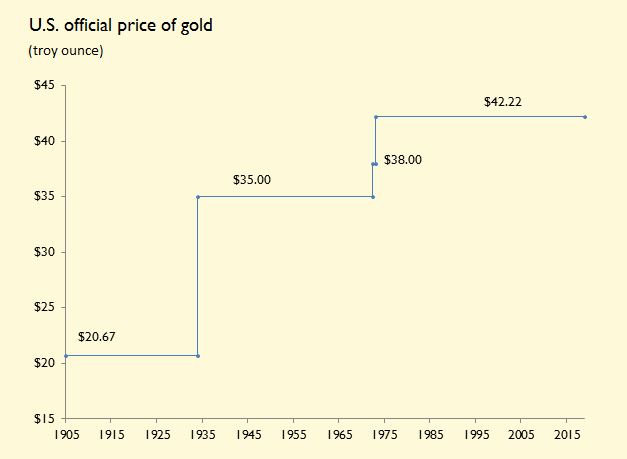
The idea, in brief, is that by increasing the U.S.'s official price of gold, which currently lies at $42.22, to the current market price of $2000 or so, the accounting value of the U.S. Treasury's stock of gold would suddenly be worth hundreds of billions more. The Treasury could then take the newly-realized extra value of its gold (known as "free gold") and submit it as collateral at the Fed, in the form of gold certificates. Once that collateral is submitted, the Fed can in turn instantiate a bunch of fresh dollars that the Treasury can spend.

Since none of these gold-related accounting changes qualifies as an increase in the official debt, voila, the Treasury can spend without running into the debt ceiling.

There's one big caveat. Rickards, for instance, goes off the rails when he writes: "one phone call from the Treasury to the Federal Reserve could reprice the Treasury’s gold from $42.22 per ounce."

It's just not that easy. All previous gold price increases, including the 1934 increase to $35, the 1972 increase to $38, and the 1973 increase to $42.22 required approval from Congress. Given that it is Congress that is the impediment to a straight debt ceiling increase, why would that very same Congress consent to a pseudo-increase via an change in the official gold price?

I suppose there may be enough gold-loving Republicans that the bill would pass. But as you can see, the gold trick is just not as effective as the premium bond/perpetual bond trick or the platinum coin trick, both of which avoid Congressional approval altogether.


The official price of gold illustrated:

Wednesday, February 1, 2023

Why I prefer perpetual/premium bonds to the platinum coin

1877 $50 Thirty-year Registered 4% Consol [link]. (A consol is a perpetual bond.)

If I had to choose one of the tricks for getting around the debt ceiling, I'd go with premium bonds/perpetual bonds over the platinum coin.

I've known about the platinum coin idea for over a decade (Here's an old blog post I wrote on it back in 2013.) But I only recently found out about the premium bond idea courtesy of Ivan the K on Twitter. (Little did I know there's a long intellectual pedigree for this idea on the blogosphere.) Related is the idea of issuing perpetual bonds, or consols, to get around the ceiling (which seems to have first been discussed at the now defunct Monetary Realism blog, by Beowulf, the person who figured out the platinum coin loophole?).

The premium/perpetual bond trick, in short, is to get around the debt ceiling by issuing new bonds either at a premium to face value (premium bonds) or with no face value at all (perpetuals). Both types of bonds get around the debt ceiling because apparently only the face value of a bond counts to the ceiling.

I prefer issuing premium and/or perpetual bonds to the platinum coin because the former options don't encumber the Fed's balance sheet. The latter does. Evading the debt ceiling with any of the proposed tricks is already a dicey proposal. Choosing as your method a trick that also handicaps the Fed only multiplies the drawbacks of the whole thing.

Encumbering the Fed's balance sheet would reduce the Fed's independence, and independence is a good thing. The Fed's job is to set a target for the national monetary unit, the dollar, which along with the mile or the pound is one of the most important components of the U.S.'s system of weights & measures. To do it's job of calibrating the dollar unit, the Fed should be protected from the day-to-day ambitions of politicians, at least more so than other government institutions.

If you recall, the platinum coin requires the President to ask the U.S. Mint to manufacture a $1 trillion coin made of platinum and then deposit it at the Fed. The Fed then instantiates $1 trillion in deposits which the government can proceed to spend.

The platinum coin trick does neuter the debt ceiling. However, in the process the Fed has issued $1 trillion more dollars than it would have otherwise. This extra issuance is in turn secured by an illiquid non-interest earning asset on its balance sheet; the platinum coin. The Fed is hobbled. For a central bank to be independent, it helps to have a consistent stream of revenue to pay for expenses. That's where interest-earning assets are key. Liquid assets are also vital, because they can be sold in a snap to market participants if necessary for monetary policy purposes. Either way, a 0%-yielding trillion dollar platinum coin doesn't make the cut.

Compare this to the alternative of issuing premium bonds or perpetuals directly to the market.

In this scenario, the Fed's balance sheet hasn't changed at all. The Fed hasn't issued an extra trillion dollars into existence. And it still holds the same portfolio of highly-liquid interest-earning assets as before. Yet the debt ceiling has been evaded.

In sum, with premium and/or perpetual bonds, you get all of the debt ceiling evasion punch with none of the decline in central bank independence. It seems to me to be clearly the better of the two options. (Unless you're not a fan of Fed independence. If you aren't, the platinum coin conveniently shoots two birds with one stone: not only does it get around the debt ceiling, but it also short-circuits the independence of the central bank.)

Saturday, May 30, 2020

How the Bank of Canada's balance sheet went from $118 billion to $440 billion in eight weeks

Ever since the coronavirus hit, the Bank of Canada's balance sheet has been exploding. In late February its assets measured just $118 billion. Eight weeks later the Bank of Canada has $440 billion in assets. That's a $320 billion jump!

To put this in context, I've charted out the Bank of Canada's assets going back to when it was founded in 1935. (Note: to make the distant past comparable to the present, the axis uses logarithmic scaling.)


The rate of increase in Bank of Canada assets far exceeds the 2008 credit crisis, the 1970s inflation, or World War II. Some Canadians may be wondering what is going on here. This blog post will offer a quick explanation. I will resist editorializing (you can poke me in the comments section for more colour) and limit myself to the facts.

We can break the $320 billion jump in assets into three components:

1) repos, or repurchase agreements
2) open market purchases of Federal government bonds
3) purchases of Treasury bills at government auctions.

Let's start with repos, or repurchase operations. Luckily, I don't have to go into much detail on this. A few weeks back Brian Romanchuk had a nice summary of the Bank of Canada's repos, which have been responsible for $185 billion of the $320 billion jump.

With a repo, the Bank of Canada temporarily purchases securities from primary dealers, and the dealers get dollars. This repo counts as one of the Bank of Canada's assets. Some time passes and the transaction is unwound. The Bank gets its dollars back while the dealers get their securities returned. The asset disappears from the Bank of Canada's balance sheet.

The idea behind repos is to provide temporary liquidity to banks and other financial institutions while protecting the Bank of Canada's financial health by taking in a suitable amount of collateral. If the repo counterparty fails, at least the Bank of Canada can seize the collateral that was left on deposit. This is the same principle that pawn shops use. The reasons for providing liquidity to banks and other financial institutions is complex, but it goes back to the lender of last resort function of centralized banking. This is a role that central banks and clearinghouses inherited back in the 1800s.

How temporary are repos? And what sort of collateral does the Bank of Canada accept? In normal times, repos are often  unwound the very next day. The Bank also offers "term repos". These typically have a duration of 1 or 3-months. The list of repo collateral during normal times is fairly limited. The Bank of Canada will only accept Federal or provincial debt. That's the safest of the safe.

But in emergencies, the Bank of Canada is allowed to extend the time span of its repos to as long as it wants. It can also expand its list of accepted collateral to include riskier stuff. Which is what it did in March 2020 as it gradually widened the types of securities it would accept to include all of the following:

Source: Bank of Canada

That's a lot of security types! (The list is much larger if you click through the above link to securities eligible for the standing liquidity facility, see here. Nope, equities are not accepted as collateral.)

As for the temporary nature of these repos, many now extend as far as two years into the future. See screenshot below:

Source: Bank of Canada

(Note that the Bank of Canada has a very specific procedure for moving from "regular" purchases to "emergency" purchases. Part of this was implemented due to its initial reaction in 2007 to the emerging credit crisis. It accidentally began to accept some types of repo collateral that were specifically prohibited by the Bank of Canada Act. The legislative changes implemented in 2008 remedied some of the problems highlighted by this episode and codified the process for going to emergency status. Yours truly was involved in this, click through the above link.)

Anyways, we've dealt with the $185 billion in repos. Now let's get into the second component of the big $320 billion jump: open market purchases of long-term government bonds, or what the Bank of Canada refers to as the Government of Canada Bond Purchase Program (GBPP). This accounts for another $50 billion or so in new assets.

Whereas a repo is temporary, an outright purchase is permanent. Some commentators have described the purchases that the GBPP is doing as "quantitative easing". But the Bank of Canada has been reticent to call it that. When it first announced the GBPP, it said that the goal was to "help address strains in the Government of Canada debt market and enhance the effectiveness of all other actions taken so far."

This is a non-standard reason. Large scale asset purchases are normally described by central bankers as an alternative tool for stimulating aggregate demand. Usually central banks use interest rate cuts to get spending going. But when interest rates are near 0% they may switch to large scale asset purchases. (The most famous of these episodes were the Federal Reserve's QE1, QE2, and QE3). But the Bank of Canada seems to be saying that its large scale purchases are meant to fix "strains" in the market for buying and selling government bonds, not to stoke the broader economy. 

Together, the GBPP and repos account for $235 billion of the $320 billion jump.

Let's deal with the last component. Another $65 or so billion in new Bank of Canada assets is comprised of purchases of government Treasury bills (T-bills). A T-bill is a short term government debt instrument, usually no more than one year. This is interesting, because here the Bank of Canada can do something a lot of central banks can't.

Most central banks can only buy up government debt in the secondary market. That is, they can only purchase government bonds or T-bills that other investors have already purchased at government auctions. The Bank of Canada doesn't face this limit. It can buy as much government bonds and T-bills as it wants in the primary market (i.e. at government securities auctions).

Since the coronavirus crisis began, the Federal government under Justin Trudeau has revved up the amount of Treasury bills that it is issuing. As the chart below illustrates, in the last two Treasury bill auctions (which now occur weekly instead of every two weeks) it has raised $35 billion each.


For its part, the Bank of Canada bought up a massive $14 billion at each of these auctions. That's 40% of the total auction. In times past, the Bank of Canada typically only bought up around 15-20% of each auction. This 15-20% allotment was typically enough to replace the T-bills that the Bank already owned and were maturing.

By moving up to a 40% allotment at each Treasury bill auction, the Bank of Canada's rate of purchases far exceeds the rate at which its existing portfolio of T-bills matures. And that's why we're seeing a huge jump in the Bank of Canada's T-bill holdings.

(So who cares whether the Bank of Canada buys government bonds/T-bills directly at government securities auctions instead of in the secondary market, as it is doing with the GBPP?  It's complicated, but part of this controversy has to do with potential threats to the independence of the central bank. But as I said at the outset, I'm resisting editorializing.)

These three components get us to $300 billion. The last $25 billion is due to other programs. I will list them below and perhaps another blogger can take these up, or I will do so in the comments section or in another blog post:

+$5 billion in Canada Mortgage Bonds
+$5 billion in purchases via the Provincial Money Market Purchase Program (PMMP)
+$1 billion in Provincial bonds
+$8 billion in bankers' acceptances via the Bankers' Acceptance Purchase Facility (BAPF)
+$2 billion in commercial paper
+$1 billion in advances

And that, folks, is how the Bank of Canada's assets grew to $440 billion in just two months.

Friday, October 25, 2019

A free market case for CBDC?


Central bank digital currency, or CBDC, is a form of highly-liquid digital debt that most governments have, till now, held back from issuing. But there is a growing push to change this. Free market economists are generally not big fans of CBDC. They see it as government encroachment on the banking sector.

In this post I'm going to push back on the free market consensus.

(This post was inspired after reading posts by Tyler Cowen and Scott Sumner).

Look, we're always going to have a government. Right? And that government is going to have to raise funds somehow in order to keep the lights on. The question is, how? Should it issue 30-day Treasury bills? Fifty-year bonds? Perpetual debt? Paper currency? Why not issue currency-ish debt instruments in digital form?

Let's start with a parable. Imagine a world in which the government has only ever issued 30-year bonds. But next month it wants to shift some of its borrowing from the 30-year bond range to the 10-year range. Government officials believe that this will reduce the government's interest costs and diversify government sources of funding.

Seems like a good idea, no?

But wait. The grocery industry has historically relied on funding itself with 10-year bonds. Till now, it hasn't had to compete with the government for the attention ten-year bond investors. Grocery store owners are furious over the impending decision. We could have difficulties funding ourselves! they fret. We might have to cut back on selling food!

Meanwhile, the restaurant industry in our imaginary world prefers to fund itself by issuing 30-year bonds. If the government raises more money in the 10-year end of the debt market and less in the 30-year end of the spectrum, restaurants will face less competition for investor attention. Go for it! say restaurant owners.

Which sector should the government choose to favor, grocery stores or restaurants? The choice seems entirely arbitrary. Government shouldn't be picking winners or losers, right? Civil servants should choose the most cost-effective form of financing.

The same argument goes for CBDC.

Bonds, bills, and CBDC are all just forms of transferable government debt.* But instead of having a fixed maturity like a bond, CBDC never matures. And whereas the interest rate on a bond is fixed and its price floats, the interest rate on CBDC is periodically adjusted while its price is fixed to $1. Either way, the government can use these instruments for funding projects and investments.

(For the rest of this post I'll use the terms CBDC and fixed-value floating-rate perpetual debt interchangeably.)

For whatever reason, modern governments choose not to fund themselves in the fixed-value floating-rate corner of the debt market.** No industry benefits more from this than banks. Individuals and businesses who want to buy fixed-value floating-rate perpetual debt have only one option available to them: bank-issued deposits. Regulations prevent all other industries from participating in this end of the debt market. So these non-banks have to turn to the 3-month to 30-year segment of the debt market where they must face the full brunt of government competition.

The presence of government competition means that non-banks' funding costs will be more onerous than otherwise. Conversely, banks' funding costs will be less onerous given a lack of government competition.

I don't see any compelling reason for why the government should avoid one end of the debt market and, in the process, favor the banking industry over other industries. I mean, if the government can cost-effectively issue CBDC in a way that reduces its overall interest obligations, then that's a win for taxpayers, no? It shouldn't go with an option that hurts taxpayers because it wants to help out a certain sector, should it?

The argument could be made that the banking industry is far more important than other industries because it does a lot of lending, and if lending slows then everyone loses. 

If the banking sector really deserves to be subsidized, why doesn't the government just pay the subsidy in a more transparent way, say by taking money directly from the pockets of individuals and non-banks and giving it to banks? 

Also, banks aren't the economy's only lenders. There are many non-bank lenders too. Sure, if a government were to issue CBDC, banks would now face more competition in the fixed-price floating-rate corner of the debt market, and perhaps would choose to lend less. But at the same time the government would be issuing less 30-year bonds, or 10-year bonds, or treasury bills. Non-bank lenders that issue debt in these ends of the debt market would face less competition than before, and might lend more.

In the end, it's a wash. One industry's loss is another's gain.

So let governments issue CBDC and compete for the attention of the fixed-price floating-rate investor, just like they already compete for the attention of the 30-year bond investor. This would remove an inefficient distortion, namely a subsidy to banks and a penalty on non-banks. This seems to be the free market position, no?


*It could be argued that one type of debt is a currency, and can be transferred from you to me, while the other isn't. But I don't buy that. Both types of debt are liquid. They can be bought and sold on exchanges. Or they can be transferred bilaterally. With bonds, a bilateral transfer can be conducted by conveying an old style physical bearer bonds, or by transferring a bond to a recipient using Treasury Direct.

**The government does issue banknotes, which are sort of like perpetual floating-rate debt, where the decision has been made to keep the rate at 0%. And it does issue reserves to the banking sector. But the quantity of banknotes and reserves is quite small relative to overall government borrowing.

Tuesday, February 12, 2013

Settlers of Catan... the monetary version


I've been playing the game of Settlers of Catan for ages. Over time I've gotten less cutthroat and more philosophical about the game. What I've come to realize is that Settlers is a great tool for both thinking about monetary phenomena and building different sorts of monetary economies. In this post I'll assume a basic knowledge of Settlers—if you haven't played the game by now, you're living on the moon.

1. Catan isn't a barter economy

The first thing worth noting is that Catan is not a barter economy—it's a monetary economy. This might seem like an odd thing to say. After all, the trades that we see in a typical Settlers game are all commodity-for-commodity trades.

To see why it's a monetary economy, imagine the case of autarky, or a Catan in which trade is prohibited. Here, players can only build structures using cards earned from tiles on which they have a settlement. The value of a lumber card in an autarkical economy is derived solely from its use-value, or its ability to help build settlements and roads.

The moment autarky is lifted and players are allowed to trade resources amongst each other, resource cards provide their owners with a whole new range of services. Not only is a lumber card valuable for the settlements and roads it yields, but also for its ability to purchase things from others. It has become a medium-of-exchange. Given the unpredictability of dice rolls, owning a stock of readily-tradeable exchange media provides players with wiggle room, or monetary optionality. Because an option is valuable, resources that provide optionality earn liquidity premia. The more liquid the resource card, the broader the option it provides and the larger its premium.

Monetary phenomena like monetary optionality begin to emerge the moment we exit from autarky—we don't have to wait till some hypothetical item called "money" appears on the scene in Catan, nor for so-called barter to disappear. All media-of-exchange, whether they exist in our simple Catan economy or the real economy, have money-like properties. In fact, I'll show later that there is no such thing as "money" in our modern economy, only a universe of media-of-exchange that differ along a spectrum of liquidity.

2. Patterns of resource monetization in a Catan economy

The Catan universe is a well-balanced monetary economy. By well-balanced, I mean that we tend to observe an even distribution of trade. Put differently, since Catan's five resources are all equally marketable, none of them earns a superior liquidity premia.

There are ways to tilt the rules of Settlers so that trade patterns get more skewed. One way to do this is to penalize trade in certain goods. For instance, say we institute a rule that continues to allow for full trade in sheep, brick, ore, and wheat but only permits lumber to be traded when a six has been rolled (limited autarky in lumber markets). This inhibits lumber cards from serving as full media of exchange. As a result, lumber loses some of its optionality and will trade at a discount to its prior price. The distribution of trade will now be skewed away from lumber towards the other four resources. If we penalize all resources but one, we would skew the pattern of trade dramatically in this resource's favor.

Another way to affect the distribution of trade is to endow certain resources with unique properties. Let's say that ore is more storeable than the other commodities. The rule in Settlers is that when a 7 is rolled, any player with eight or more cards must lose half their hand. If ore cards don't count to the total when a 7 is rolled (they are storable, after all) then players will be able to hold larger hands as long as they cushion their hand with ore. Players will begin to trade for ore not because they wish to build a city with it, but to protect their hands from 7s. This could increase the incidence of ore cards in trade relative to other cards. The more liquid ore cards become, the more will their monetary optionality increase, as will their liquidity premium.

There are all sorts of ways to tilt the distribution of monetary trade. Be creative.

3. Let's try Settlers chartalism

The idea behind chartalism is that some external monopolizer, say a gang or a king, sets an obligation upon citizens that can only be discharged with a certain type of settlement media. This media doesn't have to be a commodity. It might be an intrinsically useless token.

Let's imagine that the robber in Settlers requires a bribe from all players whenever a 7 is rolled. If a player doesn't pay the bribe, then they must sacrifice two cards. Say that the bribe must be paid in the form of an intrinsically useless $100 Monopoly bill. Players can only purchase the Monopoly bills from the robber on their turn for one resource card. Presumably players will purchase $100 bills since the 1 card cost exceeds the potential loss of 2 cards.


A player who has already bought enough Monopoly money to satisfy the robber should a 7 come up may wish to sell excess bills to players desperate for protection. Monopoly paper bills thereby join the five existing resources as a media of exchange in Catan. We might be able to tilt the distribution of trade in favour of the chartal medium if we encourage its marketability through rule changes discussed in section two.

4. Credit-based settlers

The existing rules of Settlers prohibit credit transactions. Relaxing these rules allows us to introduce a whole new range of resources that can be used in trade—each player's future earnings power.

There are infinite ways to structure credit transactions in Catan. Informal verbal promises are one way. I tell my trading partner that I'll buy a lumber from them now for an IOU of two sheep in the future. Due to their informality, these promises are unlikely to become liquid.

To really tilt the distribution of trade towards credit, we probably want to create standardized paper credit contracts. Standardization allows for quick appraisal, and this lowers transaction costs. Transcribing the promise onto paper will encourage its negotiability, or exchangeability from player to player. The more we streamline the process, the more likely that credit will become Catan's most liquid traded resource. The simplest IOU I can think of is a one-time paper promise to pay out all production from a 6 or 8 tile. The issuer can easily satisfy this obligation since they don't have to trade away for the media to settle it—they produce the media themselves.

When we allow for credit, players are acting simultaneously as bankers. The player that succeeds in getting his or her credit to circulate from player to player has effectively increased their purchasing power relative to everyone else and will be able to advance through the game much quicker. Players that push too close to the sun will find themselves unable to meet their outstanding promises and will default. They'll lose the trust of fellow players and will find it difficult to issue credit again, their advancement in the game slowing.

5. The social contrivance of a fiat Catan dollar

Paul Samuelson famously described how the contrivance of fiat money would allow members of an economy to efficiently solve the problem of passing on savings over time. Through a "grand consensus," worthless "oblongs of paper" would be accepted into circulation. This sort of paper is different from chartal Monopoly paper since the latter discharges a particular obligation. Samuelson's oblongs are merely bits of paper. They have no non-monetary use whatsoever.

Could we get players to accept mere paper? Our first guinea pig will only do so if they know for sure that the next player will accept it. Absent a significant amount of negotiation and coordination ahead of time, its difficult to imagine why the first player will ever trust the future negotiability of paper. Far safer for him or her to just refuse any fiat paper trades. Might players spontaneously negotiate a set of rules to encourage the circulation of Samuelsonian paper? Perhaps, but if the game already allows people several trading technologies—trade in resources, trade in chartal Monopoly money, and trade in credit—will players want to devote resources negotiating an expensive institution like fiat paper? I doubt it.

6. Catan Money?

Can the rules of Settlers be manipulated so that Catan approximates our modern world in which there seems to be one universal medium-of-exchange called money? Could we get ore to appear in all of Catan's trades, or Monopoly money, or the circulating credit of one trustworthy player?

As I pointed out earlier, we don't have to. In the real world, there's no such thing as a universal medium of exchange. Rather, we have an almost an infinite range of media that vary in terms of liquidity. The "dollar", for instance, refers to a number of different exchange media: paper dollars printed by the Fed, electronic dollars created by the Fed, private savings account dollars, chequing account dollars, eurodollars, traveller's cheques, credit card dollars, and more. Private chequing account dollars can be broken down into Bank of America dollars, Wells Fargo dollars, Citi dollars etc. The fact that these various media are denominated in the same unit should not confuse us into consolidating them into one universal medium-of-exchange. A US paper dollar, for instance, is a far more liquid instrument than a hamburger patty, but it still only appears in a small percentage of total US trades. As long as we can manipulate a game of Settlers to show a skewed distribution of trades, then we've sufficiently approximated the real world.

7. Catan economics vs. modern economics

Setting up a stylized Catan environment in order to explore monetary phenomena is akin to the approach taken by modern monetary economists. Economists realized long ago that exchange media simply had no role to play in a stylized Walrasian environment. In a world with an omniscient auctioneer who calculates the prices and quantities of all trades, and in which all trades are cleared at a central clearing house, there's no room for monetary phenomena like media of exchange or liquidity premia to arise.

To get "money" into an economy, modern economists start by introducing various refinements into a Walrasian environment. Rather than have individuals meet at a centralized market, Kiyotaki and Wright (1993) have traders meeting randomly and pairwise. Wright, Trejos, and Shi (1995) replace the auctioneer with traders who are capable of negotiating prices bilaterally. Our simple Settlers environment easily captures decentralized search and bargaining.

Some environments created by modern monetary economists are downright odd. The modern work-horse Lagos/Wright model sets up an environment with day and night markets. Day markets are bilateral and anonymous while night markets are centralized. Dror Goldberg imagines different cities which specialize in a certain good. Traders must trek between cities to secure a consumption good. Settlers, of course, will appear odd to anyone seeing it for the first time. Manipulating the rules of Settlers to see how we can generate monetary patterns is very much like letting rational agents loose in an Lagos/Wright sci-fi environment. The advantage of the former is that it's fun and real people are testing out the model, not imaginary agents.

Try experimenting with some of these rule changes the next time you play Settlers and tell me what happens. Even if you don't get around to it, hopefully I've convinced you that Settlers provides a great model for thinking about monetary economic phenomena.

Tuesday, January 15, 2013

How do legal tender laws affect purchasing power?


We discussed the definition of legal tender last week. Legal tender, in short, is any medium that can always be relied on to discharge a debt. Here's the next question—how does the conferral of legal tender status on an item affect that item's value? Here are my rough thoughts.

As I did in an older post on chartal coupon money, I'm going to make use of McDonald's Corporation to illustrate monetary phenomena. Let's say McDonald's wants to create its own form of legal tender: frozen meat patties. It does so by setting the 4 inch wide, 1/4 inch thick frozen beef patty as legal tender for all its receivables. This means that anyone indebted to McDonald's has to settle their debt with legal tender patties. If they owe $1000, they have to pay with $1000 worth of beef.

Next, McDonald's requires its suppliers, many of whom are entirely dependent on McDonald's for survival, to abide by its legal tender rules. Rather than give up their relationship with McDonald's, they accept. As a result, not only can debts due to McDonald's be settled in patties—so can debts due to a number of ranchers, bakeries, farmers, wholesalers, etc who are part of the McDonald's supply chain.

These developments will immediately increase the market price of 1/4 inch frozen beef patties. Why? Given the patty's new capacity to discharge all debts due to both McDonald's and its suppliers, it will be regarded as more liquid than if it didn't have this status. Instead of storing just one box of hamburger patties for future consumption or sale, a household or restaurant might keep a second in reserve for potential debt repayments. Since it provides an extra range of liquidity services, a 1/4 inch frozen patty will thereby gain a premium over its pre-legal tender market value.

Let's say that instead of beef patties, McDonald's declares that a new intrinsically worthless issue of yellow McDonald's certificates is to be made legal tender for $100 worth of debt. Anyone can buy the certificates at McDonald's, either with cash or in kind (say by selling supplies) and use them to pay off their debts to McDonald's or its suppliers. As debts are paid off, suppliers who accumulate unneeded certificates can offload them in the secondary market where debtors who need to settle debts can buy them.

Because McDonald's and its suppliers will always accept 1 certificate to settle each $100 worth of debt, arbitrage dictates that certificates will trade near parity. After all, if the market price of certificates falls to $90, all one need do go into debt to either McDonald's or one of its suppliers to the tune of $100, purchase a $90 certificate with the proceeds, use the certificate to repay the $100 debt, and enjoy the remaining risk-free earnings of $10. Of course, if McDonald's and its suppliers limit the market's ability to borrow from them, then this limitation might reduce the effectiveness of arbitrage and cause certificates to trade at a discount.

On the other hand, if the market price of certificates rises to $110, all one need do is buy certificates from McDonald's for $100 and sell them for $110 until the gap has been closed.

In any case, what is interesting here is that legal tender laws can add a liquidity premium to an already valuable commodity, or bestow market value on worthless bits of paper. That's not to say these certificates are pure fiat. After all, what makes them valuable is that they represent a liability of sorts, acceptance of which is backed up by power. Pure fiat objects, on the other hand, are items that circulate despite being no the liability of no one and having no intrinsic usefulness whatsoever.

As long as there are unredeemed certificates, or float, McDonald's earns seigniorage profits. After all, if $1000 worth of certificates are in circulation, the company pays no interest these certificates but can invest the proceeds in interest yielding bonds. The wider the circulation of McDonald's certificates, the larger the float and juicier the profits. Other large companies will of course be interested in enjoying seigniorage, and one can imagine them also trying to exert market power over their supply chains with legal tender rules. Their ability to do so will always be counterbalanced by competition, for if seigniorage gets too onerous, McDonalds' suppliers might flee to competitor Burger King, which may have less onerous seigniorage or no legal tender rules at all.

Extreme abuse of seigniorage would eventually result in certificates being worthless. Say McDonald's gets greedy and starts to sell certificates for $110. Anyone indebted to McDonald's or one of its suppliers is thus forced into the perverse position of having to acquire a certificate for $110 in order to settle a $100 debt, giving the debtor an immediate $10 loss. As a result, no one will choose to ever indebt themselves to either McDonald's or its suppliers. Soon, all debt in the McDonald's supply chain will have expired. Certificates will be worthless since their only source of value was their ability to discharge debts—and there is no more debt to discharge.

So is modern central bank money akin to meat patties or to yellow certificates? If the former, then a $100 bill is already valuable without legal tender laws, earning only a small premium when rules confer on it legal tender status. Removing legal tender status would do little to affect its purchasing power. If the latter, then central bank money would be entirely worthless without legal tender laws.

Friday, January 11, 2013

Legal tender 101


The trillion dollar coin debate has inspired a lot of chatter about legal tender, not all of it correct. The best source on the meaning of legal tender is Dror Goldberg (the same Dror Goldberg from my Yap Stone post). His paper, Legal Tender is short and concise. Give it a read. This post is largely based off his work.

First off. If someone offers to pay you in legal tender, say a US platinum coin, are you obligated to accept it? The answer is no.

When a medium-of-exchange is denoted as legal tender, that means that it must be accepted in the discharge of certain types of debt. If you are engaged in an exchange with someone that doesn't involve the settling of debts, then legal tender laws don't apply. For example, say you walk into a corner store and offer to pay for cigarettes using legal tender platinum coins. The store owner can legally refuse to accept the coins. After all, the two of you are not settling debts—you're engaging in a spot transaction. The owner is on the right side of the law in requiring payment in, say, peanuts. Either pay him in peanuts or walk out of the store without your smokes.

According to Goldberg, legal tender laws start with non-spot transaction—those transactions in which goods & services are provided prior to final settlement, thereby creating a debt. Legal tender laws require that a creditor accept legal tender as settlement for most types of debt contracts (not all, see next paragraph). What qualifies as legal tender? In the US this includes all United States coins and currency, as well as Federal Reserve notes. In Canada, coins produced by the Royal Mint and notes issued by the Bank of Canada are legal tender (see the Currency Act). Private bank deposits are not legal tender in the US or Canada, nor are traveler's cheques or credit cards. Creditors needn't accept cheques or credit cards.

Creditors can structure contracts to avoid the obligation of accepting legal tender. All it takes is that both parties to a debt contract agree ahead of time that some alternative medium will be used to settle the debt. Say a debtor and creditor have agreed to settle three months from now in bitcoin. If after three months have passed the debtor offers to settle with a legal tender platinum coin, the creditor can refuse to accept the coin since the contract specifies BTC. Private agreement trumps legal tender laws.

Even if no alternative media has been chosen to discharge a debt, in certain situations a creditor can still refuse legal tender. In Canada, for instance, the Currency Act specifies that while $2 coins (toonies) are legal tender, they need not be accepted in the settlement of debts over $40. If a debt is larger than $25, the creditor can refuse twenty-five $1 coins (loonies). In India, a half rupee coin is only legal tender for debts less than ten rupees, which means that a creditor can refuse to accept more than twenty half-rupee coins. (See this RBI page.)

Over the years, governments have set some odd commodities to serve as legal tender. In his book Legal Tender (1903) Samuel Breckenridge notes that in 1631, the governor of Massachusetts declared that corn was to pass in payment for all debts at the market rate, unless money or beaver had been stipulated in the contract. Breckenridge goes on to write:
A little later bullets were ordered to be taken, being rated as equal each to a farthing, though no man was to be forced to take more than 12d in any one payment in this form. In 1643, likewise in Massachusetts, wampum [shell money] was given the debt-paying quality within the value of 40s at the rate of four pieces of black or eight pieces of white to a penny. Similar legislation was enacted in Connecticut and Rhode Island. In Virgina and Maryland tobacco was the commodity most universally desired, and so, in 1633, Virginia enacted that, while contracts, judgements, etc., should be reckoned in English money, they should be paid in tobacco. And a century later Maryland made tobacco a legal tender at a penny a pound, and corn at twenty cents a bushel. In North Carolina corn, pitch, tar, pork were also used at specified rates. Thus, in 1715 any one of seventeen commodities named might be used as a legal tender or in payment of taxes. (Pg 53).
Here I'm obligated to present the alternative view to Goldberg, of which Breckenridge himself provides a decent example. In his book, Breckenridge adopts the common view that legal tender laws applies to all transactions, whether these be time (credit) or cash (spot) transactions. Writes Breckenridge:
in general, it may be said that both gold and silver coins were a lawful tender; that in cash transactions the buyer, in time transactions the debtor, had the right to select the form of money to be employed. In the case of cash transactions it was found necessary to supplement this law by penal legislation and by legislation regulating prices. But in the case of time transactions, the civil power of the courts was an adequate sanction.
Who is right? Here's a quote from the Richmond Fed that settles the matter, at least in its modern US context:
However, no federal law mandates that a person or an organization must accept currency or coins as payment for goods or services not yet provided. For example, a bus line may prohibit payment of fares in pennies or dollar bills. Some movie theaters, convenience stores and gas stations as a matter of policy may refuse to accept currency of a large denomination, such as notes above $20, and as long as notice is posted and a transaction giving rise to a debt has not already been completed, these organizations have not violated the legal tender law.
It would seem that Goldberg is correct. In spot transactions—those in which a debt hasn't been created—legal tender laws don't apply. No one needs to accept your trillion dollar coin or Federal Reserve note. At least not over the counter.

Friday, October 19, 2012

Making connections: Irving Fisher and the Great Depression


Garett Jones did a podcast on Irving Fisher at Econtalk last week. He talked about the Great Depression and Fisher's debt deflation theory. Jonathan Catalan and Daniel Kuehn also discuss the podcast.

Jones focuses on Fisher's 1933 paper The Debt Deflation Theory of Great Depressions.

Two interesting quotes from Fisher's paper popped out at me:
Those who imagine that Roosevelt's avowed reflation is not the cause of our recovery but that we had "reached the bottom anyway" are very much mistaken. At any rate, they have given no evidence, so far as I have seen, that we had reached the bottom. And if they are right, my analysis must be woefully wrong. According to all the evidence, under that analysis, debt and deflation, which had wrought havoc up to March 4, 1933, were then stronger than ever and, if let alone, would have wreaked greater wreckage than ever, after March 4. Had no "artificial respiration" been applied, we would soon have seen general bankruptcies of the mortgage guarantee companies, savings banks, life insurance companies, railways, municipalities, and states.
It's worth overlaying Fisher's words with the charts of the Great Depression I posted here.

The next quote:
If reflation can now so easily and quickly reverse the deadly down-swing of deflation after nearly four years, when it was gathering increased momentum, it would have been still easier, and at any time, to have stopped it earlier. In fact, under President Hoover, recovery was apparently well started by the Federal Reserve open-market purchases, which revived prices and business from May to September 1932. The efforts were not kept up and recovery was stopped by various circumstances, including the political "campaign of fear."
It would have been still easier to have prevented the depression almost altogether. In fact, in my opinion, this would have been done had Governor Strong of the Federal Reserve Bank of New York lived, or had his policies been embraced by other banks and the Federal Reserve Board and pursued consistently after his death.
The May to September 1932 open market purchases was the first real quantitative easing, or QE-zero. You can read about their ineffectiveness in this post. Fisher says the recovery was well-started from May to September, but the data doesn't show that.

Saturday, January 14, 2012

Debt, generations, savings, and economic categorization or the "Borges Problem"


I didn't comment much on the great debt debate, stirred up a Krugman post called Debt Is (Mostly) Money We Owe to Ourselves, but followed it quite closely.

Nick Rowe taught me (here, here, here, and here), and Bob Murphy clarified (here, here, here, here, here, here, here, and here), that present generations can indeed take resources from future generations via debt issuance.

I also learnt via Daniel Kuehn here and here that if you use a very unintuitive definition of "generations", than this is not the case. Basically, you can swap the meanings of terms to argue your way out of a tight spot.

My comment is from a Murphy post:
I’ve learnt that the method by which one aggregates individuals into groups, and the labels that one attaches to such groups, can have an important influence on a debate’s ability to reach resolution. If people are aggregating differently, and using non-standard words for their categories, then the debate will degenerate into shouting matches.
In a comment on a post called Why "saving" should be abolished, Nick describes this as the Borges Problem, which I rather like. Says Nick,
Let me first do one general response:
 There are lots of different ways we can divide up the world into categories see Borges on "animals" http://en.wikipedia.org/wiki/Celestial_Emporium_of_Benevolent_Knowledge%27s_Taxonomy
 Which would be the most useful way to divide up income, and define saving?
 Which of these 3 definitions of desired saving is the most useful?
Nick later on:
Notice also that the recent debate about the burden of the debt was also an example of the "Borges Problem". Do we divide the future up into time periods or into cohorts? We get very different results depending on how we categorise the world. And sometimes the categories we use are chosen by someone long ago who had a totally different purpose and/or a totally different theory to ours. Our way of seeing the world gets distorted by the dead hand of historical ways of seeing.
Yes! I did notice that. It caused me a lot of confusion. Nick also notes that the solution is to choose the most useful categorization out of all possible options, and proceeds to advocate a different category to which we should attach the word "savings". Interesting stuff. I'm not sure how Nick proposes we solve for "usefulness" though. Isn't the fact that almost everyone uses the same term for a given categorization a good enough claim for usefulness?

Here's another Rowe comment on Kuehn's blog which is relevant:
Put it another way: there's more than one way to aggregate. We shouldn't let our theories of what is happening in the world be determined by the choices made by long-dead National Income Accountants.
Anyways, in my comment on Nick's savings post, I proposed a more useful (at least to me) Borgian response to the categorization problem. Instead of categorizing the world on the basis of flows, categorize it as a series of balance sheets, or stocks. The result is that consumption, investment, and savings are all attached to entirely different bins (and more intuitive ones, to me at least) than in a world composed in terms of flows:
Nick, I agree with you that the conversation on debt was mainly about categorizations and the lack of standardized terms associated with categorizations. That made it very frustrating to follow.
So I am all in favor of standardizing terms, as you advocate in this post. 
I noticed you originally introduced C and I as flows and A and M as stocks. Then when you brought in the individual's economy, you introduced not a stock of antique furniture, but a flow of antiques, and not a stock of money, but a flow of money. Presumably you did this to preserve stock flow consistency.
The idea of a flow of antiques or money is very unintuitive to me. Why not go the other way? Not flows of consumption and investment, but stocks? Thus you have and individual's goods C, I, A, and M, which are all stocks. Sum them all up and you have S (the noun form of S, not the verb). This S can rise or fall. As a solution to the Borgian categorization problem, this configuration makes more intuitive sense to me.
And later:
N: "but if we think of income as a flow, then thinking of C and I as stocks is going to create problems."
 Me: You start out with the C and I that you have produced in your stock of assets, hold this C and I until you find someone who'll exchange for them with the M they have in their stock of assets. Now they are holding C and I and you are holding M. So here income isn't a flow, it's just a trade, an instantaneous swap of assets held in a portfolio.
 How much of economics is taken up by definitional debates and confusion? You'd think there would be a universal set of definitions for economic terms somewhere so these issues don't pop up. When I read William Hutt's books I'm always pleased because he uses his first chapter to explicitly define every term he'll be using.
and once more *phew*:
N: "Will those trades all take place in an instant, with some buying and some selling a stock of antiques? Or will those trades happen slowly over time, as people buy or sell a flow of antiques, and slowly get back to their long run desired stocks? That depends. If antiques are a small part of your wealth, and the market is frictionless with all antiques identical and so zero search costs (obviously not, for antiques). Each person would instantly buy or sell a stock of antiques to get back to his personal desired stock. Otherwise, there will be a flow of trades. If antiques are a large fraction of your wealth, you may only buy and sell slowly, in a flow."
 me: Ok, thinking in a world with stocks, (an infinite series of balance sheets), trades still happen in an instant, even if you introduce search costs. You hold the antique on your balance sheet until you don't. The antique is in your hand up until the moment it enters the hand of the buyer.
 Introducing frictions means that someone can have the intention of selling that antique and will need to incur costs to search out someone to trade. But it doesn't mean the process must be a conceptualized as a flow. Rather, the intention of selling an antique just moves the antique to a different part of an individual's balance sheet. It continues to lie in the asset column of their balance sheet, but is moved from long-term assets to current or liquid assets. Introducing search costs means that instead of an interval of two balance sheets before a swap occurring, the interval is some number larger than two.
My rough final thoughts are that thinking in terms of stocks, not flows, introduces a number of important categories that flow-based economics ignores because it is focused on flows. The most important of these is a stock of non-durable consumption goods. In flow-based economics, it's always been odd to me that factories produce, and we instantaneously use up, consumption goods.

A stock based world also is terribly confusing way to go about things, because the word savings in a flow-based world is attached to a different category than that which it is attached to in a stock based world, much like how in the Great Debt debate the word "our children" can be attached to either a period of time or a cohort.