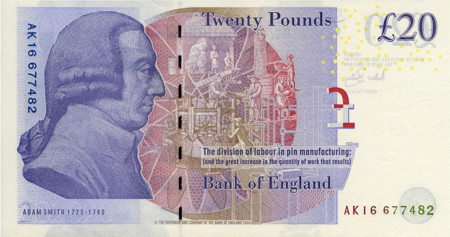
Showing posts with label Adam Smith. Show all posts

Thursday, December 31, 2020

The unbanked, the post office, and fintech in the 1880s

"A large population of people are excluded from the financial system because they don't have bank accounts. Fintechs compete to connect them and parallel plans emanate from the government to reach the unbanked, including postal banking."

What year am I describing in the above paragraph? 

It could be 2021. But it also describes 1870s. 

It's 2021 and the U.S. still has a large population of unbanked, those who have so little money that banks would rather not serve them. An astonishing 5.4% of Americansthat's 7.1 million householdsdo not have bank accounts.

Financial technology companies (aka fintechs) like PayPal and Facebook's Libra have well-meaning plans to connect the American unbanked population. Government-run proposals abound too. Postal banking is probably the most popular option, but more exotic solutions like central bank digital currency (CBDC) have also been floated. But many economists are wary that these government efforts will cripple the private sector.

None of this is new. Concerns over the unbanked, fintech, and a government participation in the payment system were all present back in England in the 1880s. Since I enjoy when the past resurfaces in the present, I'll tell the story.

------

Britain in the 1870s had a very sophisticated chequing system. Because banks were the only way for people to access cheques, and banks preferred to limit accounts to rich people and wealthy merchants, the poor and middle class were often left out. 

Luckily, the 1870s version of fintech came to the rescue. The PayPal of the day was something called the Cheque Bank. Established in 1873, the Cheque Banklike PayPal todaywas a bank-on-top-of-a- bank. What do I mean by this?

PayPal is a customer of Wells Fargo, a large commercial bank. Wells Fargo provides PayPal with banking and payments services. PayPal in turn passes these services on to PayPal account holders, folks who might not otherwise qualify as customers of Wells Fargo or, if they could, prefer the way PayPal rebundles underlying Wells Fargo services.

Stock certificate for the Cheque Bank, Limited


The Cheque Bank operated on the same principles. It opened accounts at bank branches all across United Kingdom and overseas. Like PayPal, it passed through underlying banking services to its unbanked customers. The Cheque Bank's main product was cheques, which today might seem quaint. But back then they were cutting edge.

Anyone could buy a book of Cheque Bank cheques at a stationer or cigar store, the Cheque Bank redepositing the cash it received with its bankers. The customer could then spend those cheques at stores, send them to family via the mail, or hold them as a form of saving in lieu of cash (which was always at risk of being stolen). People who accepted a Cheque Bank cheque as payment could promptly take the document to any bank and cash it.

Much like PayPal does today, the Cheque Bank held 100% reserves. That is, for every $1 in cheques it issued, it kept $1 locked up with its bankers. And so its cheques were considered to be as safe as cash. Put differently, regular banks engage in both lending and payments. But fintechs like PayPal and the Cheque Bank don't lend at all. They deposit all of their assets at an underlying bank and focus on offering the payments side of the banking business to their customers.

The Cheque Bank attracted the attention of William Stanley Jevons, one of the most important economists of the day and still very much a household name among economists today. Jevons was one of three economists (along with Carl Menger and Leon Walras) to discover the principle of marginal utility, a key economic principal which had eluded even Adam Smith. 

In his 1875 book Money and the Mechanism of Exchange, Jevons devotes a full chapter to the Cheque Bank, describing it as a "very ingenious attempt" to "extend the area of banking to the masses." Here is what one of the Cheque Bank's cheques looks like:

1899 cheque issued by the Cheque Bank [source]

The cheques could only be filled to an amount printed on the document, writes Jevons. So the above cheque, which had been purchased for £5, could be written out for anything up to £5, although in this particular case the cheque writer (H.L. Stevens) chose the sum of 3 pounds 3 shillings. 

Jevons isn't the only notable economist to write about the Cheque Bank. It also pops up over a hundred years later in economist Edward S. Prescott's work, who describes it as a "highly interesting experiment in extending the use of checks to the lower and middle classes." Prescott suggests that the ability to write a specific amount on the face of one of these cheques would have greatly facilitated payments through the postal service since there was no need for change. Unlike a regular cheque, which also offered this flexibility, the recipient of one of the Cheque Bank's cheques needn't worry about it bouncing.

Jevons was excited by the Cheque Bank. But he was not a fan of a subsequent competing payments innovation, the postal order.

The British Post Office, owned by the government, had long been engaged in the business of transmitting money orders, unofficially since 1792 and officially since 1838. A customer would walk into any money order office, put down, say, £2 and 2 shillings, and get a £2 2s money order. The recipient's name was then written on the order. It could then be sent via post to a distant office, upon which the recipient could take the money order to the counter to be cashed. The officer would first confirm the payment by referring to a separate letter of advice. This letter, sent from post office to post office, served an an extra layer of security against fraud. Only then would the £2 and 2 shillings be paid out.

The problem, according to then Postmaster General Henry Fawcett, is that the money order wasn't very useful to people who only wanted to send small amounts. "If a boy wanted to send his mother the first shilling he had saved, he would have to pay twopence for the order and a penny for postage," wrote Fawcett. In other words, to send a 12 penny (i.e. one shilling) money order, three penniesa massive 25%had to be sacrificed in fees. (A shilling in 1880 was worth around US$8 today.) And so it would have been an expensive payments option for the poor.

Prior to his appointment as Postmaster General in 1880, Fawcett had been both parliamentarian and the first professor of political economy at Cambridge. And while he wasn't as illustrious an economist as Jevons (he hasn't left us any bits of economic theory), Fawcett did write what was one of the popular textbooks of the day.

But if Fawcett wasn't going to change the study of economics, he did intend to change the payments system. As Postmaster General, Fawcett proposed complementing the money order with a new product called a postal note, or postal order. (The postal order had been earlier conceived of by George Chetwynd, the Receiver and Accountant General of the Post office). Like the cheques issued by the Cheque Bank founded just seven years before, postal orders would have a fixed denomination printed on them. These increments were to start at 1 shilling and go up to 20 shillings (US$8 to US$160 in 2019 dollars).

By contrast the post office's traditional payment product, the money order, was open-faced and had no denomination. Because postal orders would be issued in smaller amounts, the Post Office needn't bother sending separate letters of advice as a security measure, which meant that they would be far cheaper to process. And so the fees could be lower for postal orders than money orders, broadening the pool of customers.

In an 1880 essay, William Stanley Jevons blasted the idea of postal orders, which hadn't yet received legislative assent. Singling out Fawcett, Jevons wrote:

"The fact of course is that not only from the time of Adam Smith, but from a much earlier date, it has always been recognized that a Government is not really a suitable body to enter upon the business of banking. It is with regret that we must see in this year 1880 the names of so great a financier as Mr. Gladstone, and so sound an economist as Professor Fawcett, given to schemes which are radically vicious and opposed to the teachings of economic science and economic experience."
So that lays out the cast of characters in 1880. It includes exclusionary banks, hoards of unbanked, a set of opposed economists in Jevons and Fawcett, fintechs like the Cheque Bank, and a post office on the verge of issuing a novel product; postal orders.

2020 seems very much like 1880. To help connect the large population of American unbanked to the financial system, a number of modern day Fawcetts (Morgan Ricks, Mehrsa Baradaran, Rohan Grey) have floated public payments solutions including a return of postal banking, central bank digital currency (CBDC), or central bank-accounts-for-all.

Our modern day equivalents to the Cheque Bank includes non-banks such as prepaid debit card issuers Walmart and Netspend, both of which are trying to reach unbanked Americans. Online wallet companies like PayPal and Chime are also in the mix. And stablecoin issuers such as Facebook's upcoming Libra project talk a big game when it comes to financial inclusion. To round things out you've got your modern day Jevonses; economists who don't buy the idea that the government should get into banking (Larry White, George Selgin, Diego Zuluaga).

So how did things end up in 1880? Despite opposition from Jevons and the Economist, Fawcett's postal order dream came to fruition. After receiving legislative approval, the world's first postal orders were issued in 1881:

Postal orders would go on to become very popular. They largely displaced money orders, except for large amounts. Other postal systems including that of New Zealand, Canada, Australia, and the U.S. would go on to copy the idea. The UK's modern day incarnation of the post, the Post Office, still offers a version of the product.

And what about the Cheque Bank? Digging through old documents, Edward Prescott discovered that the Cheque Bank failed in the late 1890s. According to liquidation proceedings reported in the Banker’s Magazine, it was plagued by forgery problems and increased competition for less wealthy depositors from banks. Perhaps the emergence of the postal order also played a part.

I'm not invoking the 1880s as a prediction of what will occur in the 2020s. Rather, it fascinates me because it reveals how old these payments dilemmas are. The same tensions between public and private payments were present then as they are now. And it's also interesting to see how economists have always been engaged in questions of financial inclusion. Not just Fawcett but Jevons too, who we know primarily for his work on monetary theory. 

And over a hundred years later, Edward Prescott delved into the topic, too. In a 1999 paper (which mentions the Cheque Bank), Prescott discusses the idea of opening up an inexpensive type of bank account called an Electronic Transfer Account (ETA) so that all Americans, particularly the unbanked, might receive Federal benefit payments digitally. (Prescott was skeptical that ETAs might work out. The program, introduced in 1999, was discontinued in 2018 and has been replaced with a prepaid debit card program.)

In closing, the topic of how to help the unbanked is a complicated one with many moving parts. Which is why we should explore how things played out in different times. Perhaps history can get us to see the debate in a new light.

Merry Christmas and a Happy New Year!


P.S. If you're interested in learning more about Jevons's thinking on payments, he was a big champion of the idea of creating an international coin standard. I wrote about it here. Think of it as a proto-version of the Euro. Jevons came up with a "tidy English solution" for fitting Britain into this proposed international coin union. The project never came to fruition.

Friday, June 14, 2013

Real or unreal: Sorting out the various real bills doctrines


In the comments section of my post on Adam Smith and the Ayr Bank, frequent commenter John S. brought up the real bills doctrine. The phrase real bills doctrine gets thrown around a lot on the internet. To muddy the waters, there are several versions of the doctrine. In this post I hope to dehomogenize the various versions in order to add some clarity.

1. Lloyd Mints's version

We may as well start with Lloyd Mints's version, since he coined the phrase real bills doctrine back in 1945 on his way to denouncing the doctrine. Mints taught at the University of Chicago and mentored Milton Friedman. [1] Here is Mints:
The real-bills doctrine runs to the effect that restriction of bank earning assets to real bills of exchange will automatically limit, in the most desirable manner, the quantity of bank liabilities; it will cause them to vary in quantity in accordance with the "needs of business"; and it will mean that the bank's assets will be of such a nature that they can be turned into cash on a short notice and thus place the bank in the position to meet unlooked-for calls for cash. - A History of Banking Theory
Mints's RBD states that so long as only real-bills (short term liquid debt instruments created by merchants to finance inventory) are discounted by the banking system, an excess amount of notes can never be issued. When businesses require cash, they'll simply discount bills at a bank, and when that cash is no longer required, they'll pay back their borrowing. Even in a world *without* note convertibility into specie (a "fiat standard")  the real bills stipulation alone is sufficient to keep the price level anchored.

Mints rightly declared that this version of the RBD was "completely wrong". After all, a central bank not constrained by convertibility might discount only real bills, yet by discounting at an unreal price, it would alter the purchasing power of the notes it issues and create either runaway inflation or deflation). The price level was indeterminate in Mints's RBD-world.

Mints singled out Adam Smith for being "the first thoroughgoing exponent of the real-bills doctrine". For the next forty years, Smith's reputation as a monetary theorist would be tarnished. [2]

2. Adam Smith's version

Though tarred and vilified, poor Adam Smith never actually conformed to the real bills doctrine as described by Mints. This has been pointed out by David Laidler in his 1981 paper Adam Smith as a Monetary Economist, one of the first efforts to rehabilitate Smith's reputation as a monetary theorist.

Smith lived in an era in which paper money was fully convertible into a fixed amount of gold. Mints's description of the RBD, on the other hand, applies to a fiat world. For Smith, the gold convertibility clause was sufficient to ensure that the economy needn't endure an excess amount of notes. After all, should banks as a whole issue more than was desired, the public would return the notes en masse for specie. This is the so-called reflux process.

That being said, Smith did mention real bills several times in the Wealth of Nations. He famously advises banks that they should only discount "real bills of exchange drawn by a real creditor upon a real debtor." (I go into some detail in my last post on the personal and historical reasons that may have motivated Smith to advocate this position).

Why limit discounts to real bills? When the banking system issues excess paper currency, gold convertibility ensures that this excess will soon reflux back to issuer. A bank that holds long term loans and bonds issued by speculators will be insufficiently prepared to meet the demands of reflux since liquidating such debts might take time. A bank that holds short term bills issued by credit-worthy merchants will be better equipped to meet redemption demands, and less likely to meet the same demise as that experienced by the Ayr Bank, a bank run that Smith personally witnessed.

Thus Smith's admonishment to only discount real bills wasn't a mechanism for anchoring the economy's price level—gold convertibility served this purpose. Smith's real bills stipulation was just good advice for individual banks: stay liquid and don't take on too much credit and term risk. This distinction has been aptly described by David Glasner in his paper the Real Bills Doctrine in the Light of the Law of Reflux, and for his part Laidler notes that "as advice to an individual bank, it's probably pretty sound, as a principle of
monetary policy under commodity convertibility it is relatively harmless..." [link]

3. The Bank Directors' version

Why did Mint's cast Adam Smith as his first thorough-going exponent of the RBD?

In 1797, some seven years after Smith had died, Britain went off the gold standard. (See this post for details). The pound soon began to trade at a discount to its pre-1797 gold value. In other words, the pound was capable of purchasing less gold. The Directors of the Bank of England found themselves accused of creating inflation, notably by the members of the 1810 Bullion Committee. One of the apologizers for the Directors, Charles Bosanquet, a pamphleteer, wrote a famous rebuttal in 1810 that insisted that by limiting discounts to "solid paper for real transactions," the Bank could not have contributed to a deprecation of the pound. According to Bosanquet, several factors outside of the Bank's control had caused the deprecation.

To help buttress his point, Bosanquet invoked the name of Adam Smith. Wrote Bosanquet: "The axiom, or rule of conduct, on which the Committee has been pleased to heap contempt and ridicule, respecting which they have declared that the doctrine is fallacious, and leads to dangerous results, was promulgated by, and is founded on, the authority of Dr. Adam Smith."

Bosanquet's appropriation of Smith's name was inappropriate since Smith implicitly assumed gold convertibility. But the damage had been done. From then on, economic historians like Mints would automatically associate Smith's name with the arguments of the Directors.

The Directors' RBD is very much a manifestation of Lloyd Mints's RBD, which we already know was a poor guide for monetary policy. Years later, Walter Bagehot would write that when the Directors were examined by the Bullion Committee in 1810, "they gave answers that have become almost classical by their nonsense". If anyone deserved to be castigated as the first thoroughgoing exponents of Mints's real bills doctrine, it was the Directors and not Smith.

4. Antal Fekete's version

If you've spent some time wading through the online monetary economics community, you'll have run into Antal Fekete's real bills doctrine. This is an attempt to apply a warmed over version of Adam Smith's RBD mixed in with some Austrian free market economics.

The use of bills of exchange began to diminish in the late 1800s and today they are a relatively unimportant financial instrument, having been replaced in bank portfolios by commercial paper, bonds, mortgages, and other types of debt. Fekete tries to draw a number of broad based conclusions from this trend. The crowding out of real bills by non-real bills (longer term finance bills and government issued treasury bills), for instance, is seen by Fekete as the reason for the Great Depression and the creation of the modern Welfare state:
When real bills were replaced by non-self-liquidating finance bills, payment of wages has become haphazard. Employment was made touch-and go, hiring, ‘hand-to-mouth’. This threatened with unemployment on a massive scale, unless governments were willing to assume responsibility for paying wages. [Link]
Conversely, rehabilitating the real-bills system would end chronic unemployment and reduce the size of government. I only have a passing knowledge of Fekete's thinking — it really doesn't do much for me —so hopefully someone in the comments section can pick up the slack.

5. Mike Sproul's version

Of the modern reincarnations of the RBD, I'm far more familiar with Mike Sproul's version.

Mike's version is an application of modern finance to monetary economics. The price of a financial asset is determined by the discounted value of the expected flows of cash thrown off by underlying capital. Alcoa's stock price, for instance, will equal the sum of discounted earnings that Alcoa's machinery and employees are expected to generate. Transferring this idea to the monetary landscape, Mike says that value of modern central bank liabilities should be determined by the earnings power of the assets held by that central bank.

Like the other versions of the RBD, Mike's version shares a preoccupation with the asset side of a bank's balance sheet. But that ends their similarity. For instance, Mike doesn't have a fetish for actual real bills. I doubt he'd agree with the Directors that so long as they only discounted short-term mercantile bills of exchange, they'd never cause a decline in the value of the pound.

That's why I prefer to call Mike's RBD the backing theory. It's a very different beast from the RBDs of Mints, Smith, Fekete, and the Bank Directors, and to share the same name only adds to the confusion.

So there you have it. If you're going to have an argument over the RBD, make sure you know which one you're arguing about!


1. Fischer Black received this letter from Milton Friedman on August 6, 1971: "With respect to your so-called passive monetary policy, here you are simply falling into a fallacy that has persisted for hundreds of years. I recommend to you Lloyd Mints' book on The History of Banking Theories for an analysis of the real bills doctrine which is the ancient form of the fallacy you express. Do let me urge you to reconsider your analysis and not let yourself get misled by a slick argument, even if it is your own. " Ouch. Play nicely, Milt. I get this via Perry Mehrling's book on Fischer Black.
2. Here's a video of Lloyd Mints in 1988 upon his 100th birthday.

Tuesday, June 11, 2013

Adam Smith's very own Lehman Crisis


It's interesting to see how after a credit crisis, economists start to take money and banking a bit more seriously. Adam Smith, who experienced his very own credit crisis -- the collapse of the Douglas Heron and Co, or the Ayr Bank, on June 22, 1772 -- is no exception. His views on money and banking became much more nuanced after that event.

Ayr Bank had been founded in 1769 in the Scottish town of Ayr. It expanded to Edinburgh and Dumfries, and in only a few short years it had succeeded in wrestling a significant chunk of Scottish banking business from incumbents the Bank of Scotland and the Royal Bank of Scotland. By 1772, according to Checkland, the Ayr Bank supplied 25% of Scotland's bank notes and deposits. In early June 1772 one of Ayr's largest customers, Alexander Fordyce, skipped London for Paris to avoid debt payments. A run on the Ayr Bank began that precipitated the bank's failure by the end of the month.

Upon observing the bank run, David Hume writes from Edinburgh, Scotland to his friend Smith on June 27, 1772:
We are here in a very melancholy Situation: Continual Bankruptcies, universal Loss of Credit, and endless Suspicions. There are but two standing Houses in this Place, Mansfield’s and the Couttses: For I comprehend not Cummin, whose dealings were always very narrow. Mansfield has pay’d away 40.000 pounds in a few days; but it is apprehended, that neither he nor any of them can hold out till the End of next Week, if no Alteration happen. The Case is little better in London. It is thought, that Sir George Colebroke must soon stop; and even the Bank of England is not entirely free from Suspicion. Those of Newcastle, Norwich and Bristol are said to be stopp’d: The Thistle Bank has been reported to be in the same Condition: The Carron Company is reeling, which is one of the greatest Calamities of the whole; as they gave Employment to near 10.000 People. Do these Events any–wise affect your Theory? Or will it occasion the Revisal of any Chapters?

Of all the Sufferers I am the most concern’d for the Adams, particularly John. But their Undertakings were so vast that nothing coud support them: They must dismiss 3000 Workmen, who, comprehending the Materials, must have expended above 100.000 a Year. They have great Funds; but if these must be dispos’d of, in a hurry and to disadvantage, I am afraid the Remainder will amount to little or nothing.
Hume asks if these events affect Smith's theory, the Wealth of Nations having not yet been published. In a letter to William Pulteney dated September 1772, a few months after the bank crisis, Smith notes that the events had indeed delayed the finishing of his book, which otherwise would have been completed that winter. When it was eventually published in 1776, Book II, Chapter II of the Wealth of Nations would include a long description of the Ayr crisis (though Smith never mentions the bank by name, most probably to protect those involved, see below).

Personal issues arising from bank failure also delayed publication of the Wealth of Nations. In the letter to Pulteney, Smith disavows any financial involvement in the crisis but notes that:
Tho I have had no concern myself in the Public calamities, some of the friends for whom I interest myself the most have been deeply concerned in them; and my attention has been a good deal occupied about the most proper method of extricating them.
According to Antoin Murphy and John Rae [biographer of Smith], the friends to whom Smith refers to probably included Smith's patron, the Duke of Buccleuch. The Duke was one of Ayr Bank's largest shareholders, and the source of Smith's £300 a year pension. Murphy intimates that as adviser to the Duke, Smith would have been privy to much of the gritty details of the bank's demise, as well as advising Buccleuch in the ongoing legal proceedings against the shareholders and directors of the bank. No doubt Smith had plenty to reflect on, including the fact that he might lose his pension.

There is also an odd letter from Hume to Smith, dated October 1772, in which Hume refers to Ayr banknotes in Smith's possession:
I ask’d the Question you proposd; and was told by Sir William Forbes, that tho’ they did not commonly take the Air Notes, yet he woud upon your Account: You may therefore send them over by the first Opportunity.
Not only did the collapse of Ayr put Smith's benefactor in financial trouble, but it seems that Smith himself was in possession of a few Ayr banknotes. Could it be that Smith himself was burned by the Air collapse, only to be helped out by William Forbes, an Edinburgh banker who had survived the crisis and generously agreed to take the notes off of Smith's hands? Or was Smith simply using his connections to help out a London-based friend who was stuck with Ayr Bank notes?

In any case, Smith's views on banking were inevitably modified by a crisis. According to Murphy, Smith became more conservative monetary theorist relative to his pre-1772 stance. Here is a quote from Smith's earlier Lectures on Jurisprudence, about six years before the crisis, in which he pooh-poohs the danger of banking crisis.
The ruin of a bank would not be so dangerous as is commonly imagined. Suppose all the money in Scotland was issued by one bank and that it became bankrupt, a very few individuals would be ruined by it, but not many, because the quantity of cash or paper that people have in their hands bears no proportion to their wealth. Neither would the wealth of the whole country be much hurt by it, because the 100 part of the riches of a country does not consist in money. (1766)
In The Wealth of Nations, Smith's benign view of banks was modified. No doubt influenced by his first hand experience of the Ayr collapse, Smith realized that the ruin of banks could have far greater consequences than he had earlier assumed. He went on to describe a set of guidelines that banks might use to avoid bankruptcy. Bankers, Smith wrote, should always verify that the bills of exchange upon which they issued credit (bills were a common collateral security accepted by banks) had arisen as the result of solid transactions between "real creditors" and "real debtors". Fictitious bills of exchange -- bills whose provenance was obscure and were usually issued by those whom Smith called "projectors", or speculators, and accepted (or co-signed) by collaborating projectors -- were to be treated with skepticism. The blogosphere's very own David Glasner describes this set of rules in this paper.

Like Smith, modern day economists are busily reappraising pre-2008 modes of thought, much of which abstracted from money and banking altogether. They have much to reflect on too. If Smith were alive today, he'd no doubt wonder why banks had lent on such unverifiable collateral, most of which in his eyes would appear to be entirely fictitious.


1: Much of this blog post is indebted to Antoin Murphy's chapter on Adam Smith in The Genesis of Macroeconomics.
2. For a full account of the demise of the Ayr Bank, here is the 1778 inquiry into the affair , or The Precipitation and Fall of Mess. Douglas, Heron and Co, Late Bankers in Air With the Causes of their Distress and Ruin Investigated and Considered. They sure loved long names back then.

Monday, March 11, 2013

Strange money: privately-issued $6 and $7 notes


In you were living in Canada between 1870 and 1880 there's a good change that you might have held in your wallet the odd beast that was the private $7 note pictured above. Below is a $6 note issued by Banque Nationale in 1870, a bank that continues to operate in Canada today.


The first striking aspect of the $7 note is that the issuer is Molsons, the very same Molsons that brews one of Canada's best selling beers. Molsons Bank would eventually merge itself with the Bank of Montreal in the 1920s.

Going back a bit in history, the brand name on these notes isn't so unusual. Most Canadians are probably not aware that the entrance of the Bank of Canada into the business of issuing paper money is relatively new. Established in 1935, the BoC has only been a money printer for 78 or so years. Private Canadian chartered banks, on the other hand, began to issue paper banknotes as early as 1819. Until they gave up their right to issue notes in 1935, these banks had been continuously issuing notes for some 125 years. So Molsons notes aren't an anomaly—if anything, they've been the norm up here in Canada, it's the BoC that's a bit weird.

So why would anyone want a $7 note? Why not just carry one $5 and two $1s?

First, we should note that issuing banknotes is a cost-effective way for an institution to fund itself. Why? Notes don't pay out interest. In comparison, bond or deposit funding are pricier funding alternatives since interest must be paid on outstanding obligations. Fierce competition emerged among early Canadian banks to see who could keep their notes in circulation and "enjoy the float". The float refers to seigniorage, or the difference between the cost of maintaining banknotes in circulation and the interest that can be earned by investing note proceeds.

While the Canadian government no doubt wanted to share in this interest-free financing, a proposal by Lord Sydenham in 1841 to end the private issue of notes and monopolize issuance at a central bank never got off the ground. The next effort to move into the business of note issuance did get traction. But rather than establish a monopoly central bank, the Provincial Notes Act of 1866 only allowed for the issuance of $8 million in Province of Canada Notes. These instruments would later come to be known as Dominion notes. Much like US greenbacks, Dominion notes were direct obligations of the government, not of a central bank, and they circulated in competition with the notes of private banks.

Having gained for itself a toe-hold in the banknote issuance business, the Canadian government proceeded to shoehorn its way into a more dominant position. In 1870, the Feds required banks to surrender the issuance of small notes, or any denomination below $4.

Without the ability to issue $1s and $2s, chartered banks could not legally provide the public with hand-to-hand payment media to facilitate transactions that totaled $6, $7, or $11, and made it inconvenient to reach amounts like $26, $32, etc. The response of the Canadian banks was rather cheeky—they decided to print out $6s and $7s ($4 notes already being widely used in Canada). These new denominations allowed a bank to provide its clients with convenient payment media sufficient to total any transaction that clients might incur. An outstanding debt of $26, for instance, could be settled with one $20 note and a $6 note rather than one $10 and four $4s.

In 1880 legislation was passed that raised minimum private denominations to $5 and only permitted multiples of five. Thus ended ten years of oddly-denominated Canadian private notes. From that point on, only $1 and $2 denominated Dominion notes could provide Canadians with the flexibility to meet odd payment amounts.

Canadian $6 and $7 are an early example of regulatory-inspired financial innovation. No doubt the clamping down on private $1s and $2s was justified at the time by an appeal to Adam Smith's Wealth of Nations. While Smith usually advocated the free-banking position, he favored banning notes in denominations below £5. Small denominations were typically used by poorer classes whose ability to monitor notes for credit quality might be less than adequate. Without proper due diligence, wrote Smith, issuers of these notes would be able to overissue and cause credit booms and busts, hurting those least able to afford it.

I don't know what portion of the Canadian government's motivation for pushing into the banknote business emerged from the regulator-as-wise-outsider view and what portion from regulator-as-profit-seeking-monopolist view. But it makes me wonder how much of modern banking regulation is motivated by well-reasoned economic thinking and a genuine Smithian concern for the poor, and how much is motivated by interest groups co-opting the state to provide them with monopoly rents. Perhaps a bit of both. In any case, we shouldn't naively assume that bank regulation will solve all our financial woes.

PS: Many of these facts come from Roeliff Morton Breckenridge's The Canadian Banking System 1817-1890

Sunday, July 15, 2012

Inflation as theft

Noah Smith writes a somewhat facile post targeting internet Austrians. They're too easy of a target - and I doubt that thinkers like Mises, Menger, or Hayek would disagree with any of Smith's facts and calculations.

They might disagree with the spirit of his post. His post paints a somewhat benign view of inflation. For instance, he pokes fun at the idea that inflation is akin to stealing by pointing out that a large component of the public (those with large debts) actually benefit from inflation.

The "inflation as stealing" meme is a very old one that predates Austrian thinkers, as I pointed out in my comment:
On a superficial level I agree with you.
On a deeper note, the idea that altering the value of money can be equated to stealing is a very old idea that predates Austrian economics, and in attacking Austrians you're also attacking thinkers like Adam Smith, ARJ Turgot, and Richard Cantillon who wrote along similar lines and were reacting to very real circumstances.
In medieval Europe, the sovereign was often the realm's biggest financial actor, controlled the mint, and by corollary set the definition of what constituted the unit of account. Debts were payable in these units. Prior to paying off its debts, the sovereign had a huge incentive to "cry up" the coin - reduce the amount of gold in the unit of account, thereby reducing the real amount the sovereign owed its creditors. On the other hand, when the sovereign was creditor and expecting payment, they had a huge incentive to "cry down" the coin, thereby increasing the amount of gold in the unit of account and increasing the real value of what they were to receive.
In short, there have been situations in which inflation and deflation "steal" the public's resources (the public being anyone who is not the sovereign). I would be hesitant to apply this to the modern western situation, but in analyzing the economics of modern third world dictatorships, it is important to understand how the dictator - much like a medieval king - might utilize the monetary system to redistribute resources from the public to his/her circle of cronies and thereby maintain a grip on power. I would strongly recommend most people from these sorts of nations to ignore your somewhat facile and euro-centric description of the effects of inflation and other forms of monetary confiscation, but I doubt they need my advice as they are probably more well-versed in the specifics than I.
In short, when the entity that is the largest debtor is also the entity that defines the nation's unit of account, and also controls the balance sheet of the nation's central bank, you have a significant conflict of interest. That doesn't mean that something conflicted will necessarily occur... but you might want to keep the potential for shenanigans in mind. In times past, conflicted sovereigns haven't always been hesitant to use their control over the monetary system to steal from non-sovereigns, and thus the meme "inflation is theft" has survived over the decades.


Here is Adam Smith, who in pointing out why the coin of the realm was below the original standard in weight, ascribed it to:
...the temporary and fraudulent views of the government, who found their interest at times to diminish the coin by adding a greater quantity of alloy, in order to pay off their various debts with a small quantity of silver and gold... in the 1st place, the creditors of the government are cheated of their money; if the coin be one half less they have but one half of the value that was given to the government, though they have in appearance the whole. To screen themselves also it is necessary that all debts in the kingdom should be paid by this money in the same manner as by the old money. So that all the creditors in the kingdom are in this manner defrauded of their just debts.
Two sources which are quite good on the method of augmentation and diminution of the coin of the realm. The first is from this chapter from Richard Cantillon's Essai sur la Nature du Commerce in Général, the second is excellent paper called Chronicle of a Deflation Unforetold by Francois Velde. The latter has another paper with Rolnick that describes the terminology of augmentation and diminution.


Here is a key for understanding the terminology:


Augmentation =  a way for the prince to reduce the real value of his debts owed by reducing the amount of gold in the nation's unit of account. An alternative way of thinking about this, the number of units of account that each coin could "purchase" was augmented.

Diminution =  a way for the prince to increase real income from debtors by increasing the amount of gold in the nation's unit of account

Debasement is a different term - it means to changing the physical constitution of the coin by reducing its gold content. The opposite of debasement is enhancement - adding precious metals to the coinage.  

Friday, May 4, 2012

Adam Smith: taxes contribute to fiat's liquidity premium, they don't drive its value


David Glasner had an article called Wicksteed on the Value of Paper Money.

David discusses the idea that it is the imposition of taxes by government, payable in fiat money tokens, that gives fiat money its value. This is chartalism, the very same idea that MMTers trumpet as their unique addition to economic discussion. This is one theory for why fiat money has value. Another is Mike Sproul's backing theory in which, just as a mutual fund's assets give its units value, a central bank's assets support the value of its liabilities. When it comes to explaining modern money, I'm partial to the latter. I'm not averse to the MMT explanation, but only as science fiction. I don't think any real monetary system has actually worked in this way.

David mentions that Adam Smith advocated the taxes-drive fiat money theory. Incidentally, Randall Wray says the same in his book Understanding Modern Money. I disagree. To make a long story short, in Smith's world, fiat money was any issue of paper money which was temporarily unredeemable and therefore circulated at a discount. In forcing people to pay taxes with this money, the sovereign created a built-in liquidity premium. But the tax obligation did not give the paper money it's original value - the probability of future redemption did. Here's the a better explanation that I left on David's blog:
I’ve read Smith pretty carefully on this. The offhanded comment comes after he talks about money that is no longer instantly convertible but redeemable at some future point in time. He uses as his example Scottish notes for which the option clause has been invoked and US colonial paper which is only redeemable after a few years.
Given deferred redemption, “such a paper money would, no doubt fall more or less below the value of gold and silver, according as the difficulty or uncertainty of obtaining payment was supposed to be greater or less, or the greater or less distance of time at which payment was exigible.”
The point being that Smith thought such money was valued according to its discounted probability of being redeemed at par.
Smith then brings up the point about taxes. 
“The paper of each colony being received in the payment of the provincial taxes, for the full value for which it had been issued, it necessarily derived from this use some additional value, over and above what it would have had, from the real or supposed distance of the term of its final discharge and redemption.”
Thus acceptability in payment of taxes added a liquidity premium to colonial paper. But it didn’t give that paper its original value. I read Smith as providing a chartal theory of the liquidity premium, and not an explanation for a positive value of fiat money.

Saturday, January 14, 2012

Mises, Smith, and the origins of money

Lord Keynes continues to squabble with the Austrians on the origins of money in two separate posts, one on Adam Smith and the other on Mises's regression theorem.

The combativeness on the blog is unproductive, but I left a few comments anyways.

On Smith:
I don't really disagree with your claims, although I think you have to read the full Wealth of Nations in order to appreciate Adam Smith's theory of money. For instance, you are quoting from book 1 chapter 4, but Smith also has a very interesting (and much more extensive) chapter describing the complex workings of the system of bills of exchange, so he was by no means focused on gold and silver as money (See book 2 chapter 2). In this way he was different from Menger, who never discusses credit. Like Henry Dunning Macleod (who I see someone has already quoted), Smith was comfortable with credit as money.
 The existence of Henry Dunning Macleod, as well as George Berkeley and James Steuart, disconfirms the thesis that classical and neo-classical economists were uniformly metallists. All advocated to various degrees a credit theory of money. Jevons credits Macleod for laying the framework for marginal utility calculus, so he was surely neoclassical.
 The "origins of money" debate is interesting but I don't know how important it is. I think it's perfectly logical to adopt a Mengerian metallist approach and a Macleodean credit approach, modifying each just enough so that they can be amalgamated. Let the anthropologists take care of the chronological order of things.
On Mises:
But there is a severe flaw underlying Mises’s whole intellectual program in producing his Regression Theorem: the truth of the assumption that money only has indirect utility.... The view that money only has utility through its exchange value is also held by neoclassicals... This idea held by Austrians and neoclassicals should be rejected."
 I think you'll find that a number of Austrians already reject this. William Hutt's paper on the Yield from Money Held is a good example.
 http://mises.org/daily/3449
There are plenty of problems with Hoppe's article, but it is a good example of what I am talking about. Hutt was a fellow traveler of the Austrians and his paper is very popular in Austrian circles.

See an earlier post on Menger and the origins of money.