Showing posts with label David Beckworth. Show all posts

Sunday, January 14, 2018

Floors v corridors


David Beckworth argues that the U.S. Federal Reserve should stop running a floor system and adopt a corridor system, say like the one that the Bank of Canada currently runs. In this post I'll argue that the Bank of Canada (and other central banks) should drop their corridors in favour of a floor—not the sort of messy floor that the Fed operates mind you, but a nice clean floor.

Floors and corridors are two different ways that a central banker can provide central banking services. Central banking is confusing, so to illustrate the two systems and how I get to my preference for a floor, let's start way back at the beginning.

Banks have historically banded together to form associations, or clearinghouses, a convenient place for bankers to make payments among each other over the course of the business day. To facilitate these payments, clearinghouses have often issued short-term deposits to their members. A deposit provides clearinghouse services. Keeping a small buffer stock of clearinghouse deposits can be useful to a banker in case they need to make unexpected payments to other banks.

Governments and central banks have pretty much monopolized the clearinghouse function. So when a Canadian bank wants to increase its buffer of clearinghouse balances, it has no choice but to select the Bank of Canada's clearing product for that purpose. Monopolization hasn't only occurred in Canada of course, almost every government has taken over their nation's clearinghouse.

One of the closest substitutes to Bank of Canada (BoC) deposits are government t-bills or overnight repo. While neither of these investment products is useful for making clearinghouse payments, they are otherwise identical to BoC deposits in that they are risk-free short-term assets. As long as these competing instruments yield the same interest rate as BoC deposits, a banker needn't worry about trading off yield for clearinghouse services. She can deposit whatever quantity of funds at the Bank of Canada that she deems necessary to prepare for the next day's clearinghouse payments without losing out on a better risk-free interest rate elsewhere.  

But what if these interest rates differ? If t-bills and repo promise to pay 3%, but a Bank of Canada deposit pays an inferior interest rate of 2.5%, then our banker's buffer stock of Bank of Canada deposits is held at the expense of a higher interest elsewhere. In response, she will try to reduce her buffer of deposits as much as possible, say by reallocating bank resources and talent to the task of figuring out how to better time the bank's outgoing payments. If more attention is paid to planning out payments ahead of time, then the bank can skimp on holdings of 2.5%-yielding deposits while increasing its exposure to 3% t-bills.

Why might BoC deposits and t-bills offer different interest rates? We know that any differential between them can't be due to credit risk—both instruments are issued by the government. Now certainly BoC deposits provide valuable clearinghouse services while t-bills don't. And if those services are costly for the Bank of Canada to produce, then the BoC will try to recapture some of its clearinghouse expenses. This means restricting the quantity of deposits to those banks that are willing to pay a sufficiently high fee for clearing services. Or put differently, it means the BoC will only provide deposits to banks that are willing to accept an interest rate that is 0.5% less than the 3% offered on t-bills.

But what if the central bank's true cost of providing additional clearinghouse services is close to zero? If so, the Bank of Canada should avoid any restriction on the supply of deposits. It should provide each bank with whatever amount of deposits it requires without charging a fee. With bankers' demand for clearing services completely sated, the differential between BoC deposits and t-bills will disappear, both trading at 2.5%.

There is good reason to believe that the cost of providing additional clearinghouse services is close to zero. It is no more costly for a central bank to issue a new digital clearinghouse certificate than it is for a Treasury secretary or finance minister to issue a new t-bill. In both cases, all it takes is a few button clicks.

Let's assume that the cost of providing clearinghouses is zero. If the Bank of Canada chooses to  constrain the supply of deposits to the highest bidders, it is forcing banks to overpay for a set of clearinghouse services which should otherwise be provided for free. In which case, the time and labour that our banker will need to divert to figuring out how to skimp on BoC deposit holdings constitutes a misallocation of her bank's resources. If the Bank of Canada provided deposits at their true cost of zero, then her employees' time could be put to a much better use.

As members of the public, we might not care if bankers get shafted. But if our banker has diverted workers from developing helpful new technologies or providing customer service to dealing with the artificially-created problem of skimping on deposits, then the public directly suffers. Any difference between the interest rate on Bank of Canada deposits and competing assets like t-bills results in a loss to our collective welfare.

-----

Which finally gets us to floors and corridors. In brief, a corridor system is one in which the central bank rations the number of clearinghouse deposits so that they aren't free. In a floor system, unlimited deposits are provided at a price of zero.

When a central bank is running a corridor system, as most of them do, the rate on competing assets like t-bills lies above the interest rate on central bank deposits. Economists describe these systems as corridors because the interest rate at which the central bank lends deposits lies above the interest rate on competing safe assets like t-bills and repo, and with the deposit rate lying at the bottom, a channel or corridor of sorts is formed.

For instance, take the Bank of Canada's corridor, illustrated in the chart below. The BoC lets commercial banks keep funds overnight and earn the "deposit rate" of 0.75%. The overnight rate on competing opportunities—very short-term t-bills and repo—is 1%. The top of the corridor, the bank rate, lies at 1.25%. So the overnight rate snakes through a corridor set by the Bank of Canada's deposit rate at the bottom and the bank rate at the top. (The exception being a short period of time in 2009 and 2010 when it ran a corridor floor).


Let's assume (as we did earlier) that the BoC's cost of providing additional clearinghouse services is basically zero. Given the way the system is set up now, there is a 0.25% rate differential (1%-0.75%) between the deposit rate and the rate on competing asset, specifically overnight repo. This means that the Bank of Canada has capped the quantity of deposits, forcing bankers to pay a fee to obtain clearing services rather than supplying unlimited deposits for free. This in turn means that Canadian bankers are forced to use up time and energy on a wasteful effort to skimp on BoC deposit holdings. All Canadians suffer from this waste.

It might be better for the Bank of Canada (and any other nation that also uses a corridor system) to adopt what is referred to as a floor system. Under a floor system, rates would be equal such that the rate on t-bills and repo lies on the deposit rate floor of 0.75%--that's why economists call it a floor system. The Bank of Canada could do this by removing its artificial limit on the quantity of deposits it issues to commercial banks. Banks would no longer allocate scarce time and labour to the task of skirting the high cost of BoC deposits, devoting these resources to coming up with new and superior banking products. In theory at least, all Canadians would be made a little better off. All the Bank of Canada would have to do is click its 'create new clearinghouse deposits'  button a few times.

-----


The line of thought I'm invoking in this post is a version of an idea that economists refer to as the optimum quantity of money, or the Friedman rule, first described by Milton Friedman back in the 1960s. Given that a central bank's cost of issuing additional units of money is zero, Friedman thought that any interest rate differential between a monetary asset and an otherwise identical non-monetary asset represents a loss to society. This loss comes in the form of people wasting resources (or incurring shoe leather costs) trying to avoid the monetary asset as much as possible. To be consistent with the zero cost of creating new monetary assets, the rates on the two assets should be equalized. The public could then hold whatever amount of the monetary asset they saw fit, so-called shoe leather costs falling to zero.

In my post, I've applied the Friedman rule to one type of monetary asset: central bank deposits. But it can also be applied to banknotes issued by the central bank. After all, banknotes yield just 0% whereas a t-bill or a risk-free deposit offers a positive interest rates. To avoid holding large amounts of barren cash, people engage in wasteful behaviour like regularly visiting ATMs.

There are several ways to implement the Friedman rule for banknotes. One of the neatest ways would be to run a periodic lottery that rewards a few banknote serial numbers with big winnings, the size of the pot being large enough that the expected return on each banknote as made equivalent to interest rate on deposits. This idea was proposed by Charles Goodhart and Hugh McCulloch separately in 1986.

Robert Lucas once wrote that implementing the Friedman rule was “one of the few legitimate ‘free lunches’ economics has discovered in 200 years of trying.” The odd thing is that almost no central banks have tried to adopt it. On the cash side of things, none of them offer a serial number lottery or any of the other solutions for shrinking the rate differential between banknotes and deposits, say like Miles Kimball's more exotic crawling peg solution. And on the deposit side, floor systems are incredibly rare. The go-to choice among central banks is generally a Friedman-defying corridor system.

One reason behind central bankers' hesitation to implement the Friedman rule is that it would threaten their pot of "fuck you money", a concept I described here. Thanks to the large interest rate gaps between cash and t-bills, and the smaller gap between central bank clearinghouse deposits and t-bills, central banks tend to make large profits. They submit much of their winnings to their political masters. In exchange, the executive branch grants central bankers a significant degree of independence... which they use to geek out on macroeconomics. Because they like to engage in  wonkery and believe that it makes the world a better place, central bankers may be hesitant to implement the Friedman rule lest it threaten their flows of fuck you money, and their sacred independence. 

That may explain why floors are rare. However, they aren't without precedent. To begin with, there is the Fed's floor that Beckworth describes, which it bungled into by accident. At the outset of this post I called it a messy floor, because it leaks (George Selgin and Stephen Williamson have gone into this). The sort of floor that should be emulated isn't the Fed's messy one, but the relatively clean floor that the Reserve Bank of New Zealand operated in 2007 and Canada did from 2009-11 (see chart above). Though these floors were quickly dropped, I don't see why the couldn't (and shouldn't) be re-implemented. As Lucas says, its a free lunch.

Tuesday, June 28, 2016

The Fedwire recession


I last wrote about Fedwire data two years ago. Since then, Fedwire has entered into a (nominal) recession. Is this something we need to worry about?

We should be interested in this data because Fedwire is the U.S.'s most important financial utility. Operated by the Federal Reserve, Fedwire processes payments between the nation's commercial banks using central banks money, or reserves, as the settlement medium. It accounts for a significant chunk of U.S. spending, or aggregate demand.

Below you'll see a chart of quarterly Fedwire transaction values using data back to 1992. It shows the total dollar volume sent over Fedwire each quarter:


You can see that the flow of spending conducted over Fedwire has been declining since the third quarter of 2014; a six quarter decline. How rare is it to see this degree of stagnation? To check, I've plotted Fedwire yearly data going back to 1987:


Assuming 2016 continues to trend lower (as it has in the first five months), then we are on the verge of seeing two consecutive years of declines in Fedwire transaction flows. The only other time we've seen this sort of pullback is from 2008-2010.

What makes the current Fedwire recession especially interesting is that the go-to measure of spending, nominal gross domestic product, continues to grow, at least tepidly. Fedwire provides a much broader measure of U.S. spending than nominal GDP, which confines itself to measuring spending on final goods and services. To get a feel for this difference, in 2015, U.S. NGDP amounted to $17.9 trillion. Fedwire transactions came out to $834 trillion, exceeding NGDP by a factor of 40x.


Why is Fedwire in a recession while NGDP isn't? Fedwire spending reflects a host of items that don't end up in NGDP. Any of the following could explain the discrepancy.

1. For starters, NGDP includes only spending on final products whereas Fedwire includes a host of intermediate spending. As an example, let's say that consumers spend $100 on bread over the year. Fedwire might include not only the $100 spent on bread, but also all the transactions involved in the course of producing that bread. If the miller wires the farmer $10 for the wheat to make flour, and the baker then pays the miller $50 for the flour, and the retailer wires $75 to the baker for the loaves, then Fedwire transactions sum to $10+$50+$75+$100=$235, far more than the $100 included in NGDP.

So if the U.S. economy's supply chain is undergoing big changes, look for this to get reflected in changes to Fedwire spending even as NGDP stays the same. When corporations become more vertically integrated, they will be do less payments over Fedwire while still providing the same amount of input to NGDP. If they turn to outsourcing, then Fedwire will see more value transacted while NGDP remains constant.

Could the current Fedwire recession be due to a shortening of the supply chain, or a decline in what Austrian economists would refer to 'roundaboutness?'

2. When it comes to spending on housing, NGDP includes only residential investment (spending on new homes) and 'housing services' such as rent and imputed rents. Fedwire, on the other hand, is a popular way for home buyers to settle housing purchases, not only for new homes but the much large category of already-constructed houses.

A housing bubble will get reflected in Fedwire data as ever more housing sales are pumped through Fedwire. NGDP won't get the same lift. Could the current Fedwire recession be due to a slackening in existing home sales?

3. Old houses aren't the only existing capital good that shows up in Fedwire but not NGDP. Firms may use Fedwire to pay for large ticket items like second hand airplanes, used Caterpillar construction equipment, commercial property, and farm equipment. None of this trade in second hand equipment gets reflected in NGDP.

4. Next up are financial assets. Payments for securities, especially government bonds, are often dispatched through Fedwire. NGDP, on the other hand, doesn't contain any financial assets. Mergers and acquisitions are often routed through Fedwire as well, but NGDP won't see a lick of that.

If financial markets and M&A are booming, expect Fedwire spending to grow faster than NGDP, and if they are stagnating, the reverse. Perhaps the Fedwire recession is due to a stagnation in capital markets activity?

5. Developments in payments efficiency may may affect the pattern of Fedwire payments. Banks will often net transactions among each other prior to using Fedwire for settlement. For example, say a client of Bank A pays a client of Bank B $100 while another client of Bank B pays a second client of Bank A $100. Rather than doing two Fedwire payments, $100 from A to B and from B to A, the two banks can just net out their debts and avoid using Fedwire. The same quantity of goods and services is being traded among individuals but the number of payments being conducted via Fedwire has been cut. If banks are becoming more efficient at netting, Fedwire transactions will decline while NGDP remains constant.

6. Cash payments, at least legitimate ones, are registered in NGDP but not in Fedwire. So as society uses less (more) cash and more (less) electronic payments, NGDP will stay constant while Fedwire payments will rise (fall).

My guess for why Fedwire has been weak relative to NGDP? Spending in markets not covered by NGDP—namely existing homes, equity, M&A, and bond markets—has been mute. Those who have criticized the Fed for abetting financial bubbles thanks to easy monetary policy should pay heed to this data. Sure, interest rates may be low compared to their historical levels, but it's not as if reems of transactions are being pushed through Fedwire, as we'd expect with bubbles.

Rather than easy monetary policy, it could very well be that the opposite is in effect. As David Beckworth has pointed out, the Fed has been embarking on campaign to tighten monetary policy since mid-2014. Interestingly, this move towards a tightening bias corresponds quite closely with the Fedwire recession that kicked off in the fourth quarter or 2014.

Thursday, February 25, 2016

Don't kill the $100 bill


Last week I asked whether the Federal Reserve could get rid of the $100 bill. This week let's discuss whether it should get rid of the $100. I don't think so. The U.S. provides the world with a universal backup monetary system. Removing the $100 would reduce the effectiveness of this backup.

Earlier this week the New York Times took up the knell for eliminating high value bank notes, echoing Larry Summers' earlier call to kill the $100 in order to reduce crime which in turn was a follow up on this piece from Peter Sands. More specifically, Summers says that "removing existing notes is a step too far. But a moratorium on printing new high denomination notes would make the world a better place."

As an aside, I just want to point out that Summers' moratorium is an odd remedy since it doesn't move society any closer to his better place, a world with less crime. A moratorium simply means that the stock of $100 bills is fixed while their price is free to float. As population growth boosts the demand for the limited supply of $100 notes, their price will rise to a premium to face value, say to $120 or $150. In other words, the value of the stock of $100 bills will simply expand to meet criminals' demands. Another problem with a moratorium is that when a $100 bill is worth $150, it takes even less suitcases of cash to make large cocaine deals, making life easier—not harder—for criminals. To hurt criminals, the $100 needs to be withdrawn entirely from circulation, a classic demonetizaiton.

With that distinction out of the way, let's deal with three of the motivations for demonetizing high denomination notes: to reduce criminality, to cut down on tax evasion, and to help remove the effective lower bound.

Criminality

Summer's idea is to kill the $100 bill so that criminals have to rely on smaller denominations like $20s. Force criminals to conduct trade with a few suitcases filled with $20 bills rather than one suitcase filled with $100 bills and they'll only be able to jog away from authorities, not sprint. What sorts of criminals would be affected? The chart below (from this article by Peter Sands) builds a picture of cash usage across the different types of crime.


As the chart illustrates, the largest illegal user of cash is the narcotics industry. So presumably the main effect of a ban of $100s will be to raise the operating costs of drug producers, dealers, and their clients.

But should we be sacrificing the benefits of the $100 bill in the name of what has always been a very dubious enterprise; the war on drugs? An alternative way to reduce crime would be to redefine the bounds of punishable offences to exclude the narcotics trade, or at least certain types of drugs like marijuana. Law enforcement officers could be re-tasked to focus on the cash intensive crimes that remain, like human trafficking and corruption. In that way crime gets more costly and we get to keep the $100 to boot, which (as I'll show) has some very important redeeming qualities.

Tax Evasion

Cash is certainly one of the best ways to evade taxes, but there are other methods to reduce tax evasion. For instance, Martin Enlund draws my attention to a tax deduction implemented by Sweden in 2007 for the purchase of household related services, or hushÃ¥llstjänster, including the hiring of gardeners, nannies, cooks, and cleaners. In order to qualify the services must be performed in the taxpayer’s home and the tax credit cannot exceed 50,000 SEK per year per person. This initial deduction, called RUT-avdrag, was extended in 2008 to include labour costs for repairing and expanding homes and apartments, this second deduction called ROT-avdrag.*

Prior to the enactment of the RUT and ROT deductions, a large share of Swedish home-related purchases would have been conducted in cash in order to avoid taxes, but with households anxious to get their tax credits, many of these transactions would have been pulled into the open.

We can evidence of this in the incredible decline in Swedish cash demand ever since:

Sweden has the distinction of being the only country in the world with declining cash usage. The lesson here is that it isn't necessary to sacrifice the $100 in order to reduce tax evasion. Just design the tax system to be more lenient on those market activities that can most easily be replaced by underground production.

Escaping the lower bound

Yep, those advocating a removal of $100s are right. Central banks can evade the effective lower bound on interest rates and go deeply negative if they kill cash, starting with high denomination notes.

But as economists such as David Beckworth have pointed out, you can keep cash and still go deeply negative. All a central banker needs to do is adopt Miles Kimball's proposal to institute a crawling peg between cash and central bank deposits. This effectively puts a penalty on cash such that the public will be indifferent on the margin between holding $100 bills or $100 in negative yielding deposits.

Another way to fix the lower bound problem is a large value note embargo whereby the Fed allows its existing stock of $100 bills to stay in circulation but doesn't print new ones (much like Summers' moratorium). This means that if Yellen were to cut deposit rates to -2% or so, the price of the $100 would quickly jump to its market-clearing level, cutting off the $100 as a profitable escape route. As for the lower denominations, the public wouldn't resort to them since $20s are at least as costly to hold as the negative rate on deposits. Unlike Miles' proposal a large value note embargo doesn't allow for a full escape from the lower bound, but it does ratchet the bound downwards a bit, and it keeps the $100 in circulation.

Why should we keep it?

The $100 bill is the monetary universe's Statue of Liberty. In the same way that foreigners have always been able to sleep a little easier knowing that Ellis Island beckons should things go bad at home, they have also found comfort in the fact that if the domestic monetary authority goes rotten, at least they can resort to the $100 bill.

The dollar is categorically different from the yen, pound or euro in that it is the world's back-up medium of exchange and unit of account. The citizens of a dozen or so countries rely on it entirely, many more use it in a partial manner along with their domestic currency, and I can guarantee you that future citizens of other nations will turn to the dollar in their most desperate hour. The very real threat of dollarization has made the world a better place. Think of all the would-be Robert Mugabe's who were prevented from hurting their nations because of the ever present threat that if they did so, their citizens would turn to the dollar.    

I should point out that the U.S. gets compensation for the unique role it performs in the form of seigniorage. Each $100 is backed by $100 in bonds, the interest on which the U.S. gets to keep. So don't complain that the U.S. is providing its services as backup monetary system for free.

Foreigners who are being subjected to high rates of domestic inflation will find it harder to get U.S dollar shelter if the $100 is killed off; after all, it costs much more to get a few suitcases of $20 overseas than one case of $100. This delayed onset of the appearance of U.S. dollars as a medium of exchange will also push back the timing of a unit of account switch from local units to the dollar. As Larry White has written, money's dual role as unit of account and medium of exchange are inextricably linked. People will only adopt something as a unit of account after it is has already been circulating as a medium of exchange. A switch in the economy's pricing unit is a vital remedy for the nasty calculational burden imposed on individuals and businesses by high inflation. The quicker this tipping point can be reached, the less hardship a country's citizens must bear. The $20 doesn't get us there as quick as the $100.

So contrary to Summers, I think we should think twice before killing the $100. The U.S. has a very special to role to play as provider of the world's backup monetary system; it should not take a step back from that role. Criminals, tax evaders, and the lower bound can be punished via alternative means. I'd be less concerned about killing other high denomination notes such as the €500, 1000 Swiss franc, or ¥10,000. That's because inflation-prone economies don't euroize or yenify—they dollarize.


Addendum: If Summers is genuinely interested in combing the world of coins and bills for what he refers to as a 'cheap lunch', then there's nothing better the U.S. can do than stop making the 1 cent coin, which is little more than monetary trash/financial kipple. Secondly, replace the $1 bill, which is made out of cotton and supported by the cotton lobby, with a $1 coin. The U.S. lags far behind the rest of the world in enacting these simple cost cutting efforts.


*See here and here for more details on RUT and ROT avdrag,
** Martin Enlund has a great post here on Sweden's cash policies.

Thursday, January 1, 2015

Cashing up the system


David Beckworth had a very interesting pair of posts outlining how QE would only have had a meaningful effect on the economy if the associated monetary base growth was permanent.

One addendum I'd add on the topic is that even permanent expansions of the monetary base can have no effect on the economy. The best example of this is the "cashing up" of the Reserve Bank of New Zealand (RBNZ) in 2006, an event that doesn't get the attention that it deserves in monetary lore.

Banks typically hold deposit balances at their central bank in order clear payments with other banks. Because New Zealand's clearing and settlement system was suffering signs of stress in the mid-2000s including delayed payments, hoarding of collateral, and increased use of the RBNZ standing lending facilities, the RBNZ decided to 'flood' the system with balances to make things more fluid. This involved conducting open market purchases that bloated the monetary base (comprised of currency plus deposits) from around NZ$6 billion in mid-2006 to just under NZ$14 billion by December of that year. See chart below.

 (Note that the RBNZ's problems began far before the credit crisis and were due entirely to the peculiar structure of the clearing system, not New Zealand's economy.)


This 'cashing up' of New Zealand's monetary system was fast, large, and permanent, so New Zealand should have experienced extremely high inflation, right? Actually, New Zealand's inflation rate was very reasonable and even declined a bit that year.

Why is that? As long as central banks are allowed to provide interest payments to depositors, permanent increases in the monetary base needn't have much of an effect on the economy. Like most modern central banks, the RBNZ pays interest to commercial banks that keep balances on deposit at the central bank. So even if a central banker permanently amps up the supply of balances, banks will not all simultaneously try to offload this excess supply and hyperinflation does not follow. This is because the deposit rate 'carrot' that is dangled in front of banks helps offset their urge to get rid of the excess. In fact, even as it was cashing-up the system the RBNZ increased its deposit rate by 5 basis points five times between July and October 2006 for a total increase of 25 basis points, a slight tightening of monetary policy. This brought the return on central bank balances to a level competitive with other assets like government treasury bills. Instead of panicking as the monetary base permanently exploded by 150%, New Zealand's banks shrugged and calmly accepted the new balances.

When central banks don't pay interest on deposits then a permanent increase in the base will typically have a large effect on the economy. Without an interest rate carrot to make deposits competitive with other assets, banks that are faced with large excess balances will race to get rid of them, causing a large spike in the price level. With the U.S. Federal Reserve only earning the legal right to pay interest in 2008, there are now no major central banks (to my knowledge) that lack their own deposit rate carrot. And all of them set that rate to be roughly competitive with the rate on other short term assets like treasury bills, specifically a few basis points below the rate on competing assets.

Just to make sure I've made my point, with the deposit rate on central bank balances being (almost) competitive with other assets, a permanent doubling in the supply of money will only cause significant inflation when combined with a large cut to the deposit rate. Keep that rate unchanged and the same doubling will only have a marginal effect on the economy. A doubling in the supply of money would actually be deflationary if combined with a large enough rise in the central bank's deposit rate. In short, central bank decisions about the deposit rate can override whatever permanent changes are made to the money supply.

Beckworth makes the case that the Federal Reserve's quantitative easing was never more than a temporary measure, and therefore had no meaningful effects on the economy. I agree with him that QE didn't have much of an effect, but not necessarily because it was temporary. Let's say that QE was not a temporary phenomenon but rather more akin to a permanent New Zealand-style 'cashing up' of the system. If so, would QE's effects on the economy have been more marked? Given the precedent set by New Zealand in 2006, I don't think so. Throughout the Fed's three QEs, the rate offered on Fed balances (generally referred to as interest on reserves, or IOR) was very competitive with the rate on other government-issued short term assets, and therefore banks would have been unlikely to feel any need to rid themselves of their rapidly growing pool of balances. So while I agree with Beckworth that the Fed's 'dirty little secret' is that QE was muted from the start, I don't think that this powerlessness necessarily hinges on QE being temporary—after all, permanent increases can fall on deaf ears, depending on the level at which the central bank's deposit rate is set. New Zealand is living proof of this.


PS. This isn't a gotcha post. Beckworth has mentioned this stuff before.

PPS. I'm not sure whether he'll agree with the following, though. Take the RBNZ again. It's 2006  and the Bank is paying a competitive rate on central bank balances. When it cashes up the system, the RBNZ simultaneously announces a regime change; it will now target 4-6% inflation rather than 1-3% inflation. It also says that the permanent increase in the supply of balances (and subsequent increases if necessary) will be sufficient to ensure this target is reached. The threat of a lower deposit rate will not be used to enforce the target, the rate being left unchanged. Will the RBNZ manage to hit its new target? I say no. Despite a regime change and a commitment to permanent open market operations, the Bank won't succeed in doubling inflation. This is because the unchanged deposit rate will be set too high, interfering with the RBNZ's ability to carry out its promise. 


References:
Review of the Reserve Bank of New Zealand's Liquidity Management Operations - A consultation paper, March 2006 [link]
Doubling Your Base and Surviving. Anderson, Gascon, Liu [link]
RBNZ 2007 Annual Report [Link]


...and on a totally unrelated note, Happy New Year!

These were my top five visited posts in 2014, as measured by Google.

1. Fedcoin
2. Draghi's fake zero-lower bound and those pesky €500 notes
3. Is the value premium a liquidity premium?
4. Gilded Cage
5. Gresham's law and credit cards

Fedcoin, which I think the internet overrated, got picked up by Ycombinator, while Draghi's fake zero-lower bound and Is the value premium a liquidity premium (both much better than Fedcoin) were tweeted by Joe Weisenthal, spreader of ideas extraordinaire. Gilded Cage demonstrates the fact that people tend to prefer posts that attack individuals or groups of people and, finally, Gresham's law and credit cards is just plain awesome  ;)

Two of my favorite posts that went pretty much under the radar screen were Fear of Liquidity and Liquidity Everywhere. Ignoring the fact that these titles sound like adverts for diapers, do give them a read.

Thanks to all you who comment on this blog. It's always fun to read your thoughts, they get me thinking about the next post.

JP

Saturday, November 15, 2014

Sign Wars


Does a lowering of a central bank's interest rates create inflation or deflation? Dubbed the 'Sign Wars' by Nick Rowe, this has been a recurring debate in the economics blogosphere since at least as far back as 2010.

The conventional view of interest rate policy is that if a central bank keeps its interest rate too low, the inflation rate will steadily spiral higher. Imagine a cylinder resting on a flat plane. Tilt the plane in one direction —a motif to explain a change in interest rates—and the cylinder, or the price level, will perpetually roll in the opposite direction, at least until the plane's tilt (i.e. the interest rate) has been shifted enough in a compensatory way to halt the cylinder's roll. Without a counter-balancing shift, we get hyperinflation in one direction, or hyperdeflation in the other.

The heretical view, dubbed the Neo-Fisherian view by Noah Smith (and having nothing to do with Irving Fisher), is that in response to a tilt in the plane, the cylinder rolls... but uphill. Specifically, if the interest rate is set too low, the inflation rate will jump either instantaneously or more slowly. But after that, a steady deflation will set in, even without the help of a counter-balancing shift in the interest rate. We get neither hyperinflation nor hyperdeflation. (John Cochrane provides a great introduction to this viewpoint).

Many pixels have already been displayed on this subject, about the only value I can add is to translate a jargon-heavy academic debate into a more finance-friendly way of thinking. Let's approach the problem as an exercise in security analysis.

First, we'll have to take a detour through the bond market, then we'll return to money. Consider what happens if IBM announces that its 10-year bond will forever cease to pay interest, or a coupon. The price of the bond will quickly plunge. But not forever, nor to zero. At some much lower price, value investors will bid for the bond because they expect its price to appreciate at a rate that is competitive with other assets in the economy. These expectations will be motivated by the fact that despite the lack of coupon payments, the bond still has some residual value; specifically, IBM promises a return of principal on the bond's tenth year.

Now there's nothing controversial in what I just said, but note that we've arrived at the 'heretical' result here. A sudden setting of the interest rate at zero results in a rapid dose of inflation (a fall in the bond's purchasing power) as investors bid down the bond's price, followed by deflation (a steady expected rise in its value over the next ten years until payout) as its residual value kicks in. The bond's price does not "roll" forever down the tilted plane.

Now let's imagine an IBM-issued perpetual bond. A perpetual bond has no maturity date which means that the investor never gets their principle back. Perpetuals are not make-believe financial instruments. The most famous example of perpetual debt is the British consol. A number of these bonds float around to this day after having been issued to help pay for WWI. When our IBM perpetual bond ceases to pay interest its price will quickly plunge, just like a normal bond. But it's price won't fall to zero. At some very low level, value investors will line up to buy the bond because its price is expected to rise at a competitive rate. What drives this expectation? Though the bond promises neither a return of principal nor interest payments, it still offers a fixed residual claim on a firm's assets come bankruptcy, windup, or a takeover. This gives value investors a focal point on which they can price the instrument.

So with a non-interest paying perpetual bond, we still get the heretical result. In response to a plunge in rates, we eventually get long term deflation, or a rise in the perpetual's price, but only after an initial steep fall.  As before, the bond's price does not fall forever.

Now let's bring this back to money. Think of a central bank liability as a highly-liquid perpetual bond (a point I've made before). If a central banker decides to set the interest rate on central bank liabilities at zero forever, then the purchasing power of those liabilities will rapidly decline, much like how the cylinder rolls down the plane in the standard view. However, once investors see a profit opportunity in holding those liabilities due to some remaining residual value, that downward movement will be halted... and then it will start to roll uphill. Once again we get the heretical result.

The residual claim that tempts fundamental investors to step in and anchor the price of a 0% yielding central bank liability could be some perceived fixed claim on a central bank's assets upon the bank's future dissolution, the same feature that anchored our IBM perpetual. Or it could be a promise on the part of the government to buy those liabilities back in the future with some real quantity of resources.

However, if central bank liabilities don't offer any residual value whatsoever, then we get the conventional result. The moment that the central bank ceases to pay interest, the purchasing power of a central bank liability declines...forever. Absent some residual claim, no value investor will ever step in and set a floor. In the same way, should an IBM perpetual bond cease to pay interest and it also had all its residual claims on IBM's assets stripped away, value investors would never touch it, no matter how low it fell.

So does central bank money boast a residual claim on the issuer? Or does it lack this residual claim? The option you choose results in a heretical result or a conventional result.

-----------

What does the data tell us, specifically the many cases of hyperinflation? As David Beckworth has pointed out, the conventional explanation has no difficulties explaining the Weimar hyperinflation; the Reichsbank kept the interest rate on marks fixed at very low levels between 1921 and 1923 so that the price level spiraled ever upwards. Heretics seem to have difficulties with Weimar—the deflation they predict never set in.

Here's one way to get a heretical explanation of the Wiemar inflation. Let's return to our analogy with bonds. What would it take for the price of an IBM perpetual bond to collapse over a period of several years, even as its coupon rate remained constant? For that to happen, the quality of the bond's perceived residual value would have to be consistently deteriorating. Say IBM management invested in a series of increasingly dumb ventures, or it faced a string of unbeatable new competitors entering its markets. Each hit to potential residual value would cause fundamental investors to mark down IBM's bond price, even though the bond's coupon remained fixed.

Now assuming that German marks were like IBM perpetual bonds, it could be that from 1921 to 1923, investors consistently downgraded the value of the residual fixed claim that marks had upon the Reichsbank's assets. Alternatively, perhaps the market consistently reduced its appraisal of the government's ability to buy marks back with real resources. Either assumption would have created a consistent decline in the purchasing power of marks while the interest rate paid on marks stayed constant.

Compounding each hit to residual value would have been a decline in the mark's liquidity premium. When the price of a highly-liquid item begins to fluctuate, people ditch that item for competing liquid items with more stable values. With less people dealing in that item, it becomes less liquid, which reduces the liquidity premium it previously enjoyed. This causes the item's purchasing power to fall even more, forcing people to once again turn to alternatives, thus making it less liquid and igniting another round of cuts to its liquidity premium and therefore its price, etcetera etcetera. In Weimar's case, marks would have been increasingly replaced by dollars and notgeld.

So consistent declines in the mark's perceived residual value, twinned with a shrinking in its liquidity premium, might have been capable of creating a Weimar-like inflation, all while the Reichsbank kept its interest rate constant.

-----------

That's not to say that central bank liabilities do have a residual value and that the heretical result is necessarily the right one. Both possibilities make sense, and both can explain hyperinflations. But to determine which is right, we need to go in and do some gritty security analysis to isolate whether central bank money possesses a fixed residual claim on either central bank assets or future government resources. Parsing the fine print in central bank acts and government documents to tease out this data is the task of lawyers, bankers, historians, fixed income analysts, and accountants. And they would have to do a separate analysis for each of the world's 150 or so central banks and currencies, since each central bank has its own unique constituting documents. In the end we might find that some currencies are conventional and others are heretic, so that some central banks should be running conventional monetary policies, and others heretic policies. 

In closing, a few links. I've taken a shot at a security analysis of central bank liabilities in a number of posts (here | here | here), but I don't think that's the final word. And if you're curious how the Weimar inflation ended, go here.

Friday, March 1, 2013

Orphaned currency, the odd case of Somali shillings


A few weeks ago, David Beckworth egged me on to write about Somalian currency. I can't resist—it's a fascinating subject. The material I'm drawing on comes from Luther & White (2011), Luther (2012), Symes (2005), and Mubarak (2003)

Orphaned banknotes

When Somalia collapsed into civil war in January 1991, the doors of the Central Bank of Somalia were blown apart, its safes were blasted, and all cash and valuables were looted.* But something odd happened—Somali shilling banknotes continued to circulate among Somalians. To this day orphaned paper shillings are used in small transactions, despite the absence of any sort of central monetary authority.

The strange case of circulating Somali shillings forces us to ask some fundamental questions about money. If the Federal Reserve and all other branches of the US government were to be suddenly swallowed up into the sea, would Fed banknotes, like Somali shillings, continue to be used? What forces conspire to keep coloured squares of paper in circulation when their original issuer has long since expired?

According to Luther & White (2011), the shillings' continued circulation within the context of a collapsed state casts doubt on the universality of the chartal theory of money. According to chartal theory, the requirement that people pay taxes with government-issued bits of paper is what drives the positive value of these bits. Since a world with no state is a world with no taxes, the continued use of shillings means that something other than tax acceptance must be driving their positive value. [As an aside, I'd note that the ongoing circulation of bitcoin also contradicts the taxes-only theory of chartal money. After all, bitcoin isn't used to pay taxes, it's used to avoid taxes].

Luther & White give what seems to me to be a very Misesian explanation for the shilling's continued positive value: the "inertia of historical acceptance". According to Ludwig von Mises's regression theorem, outlined in Theory of Money and Credit (1912), people's expectations about the value of bits of paper may "regress" into the past. An intrinsically useless bit of paper is valued today because it had a positive value yesterday, and it had a positive value yesterday because it did the day before, all the way back to day 1 when that useless bit of paper was anchored to some commodity.

This process is described as a coordination game in Luther & White. Though the central bank had collapsed in January 1991, a Somalian trader might choose to still accept shillings the day after the collapse because he had accepted them the day before and he knew that others had accepted them too. In a self conscious manner, the trader would also know that other traders knew that he had accepted them. Expectations about expectations about expectations, a Keynesian beauty contest of sorts, was sufficient to drive the use of shillings beyond the day of the central bank's demise.

Counterfeit notes and contingent redemption

Let's add some more texture to our example. Not only did old shillings continue to circulate, but several new issues of counterfeit notes joined them. These counterfeit 1000 and 500 shilling banknotes were created by warlords and businessmen subsequent to the country's collapse. Although the counterfeit notes had the same design as the pre-1991 legacy notes, small differences allowed for differentiation. According to Luther (2012), of the five known forged issues, four have the date 1996 printed on them, long after the central bank ceased to exist. The counterfeits dated 1996 are signed by central bank governor Ali Abdi Amalow who, having been appointed in 1990, had never held office long enough to have his signature affixed to genuine Somali notes. Even without these imperfections, fake banknotes would have been instantly recognizable to anyone—they would have been crisp and clean relative to the limp and dirty legacy issue.

Despite being easily differentiable, Somalians willingly accepted counterfeit 1000 and 500 shilling notes. Not only did they accept them, they considered them to be fungible with real 1000s and 500s. In other words, the market refused to place a discount on the fakes.

Mubarak (2003) offers a few reasons for the acceptance of counterfeits. Any reticence the public may have had concerning the legitimacy of counterfeit note was overcome by A) coercion on the part of issuing warlord; B) a financial inducement to accept new notes including an initial 5% discount to the price of legacy notes, and C) the claim that new notes were liabilities of the Central Bank of Somalia. According to Mubarak the latter instilled a "general public belief that the forged... banknotes must eventually be upheld and honoured when effective national government comes to power."

This last detail is interesting because it might explain not only why counterfeits were accepted, but also why legacy Somali banknotes continued to circulate after the Somali state collapsed. Upon the eventual reconstitution of the Somalian state, a new central bank would most likely be created. This newly recapitalized Central Bank of Somalia would hold a stock of assets funded, say, by the IMF.  The central bank might take upon itself the original central bank's note liability No longer orphans, old banknotes could now be convertible into deposits held at the new central bank and, insofar as the central bank targeted inflation via open market operations, these deposits would in turn be convertible into genuine backing assets.

Thus the promise of redemption by a not-yet existing central bank may have been enough to give present shillings, both genuine and counterfeit, a positive value.

This means that any changes in the purchasing power of shillings might be due not only  to variations in the quantity of outstanding Somali media-of-exchange. Reassessments of the probability of a central bank both being created and honouring the previous note issue would also affect their purchasing power. For instance, should the Transitional Federal Government, a government in-waiting of sorts, succeed in consolidating its position in Somalia by winning a key battle, the odds of redeemability would increase, as would the value of shillings.

Historically orphaned currencies

This tension between fiat-paper-as-redeemabale-financial-asset and fiat-paper-as-medium-of-exchange is an old one. It was at the centre of one of the greatest monetary debates of the 19th and early 20th century, a dustup that involved luminaries like Irving Fisher, Knut Wicksell, Laurence Laughlin, Benjamin Anderson, Ralph Hawtrey, and Ludwig von Mises. The discussion centered on the irredeemability of US Greenbacks.**

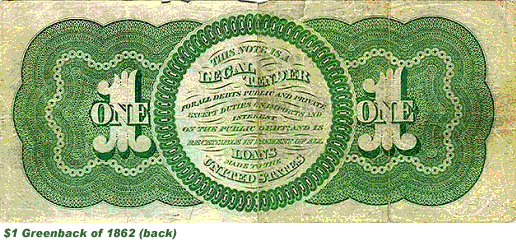
Greenbacks, which had been issued in 1861 to pay for the Union Government's expenses, were initially 100% redeemable in specie. The redemption clause was suspended later that year and subsequent issues of greenbacks didn't even claim to be convertible into gold. Greenbacks quickly fell to a large discount relative to the metal. By August 1864 the discount had hit its widest point as the paper traded at 38 cents on the gold dollar.***


As with Somali shillings, economists were curious about these seemingly-orphaned liabilities. Why were greenbacks still accepted? What governed their value? Wicksell, Mises, and Hawtrey held that if there is a demand for the medium-of-exchange as such, this demand would be sufficient to give value to whatever instrument was established by custom as the medium-of-exchange. Thus the continued acceptance of greenbacks at positive values was mostly due their already-favorable marketability.

Countering this panel of illustrious economists was J. Laurence Laughlin. Though Laughlin doesn't attract the same brand recognition as do these other long-dead economists, in his day he was considered to be America's leading monetary economist. In his book The Principles of Money (1903), Laughlin outlined the view that greenbacks should be treated like non-dividend paying common stock. Just as a stock might have some positive value now due to potential dividends several years down the road, the continued positive valuation of greenbacks was due entirely to the possibility of their future redemption.

To illustrate his point, Laughlin drew attention to the market's reaction upon the success of the Union Goverment in the Battles of Gettysberg and Vicksburg. After these battles the greenback's discount to gold dramatically narrowed, presumably because these victories were perceived by the market as increasing the probability of future redemption of greenbacks in specie. Laughlin also mentions the passage of the Redemption Act of 1875, in which the government declared its intention to redeem all greenbacks come January 1, 1879. Though still trading at a discount to gold, greenbacks began to steadily appreciate towards par as this date approached, just like a t-bill approaching maturity. Thus Laughlin's redemption theory held up nicely to the evidence.

While Wicksell described Laughlin's theory as "perverse and fantastic," it was hard for Mises, Hawtrey, or Wicksell to deny that the expectation of future redemption didn't have at least some effect on greenback's value. In his book the Value of Money (1917), Benjamin Anderson struck a middle ground between all parties. Anderson held that Laughlin was right to treat greenbacks like any other asset whose value was dependent on eventual redeemability. But Anderson also thought that Mises and the rest were correct to put an emphasis on greenback's unique monetary function. Anderson combined these views by illustrating how greenback's "money-use" would be captured by the market as an extra bit of ascribed value on top of redemption value, or a liquidity premium.

Just to make things more complicated: New Somali Shillings

Back to the Somali shilling. The last feature of the Somalian monetary economy that I find interesting is the presence of yet another media of exchange — the "New Somali Shilling".**** Just prior to the January 1991 collapse, Somalia had been experiencing accelerating inflation. The Somali government drew up plans to replace existing shillings with the New Somali shillings. Each New Shilling was to be worth 100 old shillings, and notes were to be printed in 20 and 50 shilling denominations

 According to Symes (2006), the first shipment of New Shillings arrived in Somalia several months after the collapse of the state. Ali Mahdi Muhammed, a factional leader in Mogadishu, seized several billion of these official New Shillings and spent them into the economy in November 1991. While New Shillings did gain acceptance, their use was limited to a small area in North Mogadishu—the area controlled by Ali Mahdi Muhammed. Nor were they fungible with the legacy notes. 500 worth of New Shillings, for instance, was not worth 500 worth of old shillings. Nor did New Shillings circulate at the pre-1991 intended value of 100 old shillings to one New Shilling. At the time of Mubarak's article, a New shilling was worth only a third of an old shilling.

This challenges Luther & White's theory that Somalians accepted shillings because of their previous experience with them. Why did Somalians accept New Shillings at all if they were not accustomed to doing so? Why not refuse and continue to trade in legacy shillings? Legacy shillings circulated in Mogadishu at the time, so traders would have presumably had a choice. Why take a bet on an untested currency?

New Shillings also challenge the Laughlin-esque theory that redemption underpins the positive value of fiat paper. If Somalians universally valued shillings because of their future redeemability, why would they not place a higher value on New Shillings relative to old? After all, according to its stated plan, the Central Bank of Somalia was willing to convert 100 old shillings into 1 New Shilling. If it was believed that a newly chartered central bank would take on the liability of Somalia's counterfeit notes, wouldn't that same central bank uphold a commitment to value New Shillings at a far higher rate than old ones? Why then do New Shillings trade a third the price of old shillings rather than at a multiple of 100?

As much as I dislike to leave more questions than answers, that's about all I can do for the time being. One major data point is yet to come. What actually happens to legacy and counterfeit notes when a new central bank begins to operate? The Central Bank of Somalia's website says this:
Towards fully assuming its functional and institutional responsibilities, the Bank has completed the reconstruction of its Headquarters in Mogadishu while the branch in Baidoa has been established and is already functioning with personnel in place.
Perhaps we don't have long to wait.
_____________________________________________________

*Abduraham in Luther (2012)
**Debate also surrounded the irredeemability of Austrian gulder banknotes. The Revolution of May 1848 resulted in the withdrawal of the convertibility of Austrian gulden banknotes into silver. The discount on gulder notes relative to silver averaged around 15% for the first 10 years and then dipped to an average of 28% from 1859 to 1865. Laughlin pointed out that by the 1860s speculation began to grow that Austria would switch from the silver standard to a gold standard. If the banknotes, still irredeemable, were to be honoured, it became increasingly evident that redemption would be in gold, not silver. At the same time, large silver discoveries were driving down the value of silver relative to gold. As a result of these forces, the market value of notes rose back to par with silver. As the market became progressively more confident that the notes would be redeemed, and redemption would be in much more valuable gold, gulder notes eventually exceeded their stated silver value. Laughlin's theory seemed to be borne out by the facts--the value of orphaned notes was dictated by their future potential redeemability.
*** From A History of the Greenbacks (1903), by Wesley Clair Mitchell
**** Mubarak refers to this instrument as the Na' Shilling.

Sunday, January 20, 2013

I must be a dummy for not understanding the shortage of safe asset argument


I've never understood the global shortage of safe asset meme. I'm willing to be educated.

I know that Ricardo Caballero and Gary Gorton have written about the safe asset shortage problem. In the blogosphere it pops up in David Beckworth and David Andolfatto, and the folks at FT Alphaville can't talk about much else.

First, there seems to me to be definitional issues. What is a safe asset? Beckworth, for instance, describes them as "those assets that are highly liquid and expected to maintain their value." But liquidity and riskiness are separate concepts. There are many financial instruments that are very liquid yet risky—take the S&P mini futures contract, the most liquid futures contract in the world. There are many low-risk instruments that are illiquid—a 5 year non-cashable Canadian GIC being a good example. How are we to reconcile these oppositions into one definition?

Second, it seems to me that the concept of a safety is misspecified. How do we go about classifying safety? Is it a spectrum, or are there discrete categories of safety? If a spectrum, how are we supposed to measure degrees of safety or the lack thereof? Where do we get this safety data? Next, how do we get economy-wide gradiations of safety data?

If, on the other hand, assets are to be categorized into discrete buckets of safe and non-safe, how can anyone possibly know what asset goes in each bucket? Take a vote? Whatever Gorton says? Best 4 out of 7 rock paper scissors? At what point did Italian debt go from the safe into the non-safe bucket? Or the Zim dollar? The whole process seems ad hoc and impossible to empirically verify.

But ignore all these epistemological points for now.

Let's deal first with the word shortage. If society faces a shortage of safe financial assets, won't the prices of those safe assets immediately rise and thereby remedy the shortage?*  If so, where's the problem?

Imagine a basic economy in which gold is the only safe asset and everything else is risky. There's a sudden demand for safety which means that a shortage of gold simultaneously appears in individuals' portfolios. What happens? The shortage can't be filled by gold production, supply is more or less fixed. So the gold price immediately triples. There's now enough gold to satisfy everyone's demand for safe assets.

A big part of the safe asset shortage meme seems to apply specifically to collateral. In our simple economy, if for some reason the gold market is broken, just convert risky assets into safe collateral by requiring a slightly bigger haircut than before. This is RebelEconomist's point here. Next, recruit formerly uncollateralized risky assets like pianos and grandfather clocks into serving as collateral and slap a bigger hair cut on them. Do this until the demand for collateral is met. End of story.

What does a shortage in financial asset markets even look like? I've seen shortages at Toys R Us when some new item arrives and the store manager hasn't properly anticipated demand. Lineups and unhappy customers are the result. But has anyone ever seen a lineup at the bid-ask spread for AAPL? The idea is odd. If you want to buy AAPL now, just take whatever is on offer at 601. Then take whatever is on offer at 602. Then 603. Repeat until you've bought every share that has ever been issued. The same with t-bond markets. Your demand will never go unsatisfied. No shortage here.

But maybe I'm putting too much weight on the word shortage. Maybe the problem is not a shortage per se, but the underlying increase in preferences for safety. If  people's taste for risk changes, market prices adjust to a new equilibrium in order to satisfy those tastes. Why must this new distribution of prices be considered an aberration? Does the safe asset problem apply equally when people express their demand for more safety by purchasing fire extinguishers, guns, and home alarm systems? Would we then be talking about a shortage of safe consumables?

And lastly, back to the epistemological issue. I don't think we can get proof that we've got too few safe assets because we haven't properly specified the concept of safety, which means we don't have good data. Without good data, we can't be confident in any pronouncements concerning safe asset shortages.

So tell me why I'm a dummy.

[Update: David Beckworth responds]

*put aside the idea that some of those assets are "money", and therefore may be sticky.

Wednesday, November 21, 2012

Central bank monetization doesn't have to be scary


David Beckworth has a good post pushing back against people who are pounding the Fed-is-monetizing-the-debt drums. His point was that there is no evidence of monetization. The Fed today holds roughly the same amount of government debt as a proportion of outstanding debt as it did in times past.

Accusations of monetization need to start out with proper definition of the term. To "monetize" means to turn into money. All banks engage in monetization, whether they be central banks or private banks. Banks monetize houses, debt, commodities and all sorts of other assets, issuing liquid liabilities in return. A credit card essentially monetizes your 30-day IOU. So to accuse a bank of "monetizing" is like accusing someone of breathing.

In conducting QE3 purchases, the Fed is currently monetizing government debt and agency-issued MBS. Is that bad? The Fed has to monetize something. Would people be happier if it was monetizing corporate bonds? Gold? Or do they simply want it to monetize at a slower rate?

There is a pejorative sense of the word monetize. It refers to a situation in which a bank monetizes an asset at a price that benefits the borrower. This is akin to a subsidy. In providing the subsidy, the bank grants the borrower (or issuer) more financing than the borrower otherwise deserves. When applied to the Fed, monetizing in its pejorative sense would seem to indicate that the Fed is subsidizing the government by pushing the government's borrowing rate below its fundamental rate, thereby allowing it to borrow even more. In other words, the price that the Fed is paying for government bonds is above their fundamental value.

Just because the Fed is monetizing government assets doesn't mean it is monetizing in the pejorative sense. As David points out, where's the proof?

Secondly, let's pretend that the Fed is monetizing government bonds in the pejorative sense. In providing this subsidy to the government, the Fed is earning less for itself. Say that this monetization continues until the Fed has negative capital. Typically, it is believed that a government implicitly guarantees to recapitalize the nation's central bank should it be insolvent. In this case, the government just returns to the Fed all the subsidies granted by the Fed. It's a wash, and monetization (in the pejorative sense) has had no net effects.

We need to be explicit about definitions and the relationship between the government and central bank when we talk about monetization.

Wednesday, October 3, 2012

QE-zero

Bob Murphy asks if central bank actions taken during the early 1930s might be considered "unprecedented". In the comments I pointed out that during that era an early form of QE was tried. I'm not referring here to the famous 1933 Roosevelt purchases of gold that market monetarists often point to. For instance, see David Glasner here, David Beckworth here, and Scott Sumner here. Scott also has a very interesting paper on the 1933 gold purchasing program (pdf). No, I was referring to the 1932 treasury purchasing program.

I'm going to replicate the simple graphical analysis that market monetarists use in order to look at the 1932 episode. See this post by Lars Christensen, for example, who overlays important monetary events (QE1, QE2, LTRO) over the S&P500.

Here is the context. Prior to 1932, the Federal Reserve system was significantly limited in its ability to embark on large purchases of government securities. This was because of strict backing laws in the Federal Reserve Act that limited eligible backing assets to gold and assets accepted as collateral for Fed discount loans, primarily commercial paper. In effect, the Reserve banks could only purchase government debt to the extent that there was already excess gold and discounted assets on the Reserve bank balance sheets.

This limitation was removed with the passage of the Glass Steagall Act of February 1932, which allowed the Fed to include government debt as backing for notes and deposits. Almost immediately the Federal Reserve began a large scale asset purchasing program that increased the system's government debt portfolio from $743 million at the end of February 1932 to $1413m by May. The program, which I'll call QE0, continued at a slower rate after May, eventually hitting a peak just above $1800m by the end of July 1932. I overlay this on the Dow Jones Industrial Average.


The second chart extends the time frame to include 1933, putting QE0 on a scale with the Roosevelt devaluation.


Gavyn Davies, who has treaded this path before, notes that Milton Friedman and Anna Schwartz declared QE0 to be a success. In their Monetary History of the United States, the two drew attention to the conjunction of QE0 with a lull in bank failures and a "tapering off of the in the decline in the stock of money". They point to the bottoming of industrial production in August, five months after QE0 started, as a sign of its success. In his History of the Federal Reserve, Allan Meltzer also strikes a note of optimism when he discusses QE0, noting many of the same improvements in data that Friedman and Schwartz point to. Meltzer writes that "it seems likely that had purchases continued, the collapse of the monetary system during the winter of 1933 might have been avoided" and notes the rise in stock prices beginning in July as evidence.


But no market monetarist would agree with Friedman and Schwartz's analysis, since the new breed of monetarists take asset prices as the best indication of monetary stance. Scott Sumner points out here, for instance, that US equity markets had one of their fastest two day rallies in history as President Hoover met with Congressional leaders to begin work on Glass Steagall. All good, then, for the market monetarist stance, who like to see rising market prices coincide with easy monetary policy at the zero lower bound. Unfortunately for them that was the end of the rally. Markets continued falling to new lows even as QE0 accelerated. Scott Sumner indeed notes that "In many respects, the period from April to July 1932 was the worst three months of the entire Depression. Commodity prices continued to fall, and both stock prices and industrial production reached their Depression lows in July." Oddly enough, only with the end of the QE0 did stock prices begin to rise again, as the first chart shows, which runs contra to market monetarist thinking.

No wonder then that market monetarists prefer to look at the second chart. In 1933, the conjunction of increases in stock prices with various monetary events, including the departure of the dollar from gold convertibility and Roosevelt's gold purchase plan, is quite striking. This cozy relationship is no doubt the main reason that market monetarists prefer to point to 1933 rather than QE0 for evidence of monetary policy effectiveness at the zero lower bound.

QE0's seeming failure might seem to confirm Murray Rothbard's view that the huge increase in the money supply engendered by QE0 "endangered public confidence in the government's ability to maintain the dollar on the gold standard," leading to a loss of confidence on the part of foreigners who drew out gold, and on the part of Americans who converted deposits into notes. This turned an intended inflation into an unintended deflation. The aboves is also Peter Temin's view, who points out that the purchases reduced confidence, the resulting gold outflow nullifying QE0's potential for expansion.

My reading of Scott Sumner is that the 1932 purchasing program was rendered ineffective because of growing expectations that the dollar would float, leading to gold ouflows and an ensuing general panic in equity markets. In meting out blame for this panic, Sumner emphasizes the role of Congress in engendering uncertainty rather than the Fed's QE0 program. Once the dollar panic was alleviated and the hoarding instinct of foreign central banks and the private sector satiated, markets began their rise in the latter half of 1932.

Hsieh and Romer (pdf), on the other hand, use data on dollar forward rates to show that traders were not particularly worried about a dollar devaluation. If H&R are right, then one can only conclude that there was no dollar crisis, leaving market monetarists with no corresponding event to blame for counterbalancing the inflationary effects of QE0. So QE0, it would seem, was irrelevant -- a non-event. Scott talks about Hsieh and Romer's paper here. It all seems rather tortured to me, and leads me to (somewhat dismally) conclude that one can probably get a set of historical events to say almost anything one wants it to say. This is not a criticism of Scott, but one of economics in general.


All of this leads to current discussion of QE3. The New Keynesians point to the ineffectiveness of QE itself at the zero lower bound. For instance, see Simon Wren Lewis. This view is inherited from John Maynard Keynes who, it would seem, got it from his observations of the failure of QE0 in 1932. Here is Keynes in Chapter 15 of the General Theory:
There is the possibility, for the reasons discussed above, that, after the rate of interest has fallen to a certain level, liquidity-preference may become virtually absolute in the sense that almost everyone prefers cash to holding a debt which yields so low a rate of interest. In this event the monetary authority would have lost effective control over the rate of interest. But whilst this limiting case might become practically important in future, I know of no example of it hitherto. Indeed, owing to the unwillingness of most monetary authorities to deal boldly in debts of long term, there has not been much opportunity for a test. Moreover, if such a situation were to arise, it would mean that the public authority itself could borrow through the banking system on an unlimited scale at a nominal rate of interest.
The most striking examples of a complete breakdown of stability in the rate of interest, due to the liquidity function flattening out in one direction or the other, have occurred in very abnormal circumstances. In Russia and Central Europe after the war a currency crisis or flight from the currency was experienced, when no one could be induced to retain holdings either of money or of debts on any terms whatever, and even a high and rising rate of interest was unable to keep pace with the marginal efficiency of capital (especially of stocks of liquid goods) under the influence of the expectation of an ever greater fall in the value of money; whilst in the United States at certain dates in 1932 there was a crisis of the opposite kind — a financial crisis or crisis of liquidation, when scarcely anyone could be induced to part with holdings of money on any reasonable terms.
The market monetarists, of course, believe in the effectiveness of QE, although announcing a nominal target would greatly improve a purchase program's effectiveness.

This is what Nick Rowe means when he says that there are two types of economists (HT Bob Murphy). There are those who think monetary policy is useless at the zero lower bound, and those who don't. I wonder how much of the divergence between these two traditions has its origins in the data generated by the separate 1932 and 1933 monetary events. If you focused on the latter, you became a monetary policy believer, if you focused on the former you stopped believing.

Other posts on the efficacy of QE or lack thereof:

Stephen Williamson (here and here), Bruegel blog, Richard Serlin, Miles Kimball (here and here), Paul Krugman (here and here), James Hamilton, John Taylor, John Cochrane, Michael Woodford (pdf), and Simon Wren Lewis.