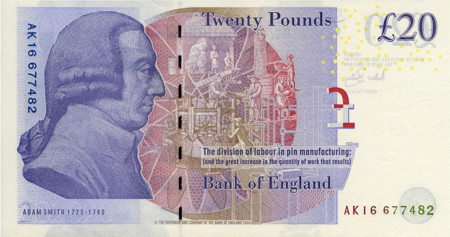
Showing posts with label real bills doctrine. Show all posts

Sunday, January 26, 2020

Monetary policy is not a tightrope


[This is a guest post by Mike Sproul. Mike has posted a few times before to the Moneyess blog.]

Here is a summary of the Federal Reserve’s Principles for the Conduct of Monetary Policy, which aims at “walking the tightrope” between inflation and unemployment:
…the central bank should provide monetary policy stimulus when economic activity is below the level associated with full resource utilization and inflation is below its stated goal. Conversely, the central bank should implement restrictive monetary policy when the economy is overheated and inflation is above its stated goal.
In contrast, here is the real bills doctrine:
Money should be issued in exchange for short-term real bills of adequate value.
The real bills doctrine was developed by practicing bankers over centuries of experience, and was written into the Fed’s original charter. The real bills doctrine survived for centuries because banks that obeyed it survived. They tended to stay solvent, and they provided an elastic currency that grew and shrank with the needs of business. At the same time, the real bills doctrine helped banks to avoid inflation, recession, liquidity crises, and bank panics.

In this essay, I hope to make the point that as long as the Fed obeys the real bills doctrine, it cannot go wrong in issuing as much money as the public will absorb. In other words, monetary policy is not like walking a normal tightrope. It is perfectly safe to lean in the direction of “too much money”, but dangerous and pointless to lean in the direction of “too little money”.

A few points to notice:

1. As long as new money is issued in exchange for adequate backing, the Fed’s assets will move in step with its issue of money, and there will be no inflation. This explains (among other things) why the Fed was able to issue enormous amounts of money after 2008, without causing inflation.

2. If unemployment is a threat, then the Fed should not hesitate to issue new money (adequately backed). Unemployment is often caused by a tight money condition and accompanying liquidity crises. Issuing new money in this situation will relieve the liquidity crisis, thus reducing unemployment. Meanwhile, adequate backing assures that the new money will not cause inflation.

3. If inflation is a threat, then a restrictive monetary policy will only succeed in creating a tight money condition, without addressing the real problem, which is too little backing per unit of money. The right solution to inflation would be to correct whatever problem is causing the Fed’s assets to fall relative to its issue of money, and then, so long as backing is adequate, issue as much money as the public will receive. The only drawback is that the public might be faced with unwanted cash piling up in vaults and mattresses, but the storage cost of too much cash would be insignificant in comparison to the recessionary effects of too little cash. Besides, unwanted cash can only pile up so much before it simply refluxes to its issuer.

The recessionary effects of tight money, as well as the stimulative effects of issuing new money, have been noted by nearly all observers of monetary history.
The remedy was forthcoming in a scheme prepared at a meeting which had been held a week earlier (April, 1793) at Pitt’s private house. It provided for the creation of additional liquid assets in the shape of Exchequer bills, to be lent to temporarily embarrassed firms. By this means the channels of trade were successfully thawed, and, as it proved, without loss to the Treasury. Clearly, therefore, the panic was due to a temporary need for greater liquidity, which the Bank could not this time meet by contracting advances to the government, since these were needed to prosecute the war. (Ashton and Sayers, p. 10, 1953).
The real bills view is that the Fed should not only provide liquidity in times of crisis, but should provide abundant liquidity at all times, in order to assure that crises never get started in the first place. So the real bills doctrine tells us not to worry that the Fed’s balance sheet has been exploding over the last few months. An exploding balance sheet may be exactly what the economy needs. But the “tightrope” mindset makes the Fed wary of issuing too much money, for fear of causing inflation. This fear is unjustified. On real-bills principles, the Fed need only take the simple precaution of only issuing cash in exchange for assets of adequate value, and inflation will cease to be a threat. We have nothing to fear from too much money, and everything to fear from too little. Rather than unwinding the Fed’s balance sheet, the Fed should unwind its “tightrope” approach to monetary policy.

Tuesday, June 3, 2014

Scott Sumner vs. the Real Bills Doctrine


This is a guest post by Mike Sproul. Mike's last guest post is here.

Scott Sumner and I have argued about the backing theory of money (aka the real bills doctrine) quite a bit over the years, starting in 2009 and continuing to the present. (link 1, link 2, link 3, link 4, …) Scott rejects the backing theory, while I favor it. I think that printing more money is not inflationary as long as the money is adequately backed, while Scott thinks that printing more money causes inflation even if it is adequately backed. Our discussions in the comments section of his Money Illusion blog extend well over 50 pages, so I’m going to try to condense those 50+ pages into two key points that cover the main arguments that Scott and I have had over the backing theory. (That’s John Law on the right. He was an early proponent of the real bills doctrine, oversaw a 60% increase in French industry in the space of two years, and was the architect of the western world’s first major hyperinflation and stock market crash.)

The key points:
1. Scott thinks that the liabilities of governments and central banks are not really liabilities.

For example:

“In what sense is cash a liability of the Fed? I thought once we left the gold standard the Fed was no longer required to redeem dollars?” (July, 2009)

“Dollar bills are not debt. The government is not required to redeem them for anything but themselves. That's not debt.” (August, 2009).

It would be cheating if I were to point out that the Federal Reserve’s own balance sheet identifies Federal Reserve notes (FRN’s) as the Fed’s liability, and that a large chunk of the Fed’s assets are classified as “Collateral Held Against Federal Reserve Notes”. Scott already knows that. It’s just that he thinks that the accountants are wrong, and that FRN’s are not a true liability of the Fed or of the government.

Scott’s argument is based on gold convertibility. On June 5, 1933, the Fed stopped redeeming FRN’s for a fixed quantity of gold. On that day, FRN’s supposedly stopped being the Fed’s liability. But there are at least three other ways that FRN’s can still be redeemed: (i) for the Fed’s bonds, (ii) for loans made by the Fed, (iii) for taxes owed to the federal government. The Fed closed one channel of redemption (the gold channel), while the other redemption channels (loan, tax, and bond) were left open. For example, suppose that 10% of FRN’s in circulation were originally issued in exchange for gold, 20% of FRN’s were originally issued on loan, another 30% were given to the federal government, which spent them on office buildings, and the remaining 40% of FRN’s were issued in exchange for bonds. That would mean that 90% (=20+30+40) of circulating FRN’s could be redeemed through the loan, tax, and bond channels alone. Only after those channels were used up and closed would it matter whether the Fed re-opened the gold channel. Assuming that the Fed still cared about maintaining the value of the dollar, the Fed would finally have to start using its gold to buy back the remaining 10% of FRN’s in circulation. But as long as the loan, bond, and tax channels remain open, the mere suspension of gold convertibility does not make FRN’s cease to be the liability of the Fed or of the government.

So Federal Reserve Notes are a true liability, whether or not they are gold-convertible. And like any liability, they are valued according to the assets backing them, just like the backing theory says. In the case of a gold-convertible currency, this is not disputed by Scott or anyone else. For example, as long as the Fed maintained gold convertibility of the dollar at $1=1 oz, it would not matter if the Fed held assets worth 100 oz as backing for $100 in FRN's, or 300 oz worth of assets as backing for $300 in FRN's. The quantity of convertible FRN's can be increased by any amount without affecting their value, as long as they are fully backed. Once we understand that both convertible and inconvertible FRN's are a true liability of the Fed, it is easy to see that the quantity of inconvertible FRN's could also be increased by any amount, and as long as the Fed's assets rose in step, there would be no effect on the value of the dollar. (There is a comparable result in Finance theory: that the value of a convertible call option is equal to the value of an inconvertible call option.)

2. Scott thinks that if the central bank issues more money, then the money will lose value even if the money is fully backed.

For example:
“ That’s where we disagree. I think open market operations have a huge impact on the price level, even if they involve the exchange of assets of equal market value.” (April 2012)

“ I understand what the backing theory says, I just don’t think it has much predictive power. Nor do I think it matches common sense. If you increase the monetary base 10-fold, prices will usually rise, even if the money is fully backed.” (July, 2009)


The problem with supposing a 10-fold increase in the monetary base is that we must ask how and why the money supply increased. If the new money was not adequately backed, then I agree that it would cause inflation. So if every dollar bill magically turned into ten dollar bills, or if helicopters showered us with newly-printed dollar bills, or if the Fed issued billions of new dollar bills in exchange for worthless bonds or worthless IOU’s, then Scott and I would both expect inflation. It’s just that I would expect inflation because the quantity of Federal Reserve Notes was outrunning the Fed’s assets, while Scott would expect inflation because the quantity of FRN’s was outrunning the quantity of goods being bought with those FRN’s.

But if the Fed issued billions of new dollars in exchange for assets of equal value, then I’d say there would be no inflation as long as the new dollars were fully backed by the Fed’s newly acquired assets. I’d also add a few words about how those dollars would only be issued if people wanted them badly enough to hand over bonds or other assets equal in value to the FRN’s that they received from the Fed.

This is where things get sticky, because Scott would once again agree that under these conditions, there would be no inflation. Except that Scott would say that the billions of new dollars would only be issued in response to a corresponding increase in money demand. So while I’d say that there was no inflation because the new money was backed by the Fed’s new assets, Scott would say that there was no inflation because the new money was matched by an increase in money demand. It seems that for every empirical observation, he has his explanation and I have mine. We are stuck with an observational equivalence problem, with neither of us able to point to an empirical observation that the other guy's theory can't explain.

But what if the Fed lost some or all of its assets while the quantity of FRN’s stayed constant? The backing theory would predict inflation because the Fed would have less backing per dollar, and the quantity theory would predict no inflation, since the same number of dollars would still be chasing the same amount of goods. It looks like we finally have a testable difference in the two theories. But here again, it’s easy for both Scott and me to get weaselly. If inflation happened in spite of Scott’s prediction, he could answer that money demand must have fallen. If my expected inflation failed to materialize, I could answer that the government stands behind the Fed, so any loss of assets by the Fed would be compensated by a government bailout. Empirical testing, it turns out, is hard to do. But at least I can claim one small victory: Scott is clearly wrong when he says that the backing theory doesn't have much predictive power. It obviously has just as much predictive power as Scott's theory, since every episode that can be explained by Scott's theory can also be explained by my theory.

Scott is also wrong to claim that the backing theory doesn't match common sense. Clearly, it makes perfect sense. Everyone agrees that the value of stocks and bonds is determined by the value of the assets backing them, and the backing theory says, very sensibly, that the same is true of money. Actually, it's when we start to use our common sense that the backing theory gains the advantage over the quantity theory. There are many aspects of the quantity theory that defy common sense, but I'll focus on four of them:

(i) The rival money problem. When the Mexican central bank issues a paper peso, it will get 1 peso’s worth of assets in return. The quantity theory implies that those assets are a free lunch to the Mexican central bank, and that they could actually be thrown away without affecting the value of the peso. This free lunch would attract rival moneys. For example, if US dollars started being used in Mexican border towns, then the Mexicans would lose some of their free lunch to the Americans. As the dollar invaded Mexico, the demand for pesos would fall, and the value of the peso would fall with it. More and more of the free lunch would be transferred from Mexico to the US, until the peso lost all value. If the quantity theory were right, one wonders how currencies like the peso have kept any value at all.

(ii) The counterfeiter problem. If the Fed increased the quantity of FRN’s by 10% through open-market operations, the quantity theory predicts about 10% inflation. If the same 10% increase in the money supply were caused by counterfeiters, the quantity theory predicts the same 10% inflation. In this topsy-turvy quantity theory world, the Fed is supposedly no better than a counterfeiter, even though the Fed puts its name on its FRN’s, recognizes those FRN’s as its liability, holds assets against those FRN’s, and stands ready to use its assets to buy back the FRN’s that it issued.

(iii) The currency buy-back problem. Quantity theorists often claim that central banks don’t need assets, since the value of the currency is supposedly maintained merely by the interaction of money supply and money demand. But suppose the demand for money falls by 20%. If the central bank does not buy back 20% of the money in circulation, then the quantity theory says that the money will fall in value. But then it becomes clear that the central bank does need assets, to buy back any refluxing currency. And since the demand for money could fall to zero, the central bank must hold enough assets to buy back 100% of the money it has issued. In other words, even the quantity theory implies that the central bank must back its money.

(iv) The last period problem. I’ll leave this one to David Glasner:
“For a pure medium of exchange, a fiat money, to have value, there must be an expectation that it will be accepted in exchange by someone else. Without that expectation, a fiat money could not, by definition, have value. But at some point, before the world comes to its end, it will be clear that there will be no one who will accept the money because there will be no one left with whom to exchange it. But if it is clear that at some time in the future, no one will accept fiat money and it will then lose its value, a logical process of backward induction implies that it must lose its value now.”
Taken together, I think these four problems are fatal to the quantity theory. Scott is welcome to bring up any problems that he thinks might be similarly fatal to the backing theory, but it will be a tough job. It’s easy to make the quantity theory fit the data. It’s harder to reconcile it with common sense.


Addendum: Scott Sumner responds.And Mike Freimuth comments. Over at Scott's blog, Mike Sproul writes a rejoinder to Scott. And now David Glasner has chimed in.

Friday, June 14, 2013

Real or unreal: Sorting out the various real bills doctrines


In the comments section of my post on Adam Smith and the Ayr Bank, frequent commenter John S. brought up the real bills doctrine. The phrase real bills doctrine gets thrown around a lot on the internet. To muddy the waters, there are several versions of the doctrine. In this post I hope to dehomogenize the various versions in order to add some clarity.

1. Lloyd Mints's version

We may as well start with Lloyd Mints's version, since he coined the phrase real bills doctrine back in 1945 on his way to denouncing the doctrine. Mints taught at the University of Chicago and mentored Milton Friedman. [1] Here is Mints:
The real-bills doctrine runs to the effect that restriction of bank earning assets to real bills of exchange will automatically limit, in the most desirable manner, the quantity of bank liabilities; it will cause them to vary in quantity in accordance with the "needs of business"; and it will mean that the bank's assets will be of such a nature that they can be turned into cash on a short notice and thus place the bank in the position to meet unlooked-for calls for cash. - A History of Banking Theory
Mints's RBD states that so long as only real-bills (short term liquid debt instruments created by merchants to finance inventory) are discounted by the banking system, an excess amount of notes can never be issued. When businesses require cash, they'll simply discount bills at a bank, and when that cash is no longer required, they'll pay back their borrowing. Even in a world *without* note convertibility into specie (a "fiat standard")  the real bills stipulation alone is sufficient to keep the price level anchored.

Mints rightly declared that this version of the RBD was "completely wrong". After all, a central bank not constrained by convertibility might discount only real bills, yet by discounting at an unreal price, it would alter the purchasing power of the notes it issues and create either runaway inflation or deflation). The price level was indeterminate in Mints's RBD-world.

Mints singled out Adam Smith for being "the first thoroughgoing exponent of the real-bills doctrine". For the next forty years, Smith's reputation as a monetary theorist would be tarnished. [2]

2. Adam Smith's version

Though tarred and vilified, poor Adam Smith never actually conformed to the real bills doctrine as described by Mints. This has been pointed out by David Laidler in his 1981 paper Adam Smith as a Monetary Economist, one of the first efforts to rehabilitate Smith's reputation as a monetary theorist.

Smith lived in an era in which paper money was fully convertible into a fixed amount of gold. Mints's description of the RBD, on the other hand, applies to a fiat world. For Smith, the gold convertibility clause was sufficient to ensure that the economy needn't endure an excess amount of notes. After all, should banks as a whole issue more than was desired, the public would return the notes en masse for specie. This is the so-called reflux process.

That being said, Smith did mention real bills several times in the Wealth of Nations. He famously advises banks that they should only discount "real bills of exchange drawn by a real creditor upon a real debtor." (I go into some detail in my last post on the personal and historical reasons that may have motivated Smith to advocate this position).

Why limit discounts to real bills? When the banking system issues excess paper currency, gold convertibility ensures that this excess will soon reflux back to issuer. A bank that holds long term loans and bonds issued by speculators will be insufficiently prepared to meet the demands of reflux since liquidating such debts might take time. A bank that holds short term bills issued by credit-worthy merchants will be better equipped to meet redemption demands, and less likely to meet the same demise as that experienced by the Ayr Bank, a bank run that Smith personally witnessed.

Thus Smith's admonishment to only discount real bills wasn't a mechanism for anchoring the economy's price level—gold convertibility served this purpose. Smith's real bills stipulation was just good advice for individual banks: stay liquid and don't take on too much credit and term risk. This distinction has been aptly described by David Glasner in his paper the Real Bills Doctrine in the Light of the Law of Reflux, and for his part Laidler notes that "as advice to an individual bank, it's probably pretty sound, as a principle of
monetary policy under commodity convertibility it is relatively harmless..." [link]

3. The Bank Directors' version

Why did Mint's cast Adam Smith as his first thorough-going exponent of the RBD?

In 1797, some seven years after Smith had died, Britain went off the gold standard. (See this post for details). The pound soon began to trade at a discount to its pre-1797 gold value. In other words, the pound was capable of purchasing less gold. The Directors of the Bank of England found themselves accused of creating inflation, notably by the members of the 1810 Bullion Committee. One of the apologizers for the Directors, Charles Bosanquet, a pamphleteer, wrote a famous rebuttal in 1810 that insisted that by limiting discounts to "solid paper for real transactions," the Bank could not have contributed to a deprecation of the pound. According to Bosanquet, several factors outside of the Bank's control had caused the deprecation.

To help buttress his point, Bosanquet invoked the name of Adam Smith. Wrote Bosanquet: "The axiom, or rule of conduct, on which the Committee has been pleased to heap contempt and ridicule, respecting which they have declared that the doctrine is fallacious, and leads to dangerous results, was promulgated by, and is founded on, the authority of Dr. Adam Smith."

Bosanquet's appropriation of Smith's name was inappropriate since Smith implicitly assumed gold convertibility. But the damage had been done. From then on, economic historians like Mints would automatically associate Smith's name with the arguments of the Directors.

The Directors' RBD is very much a manifestation of Lloyd Mints's RBD, which we already know was a poor guide for monetary policy. Years later, Walter Bagehot would write that when the Directors were examined by the Bullion Committee in 1810, "they gave answers that have become almost classical by their nonsense". If anyone deserved to be castigated as the first thoroughgoing exponents of Mints's real bills doctrine, it was the Directors and not Smith.

4. Antal Fekete's version

If you've spent some time wading through the online monetary economics community, you'll have run into Antal Fekete's real bills doctrine. This is an attempt to apply a warmed over version of Adam Smith's RBD mixed in with some Austrian free market economics.

The use of bills of exchange began to diminish in the late 1800s and today they are a relatively unimportant financial instrument, having been replaced in bank portfolios by commercial paper, bonds, mortgages, and other types of debt. Fekete tries to draw a number of broad based conclusions from this trend. The crowding out of real bills by non-real bills (longer term finance bills and government issued treasury bills), for instance, is seen by Fekete as the reason for the Great Depression and the creation of the modern Welfare state:
When real bills were replaced by non-self-liquidating finance bills, payment of wages has become haphazard. Employment was made touch-and go, hiring, ‘hand-to-mouth’. This threatened with unemployment on a massive scale, unless governments were willing to assume responsibility for paying wages. [Link]
Conversely, rehabilitating the real-bills system would end chronic unemployment and reduce the size of government. I only have a passing knowledge of Fekete's thinking — it really doesn't do much for me —so hopefully someone in the comments section can pick up the slack.

5. Mike Sproul's version

Of the modern reincarnations of the RBD, I'm far more familiar with Mike Sproul's version.

Mike's version is an application of modern finance to monetary economics. The price of a financial asset is determined by the discounted value of the expected flows of cash thrown off by underlying capital. Alcoa's stock price, for instance, will equal the sum of discounted earnings that Alcoa's machinery and employees are expected to generate. Transferring this idea to the monetary landscape, Mike says that value of modern central bank liabilities should be determined by the earnings power of the assets held by that central bank.

Like the other versions of the RBD, Mike's version shares a preoccupation with the asset side of a bank's balance sheet. But that ends their similarity. For instance, Mike doesn't have a fetish for actual real bills. I doubt he'd agree with the Directors that so long as they only discounted short-term mercantile bills of exchange, they'd never cause a decline in the value of the pound.

That's why I prefer to call Mike's RBD the backing theory. It's a very different beast from the RBDs of Mints, Smith, Fekete, and the Bank Directors, and to share the same name only adds to the confusion.

So there you have it. If you're going to have an argument over the RBD, make sure you know which one you're arguing about!


1. Fischer Black received this letter from Milton Friedman on August 6, 1971: "With respect to your so-called passive monetary policy, here you are simply falling into a fallacy that has persisted for hundreds of years. I recommend to you Lloyd Mints' book on The History of Banking Theories for an analysis of the real bills doctrine which is the ancient form of the fallacy you express. Do let me urge you to reconsider your analysis and not let yourself get misled by a slick argument, even if it is your own. " Ouch. Play nicely, Milt. I get this via Perry Mehrling's book on Fischer Black.
2. Here's a video of Lloyd Mints in 1988 upon his 100th birthday.

Tuesday, June 11, 2013

Adam Smith's very own Lehman Crisis


It's interesting to see how after a credit crisis, economists start to take money and banking a bit more seriously. Adam Smith, who experienced his very own credit crisis -- the collapse of the Douglas Heron and Co, or the Ayr Bank, on June 22, 1772 -- is no exception. His views on money and banking became much more nuanced after that event.

Ayr Bank had been founded in 1769 in the Scottish town of Ayr. It expanded to Edinburgh and Dumfries, and in only a few short years it had succeeded in wrestling a significant chunk of Scottish banking business from incumbents the Bank of Scotland and the Royal Bank of Scotland. By 1772, according to Checkland, the Ayr Bank supplied 25% of Scotland's bank notes and deposits. In early June 1772 one of Ayr's largest customers, Alexander Fordyce, skipped London for Paris to avoid debt payments. A run on the Ayr Bank began that precipitated the bank's failure by the end of the month.

Upon observing the bank run, David Hume writes from Edinburgh, Scotland to his friend Smith on June 27, 1772:
We are here in a very melancholy Situation: Continual Bankruptcies, universal Loss of Credit, and endless Suspicions. There are but two standing Houses in this Place, Mansfield’s and the Couttses: For I comprehend not Cummin, whose dealings were always very narrow. Mansfield has pay’d away 40.000 pounds in a few days; but it is apprehended, that neither he nor any of them can hold out till the End of next Week, if no Alteration happen. The Case is little better in London. It is thought, that Sir George Colebroke must soon stop; and even the Bank of England is not entirely free from Suspicion. Those of Newcastle, Norwich and Bristol are said to be stopp’d: The Thistle Bank has been reported to be in the same Condition: The Carron Company is reeling, which is one of the greatest Calamities of the whole; as they gave Employment to near 10.000 People. Do these Events any–wise affect your Theory? Or will it occasion the Revisal of any Chapters?

Of all the Sufferers I am the most concern’d for the Adams, particularly John. But their Undertakings were so vast that nothing coud support them: They must dismiss 3000 Workmen, who, comprehending the Materials, must have expended above 100.000 a Year. They have great Funds; but if these must be dispos’d of, in a hurry and to disadvantage, I am afraid the Remainder will amount to little or nothing.
Hume asks if these events affect Smith's theory, the Wealth of Nations having not yet been published. In a letter to William Pulteney dated September 1772, a few months after the bank crisis, Smith notes that the events had indeed delayed the finishing of his book, which otherwise would have been completed that winter. When it was eventually published in 1776, Book II, Chapter II of the Wealth of Nations would include a long description of the Ayr crisis (though Smith never mentions the bank by name, most probably to protect those involved, see below).

Personal issues arising from bank failure also delayed publication of the Wealth of Nations. In the letter to Pulteney, Smith disavows any financial involvement in the crisis but notes that:
Tho I have had no concern myself in the Public calamities, some of the friends for whom I interest myself the most have been deeply concerned in them; and my attention has been a good deal occupied about the most proper method of extricating them.
According to Antoin Murphy and John Rae [biographer of Smith], the friends to whom Smith refers to probably included Smith's patron, the Duke of Buccleuch. The Duke was one of Ayr Bank's largest shareholders, and the source of Smith's £300 a year pension. Murphy intimates that as adviser to the Duke, Smith would have been privy to much of the gritty details of the bank's demise, as well as advising Buccleuch in the ongoing legal proceedings against the shareholders and directors of the bank. No doubt Smith had plenty to reflect on, including the fact that he might lose his pension.

There is also an odd letter from Hume to Smith, dated October 1772, in which Hume refers to Ayr banknotes in Smith's possession:
I ask’d the Question you proposd; and was told by Sir William Forbes, that tho’ they did not commonly take the Air Notes, yet he woud upon your Account: You may therefore send them over by the first Opportunity.
Not only did the collapse of Ayr put Smith's benefactor in financial trouble, but it seems that Smith himself was in possession of a few Ayr banknotes. Could it be that Smith himself was burned by the Air collapse, only to be helped out by William Forbes, an Edinburgh banker who had survived the crisis and generously agreed to take the notes off of Smith's hands? Or was Smith simply using his connections to help out a London-based friend who was stuck with Ayr Bank notes?

In any case, Smith's views on banking were inevitably modified by a crisis. According to Murphy, Smith became more conservative monetary theorist relative to his pre-1772 stance. Here is a quote from Smith's earlier Lectures on Jurisprudence, about six years before the crisis, in which he pooh-poohs the danger of banking crisis.
The ruin of a bank would not be so dangerous as is commonly imagined. Suppose all the money in Scotland was issued by one bank and that it became bankrupt, a very few individuals would be ruined by it, but not many, because the quantity of cash or paper that people have in their hands bears no proportion to their wealth. Neither would the wealth of the whole country be much hurt by it, because the 100 part of the riches of a country does not consist in money. (1766)
In The Wealth of Nations, Smith's benign view of banks was modified. No doubt influenced by his first hand experience of the Ayr collapse, Smith realized that the ruin of banks could have far greater consequences than he had earlier assumed. He went on to describe a set of guidelines that banks might use to avoid bankruptcy. Bankers, Smith wrote, should always verify that the bills of exchange upon which they issued credit (bills were a common collateral security accepted by banks) had arisen as the result of solid transactions between "real creditors" and "real debtors". Fictitious bills of exchange -- bills whose provenance was obscure and were usually issued by those whom Smith called "projectors", or speculators, and accepted (or co-signed) by collaborating projectors -- were to be treated with skepticism. The blogosphere's very own David Glasner describes this set of rules in this paper.

Like Smith, modern day economists are busily reappraising pre-2008 modes of thought, much of which abstracted from money and banking altogether. They have much to reflect on too. If Smith were alive today, he'd no doubt wonder why banks had lent on such unverifiable collateral, most of which in his eyes would appear to be entirely fictitious.


1: Much of this blog post is indebted to Antoin Murphy's chapter on Adam Smith in The Genesis of Macroeconomics.
2. For a full account of the demise of the Ayr Bank, here is the 1778 inquiry into the affair , or The Precipitation and Fall of Mess. Douglas, Heron and Co, Late Bankers in Air With the Causes of their Distress and Ruin Investigated and Considered. They sure loved long names back then.