Showing posts with label counting money. Show all posts

Sunday, December 8, 2013

Milton Friedman and moneyness

Steve Williamson recently posted a joke of sorts:
What's the difference between a New Keynesian, an Old Monetarist, and a New Monetarist? A New Keynesian thinks no assets matter, an Old Monetarist thinks that some of the assets matter, and a New Monetarist thinks all of the assets matter.
While I wouldn't try it around the dinner table, what Steve seems to be referring to here is the question of money. New Keynesians don't have money in their models, Old Monetarists have some narrow aggregate of assets that qualify as M, and New Monetarists like Steve think everything is money-like.*

This is a interesting way to describe their differences, but is it right? In this post I'll argue that these divisions aren't so cut and dry. Surprisingly enough, Milton Friedman, an old-fashioned monetarist, was an occasional exponent of the idea that all assets are to some degree money-like. I like to call this the moneyness view. Typically when people think of money they take an either/or approach in which a few select goods fall into the money category while everything else falls into the non-money category. If we think in terms of moneyness, then money is a characteristic that all goods and assets possess to some degree or another.

One of my favorite examples of the idea of moneyness can be found in William Barnett's Divisia monetary aggregates. Popular monetary aggregates like M1 and M2 are constructed by a simple summation of the various assets that economists have seen fit to place in the bin labeled 'money'. Barnett's approach, on the other hand, is to quantify each asset's contribution to the Divisia monetary aggregate according to the marginal value that markets and investors place on that asset's moneyness, more specifically the value of the monetary services that it throws off. The more marketable an asset is on the margin, the greater its contribution to the Divisia aggregate.

Barnett isolates the monetary services provided by an asset by first removing the marginal value that investors place on that asset's non-monetary services, where non-monetary services might include pecuniary returns, investment yields and consumption yields. The residual that remains after removing these non-monetary components equates to the market's valuation of that given asset's monetary services. Since classical aggregates like M1 glob all assets together without first stripping away their various non-monetary service flows, they effectively combine monetary phenomena with non-monetary phenomena—a clumsy approach, especially when it is the former that we're interested in.

An interesting incident highlighting the differences between these two approaches occurred on September 26, 1983, when Milton Friedman, observing the terrific rise in M2 that year, published an article in Newsweek warning of impending inflation. Barnett simultaneously published an article in Forbes in which he downplayed the threat, largely because his Divisia monetary aggregates did not show the same rise as M2. The cause of this discrepancy was the recent authorization of money market deposit accounts (MMDAs) and NOW accounts in the US. These new "monies" had been piped directly into Friedman's preferred M2, causing the index to show a discrete jump. Barnett's Divisia had incorporated them only after adjusting for their liquidity. Since neither NOW accounts nor MMDAs were terribly liquid at the time—they did not throw off significant monetary services—their addition to Divisia hardly made a difference. As we know now, events would prove Friedman wrong since the large rise in M2 did not cause a new outbreak of inflation.**

However, Friedman was not above taking a moneyness approach to monetary phenomenon. As Barnett points out in his book Getting it Wrong, Friedman himself requested that Barnett's initial Divisia paper, written in 1980, include a reference to a passage in Friedman & Schwartz's famous Monetary History of the United States. In this passage, Friedman & Schwartz discuss the idea of taking a Divisia-style approach to constructing monetary aggregates:
One alternative that we did not consider nonetheless seems to us a promising line of approach. It involves regarding assets as joint products with different degrees of "moneyness" and defining the quantity of money as the weighted sum of the aggregate value of all assets, the weights varying with the degree of "moneyness".
F&S go on to say that this approach
consists of regarding each asset as a joint product having different degrees of "moneyness," and defining the quantity of money as the weighted sum of the aggregate value of all assets, the weights for individual assets varying from zero to unity with a weight of unity assigned to that asset or assets regarded as having the largest quantity of "moneyness" per dollar of aggregate value.
There you have it. The moneyness view didn't emerge suddenly out of the brains of New Monetarists. William Barnett was thinking about this stuff a long time ago, and even an Old Monetarist like Friedman had the idea running in the back of his mind. And if you go back even further than Friedman, you can find the idea in Keynes & Hayek, Mises, and as far back as Henry Thornton, who wrote in the early 1800s. The moneyness idea has a long history.


* Steve on moneyness: "all assets are to some extent useful in exchange, or as collateral. "Moneyness" is a matter of degree, and it is silly to draw a line between some assets that we call money and others which are not-money."

...and on old monetarists: "Central to Old Monetarism - the Quantity Theory of Money - is the idea that we can define some subset of assets to be "money". Money, according to an Old Monetarist, is the stuff that is used as a medium of exchange, and could include public liabilities (currency and bank reserves) as well as private ones (transactions deposits at financial institutions)."

** See Barnett, Which Road Leads to Stable Money Demand?

Saturday, March 23, 2013

Money: is it immortal or does it die young?

Dreaming of Immortality in a Thatched Cottage - 1500s


Exogenous/endogenous money, reflux, hot potato money, helicopter money, inelastic vs elastic currency. These are all part of the colourful lexicon developed by monetary economists over the centuries to outline a general set of problems: how does money get emitted from source, and when, if at all, does it return to source?

We usually describe money as exogenous, hot potato, helicopter, or inelastic if it is emitted at the initiative of the issuer, and the issuer doesn't allow the public to exercise any initiative in returning this money back to source. Once it has been air-dropped into circulation from a helicopter, this kind of money becomes immortal, passing like a hot potato from person to person forever.

We describe money as elastic or endogenous when the money-using public exercises its own initiative in both drawing money out from an issuing source and pushing (refluxing) this money back to the source. This sort of money never strays far from its issuer, snapping back like a rubber band to be destroyed when it is no longer wanted. Rather than being a hot-potato zombie, elastic money lives fast and dies young.

There's a big debate among monetary economics about whether money is exogenous/hot potato/helicopter/elastic inelastic or if it is endogenous/elastic/refluxible. This debate goes all the way back to the banking-currency school battle of the early 1800s. Currency school advocates wanted to limit the note issuing power of private banks in order to prevent the overissue of notes, whereas members of the banking school believed such regulation unnecessary since in a competitive banking system, unwanted notes would simply reflux back to the issuer. The currency school won that debate, but the war continues.

I find it helpful to skirt around the skirmish and re-orientate the debate around finance, not monetary economics. This means that we've got to translate the language of monetary economists—hot potatoes, exogenous/endogenous, reflux, and the like—into the lexicon of financial instruments.

Let's head over to the stock market first. I'm going to hypothesize that the common stock is a thoroughly exogenous financial instrument. A firm decides when to issue new stock and at what price. Once stock has been issued, there's no way for an investor to automatically return the stock to the issuer. Stock wanders zombie-like through the financial world until the issuing firm is wound up, if ever. General Electric's original 1000 shares, for instance, have been hot-potatoing through financial markets since June 23, 1892.

Also found on stock markets are exchange-traded funds, or ETFs. Unlike stocks, though, I would say that ETFs are thoroughly endogenous financial instruments. Take the SPDR Gold Trust ETF. When investor demand for the Gold Trust heats up, ETF units will trade at a premium to their implied gold value. Large authorized-participants buy units from the ETF originator at par, paying with gold, and then sell these blocks to the public until the premium has disappeared. Vice versa when GLD units are at a discount to their real gold value. Now the authorized-participants buy units from the public at a depressed price and sell them to the ETF originator at par for gold. The result is that the quantity of outstanding units fluctuates quite widely, as the chart shows, but the price, specifically the premium/discount, stays constant. The public, through the intermediation of authorized-participants, sucks out whatever quantity of ETF units from the issuer that it desires, and then refluxes unwanted units back to it.


Unlike ETFs, bonds are exogenous financial instruments. Firms issue bonds when they need funding and these instruments stay outstanding until redemption date or firm instigated early-retirement. Until then, bonds pass hot potato-like from hand to hand in the secondary market.

Not all bonds are like this though. A retractible bond, or retractible debenture, is a different beast. Investors can choose to exercise the retractibility feature of this species of bond and force its issuer to buy it back. If we break down a retractable bond into its parts we see that it is a bond with an embedded put option. The put allows investors take the initiative and "reflux" the bond back to the issuer.

Retractability, or puttability, is a feature that gets often gets added to preferred shares and sometimes even common stock. The interesting thing about retractibility and puttability is that it turns what was once an exogenous hot potato asset into a semi-endogenous instrument. While investors can not "pull" retractible bonds or puttable stock out of an issuer, they can easily push, or "put", already-issued retractibles back to the issuer when those instruments are no longer desired.

How can we turn our semi-endogenous retractible bond or puttable share into a fully endogenous instrument? Let's consider another financial instrument, the gift card. Indigo, a bookstore up here in Canada, allows consumers to buy any quantity of gift certificates at the till. These gift certificates are puttable—their owner can immediately return the card for redemption. That the public can take the initiative in both buying unlimited amounts of gift cards and returning those coupons whenever they want qualifies them as fully endogenous. Not only is the "discount window"* for endogenous instruments like puttable gift certificates and ETF units always open, there is also a well-defined rule for pricing the emission of new units. Retractible bonds, which already have the put feature, would qualify as fully endogenous if their issuer were to set up a "window" with a set of rules so that investors could draw out new bonds on their own accord.**

Because endogenous and exogenous instruments are structured differently, they act in peculiar ways when market conditions change. When the demand for an exogenous instrument like GE stock increases, its price will quickly rise to meet that demand while its quantity stays fixed. When demand falls, the only way for investors to rid themselves of GE is to bid its price down until it reaches a real value at which the market willingly holds it. Things work differently with endogenous instruments. When the demand for an endogenous instrument like a coupon or gift certificate increases, its quantity quickly rises whereas its price stays fixed. When demand falls, investors can exercise their put option and send them back to their issuer. In sum, prices do all the work in exogenous adjustment whereas quantities do all the work with endogenous adjustment. Exogenous issuers can choose the quantity of their issue, but not the price, whereas endogenous issuers can choose the price but not the quantity.

So back to the great debate. Is money endogenous or exogenous? If money is defined as a certain narrow set of financial instruments (cash + deposits, M1, M2, whatever) then we need to appraise each instrument's structure to see whether its issuer provides an associated discount window and embeds a put option—or not. A quick glance through the instruments found on the narrowest lists of money (say M1) shows that almost all of these instruments have embedded put options and discount windows, so narrow money is primarily endogenous.

This is different from a few centuries ago when gold and silver constituted a significant share of the narrow money supply. Since the only way to get rid of an ounce of metal is to pass it on, gold, like stock, is exogenous and immortal, with the very same gold coin once used 5000 years ago still circulating today, though perhaps in bar form. Modern monetary economists are beginning to add exogenous assets like t-bills, bonds, and other AAA-rated debt securities to the list of money since these assets can be easily collateralized. In doing so, economists are slowly returning to a world in which a larger percentage of the assets on the list of money are exogenous.***

And finally, there's the moneyness, or liquidity, view. From this perspective, there is no limited list of money-items. Rather, all assets provide varying degrees of money-services. Put differently, moneyness is a vector which spans all assets. Because it inheres to a degree in all assets, moneyness is both endogenous and exogenous. After all, the universe of assets is comprised of both types of assets. A change in the demand for liquidity/moneyness results in a complex shift in prices and quantities. Liquid endogenous instruments are drawn out of issuers and less-liquid endogenous instruments refluxed back to issuers. Liquid exogenous instruments rise in price while less liquid exogenous instruments fall in price.
____________________________________

*In modern days, the discount window refers to a central bank's ability to lend. In the old days, banks had actual "windows" behind which stood a bank officer who would accept securities in return for bank deposits or cash. A "discount" to its market value was applied to the securities, a sort of haircut that also provided the banks with income. See this image from the Philly Fed.

**A bank deposit is the quintessential endogenous instrument. There are multiple windows for buying a deposit -- one can either sell cash to get deposits, or sell personal IOU to get them, with each window offering different rules and rates. When deposits are no longer needed, one can "put" them back at any point by requesting cash or a return of one's personal IOU.


***With the emergence of Bitcoin, Ripple XRPs, and the other alt-currencies, we're seeing the return of exogenous monies with a vengeance.

Note: For more on reflux, I'd definitely recommend Mike Sproul's The Law of Reflux. For more on exogenous money, Nick Rowe is who you should be reading.

Tuesday, January 8, 2013

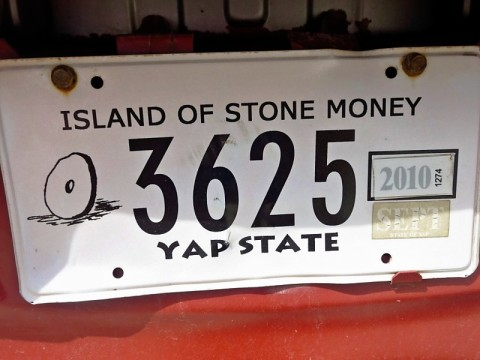
Yap stones and moneyness


For diligent readers who have trudged through my first two post on Yap stones (here and here), I promise this will be my last on the subject.

There is an interesting exchange between historian Cora Lee Gillilland, the author of The Stone Money of Yap: A Numismatic Survey (pdf), and critic David M. Schneider in the December 1976 issue of the American Anthropologist. Schneider was a well known anthropologist and contributor to The Micronesians of Yap and their depopulation.

In response to Gillilland's survy, Schneider issues a warning that:
Suffice it to say that traditional Yap does not have “money” in any technical sense of the word. None of the objects listed on page 1 [of Gillilland], like yar, gau, ma, or mbul, are money in any proper sense. It is certainly true that rai has been called “stone money” and that the literature which is cited (all of which is very far out-of-date) calls it “money.” And indeed, the Yapese themselves call rai “stone money.” But to call a “cow” a “dog” does not make the cow a dog. Even if the traditional European name of the object called rai is “stone money,” the most rudimentary scholarship could have established that it is not money.
Gillilland replies:
He [Schneider] has postulated a definition of "money" I know not whether exclusively his or one generally accepted by his discipline. For my part I am a historian, not an anthropologist, and as stated in the title and introduction of my work I take a numismatic view. Schneider's definition of the English word "money" is too narrow and traditional to be acceptable. I am not alone and would cite scholars such as Melville J. Herskovits, Alison H. Quiggin, and Paul Einzig who have all discussed this issue and have concluded that primitive media, including rai, are within the perimeters of "money."
The above quarrel is a great example of the sorts of debate one sees amongst those who have adopted the standard money-view the world. The money-view dictates that before embarking on a monetary exploration of Yap, all valued items on the island must be split into money or non-money. This is always a controversial process. Do we add yar, gau, ma, or mbul to our "money" category, all of which Gillilland lists as media of exchange? (See first post, #5). Furness too reports that for "small change", Yapese used yar (pearl shells), and that when used in exchange, mbul, or banana fibre mats, were valued at the same rate as a rai stone three hands spans in diameter. What about coconuts? Furness writes about a trade in which "Old Ronoboi paid twenty thousand coconuts for a cooking stove 'made in Germany' of thin sheet-iron". Or should we only add rai stones to the money category, relegating coconuts and the rest to the non-money category? If so, then monetary analysis of the island of Yap begins and ends with rai.

On the other hand, if we adopt Schneider's categorization, then nothing appears in the money category, in which case we can't do monetary analysis at all since all we've got is a barter economy. This argument over the contents of the category called "money" is never-ending.

The moneyness view starts its monetary analysis of Yap from a different perspective. Rather than splitting Yap's commodities into money and non-money, we try to analyze the monetary nature, or moneyness/liquidity, of all items that were traded on Yap. According to Gillilland and Furness, this list of traded items includes not only the famous stones, but also yar, mbul, gau, and ma. We can also add a few trade commodities like bĂȘche-de-mer (sea cucumber), turmeric, coconuts, and copra (dried coconut meat) to our list, as well as local commodities like housing materials, fishing equipment, canoes, bananas, yams, taro, and fish. Non-commodities like labour, war indemnities, funeral expenses, women, and dances were also all traded by the Yapese and find their way onto our list.

In adopting the view that the monetary nature of any item is a function of its liquidity, or its ability to be exchanged away, we shift monetary analysis from a focus on one (or a few) item(s) categorized as pure money to analyzing the relative liquidities of all items on our list. How often did each good appear in Yapese exchange? Would we see a flat distribution in which all items appear in roughly the same amount of trades, or a sloped distribution in which certain items appear in more trades? How does this distribution change over time? What sort of liquidity premia would each item have carried? For instance, if a yap stone could never be traded onwards, for how much less would the Yapese have valued that stone? What about the premia on mbul, coconuts, and labour?

So by shifting the axis of what we consider to be "monetary" from money to moneyness, we can ask ourselves a range of different questions. Nor do we need to follow Schneider and halt our monetary analysis when so-called barter prevails, since even then all goods will be liquid to some degree.

Enough yapping away about Yap (sorry, I couldn't resist).

Saturday, March 17, 2012

Old monetarism, new monetarism, and moneyness

Stephen Williamson had a good post recently in which he noted:

Central to Old Monetarism - the Quantity Theory of Money - is the idea that we can define some subset of assets to be "money". Money, according to an Old Monetarist, is the stuff that is used as a medium of exchange, and could include public liabilities (currency and bank reserves) as well as private ones (transactions deposits at financial institutions). Further, Friedman in particular argued that one could find a stable, and simple, demand function for this "money," and estimate its parameters. Lucas does that exercise here, and then uses the estimated money demand function parameters to measure the costs of inflation.
What's wrong with that? The key problem, of course, is that the money demand function is not a structural object. Some central bankers, including Charles Goodhart, figured that out. Goodhart's idea is a bit subtle, but there are more straighforward reasons to think that the parameters we estimate as "money demand" parameters are not structural. First, all assets are to some extent useful in exchange, or as collateral. "Moneyness" is a matter of degree, and it is silly to draw a line between some assets that we call money and others which are not-money.
I challenged him on how important moneyness actually is in new monetarist literature. Why, for instance, do so many new monetarist papers include some variable M if money is a matter of degree? You can't represent the idea "as a matter of degree" with a variable called M which by definition excludes all non-M assets. If you do so, you're already drawing lines between assets.

He never really responded to me. Steve, any thoughts? You've got the floor.

Thursday, January 5, 2012

Moneyness and liquidity options

Lars Christensen had an interesting post on moneyness and the Divisia indexes. He recommended an old paper of Steve Horowitz's which I read some time ago and have always respected. See A Subjectivist Approach to the Demand for Money.

Essentially, you can't believe in the concept of moneyness and also believe in the effort to count money through indexes like M1, M2, or even the Divisia indexes. The two efforts contradict each other. The best way to get a market indication of moneyness, or liquidity, is through the introduction of liquidity options. My comment follows:

If moneyness is a subjective concept, and I think it is, then trying to sum up various money assets into a Divisia index is problematic. That’s because an asset that appears to be high on one person’s subjective moneyness scale will be low on another’s, the result being that it is impossible to create objective categories for moneyness.

Ultimately, the best way to determine moneyness is to back out the market’s assessment of an asset’s liquidity premium. The best way to do this is to introduce liquidity options on various assets and see how the market prices these options. Anyways, this is science fiction for now since liquidity options don’t exist.


Previous posts on liquidity options.