Sunday, May 28, 2023

The gold trick, the 2023 edition

Along with the trillion dollar platinum coin and premium/perpetual bonds, the gold trick lies in the genre of strange-accounting-tricks-to-evade-the-US-debt-ceiling.

With the debt ceiling getting closer every day, gold bugs like James Rickards are calling for the U.S. to trigger the gold trick with "just one simple phone call."

I've explained the gold trick three times before [ here | here | here ]. I don't really feel like rehashing the intricacies of it again, so reread my posts if you want to absorb all the complexities.

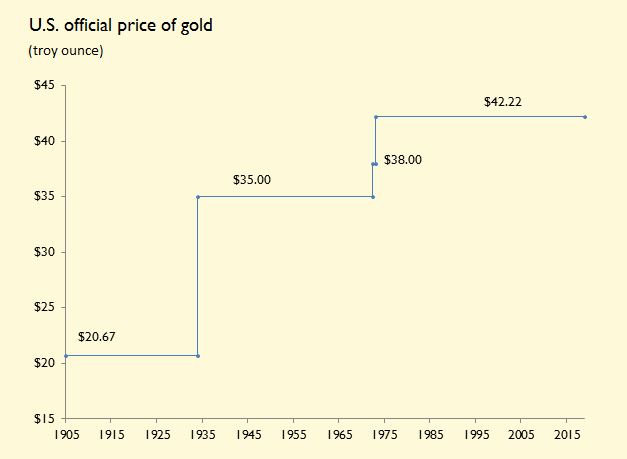
The idea, in brief, is that by increasing the U.S.'s official price of gold, which currently lies at $42.22, to the current market price of $2000 or so, the accounting value of the U.S. Treasury's stock of gold would suddenly be worth hundreds of billions more. The Treasury could then take the newly-realized extra value of its gold (known as "free gold") and submit it as collateral at the Fed, in the form of gold certificates. Once that collateral is submitted, the Fed can in turn instantiate a bunch of fresh dollars that the Treasury can spend.

Since none of these gold-related accounting changes qualifies as an increase in the official debt, voila, the Treasury can spend without running into the debt ceiling.

There's one big caveat. Rickards, for instance, goes off the rails when he writes: "one phone call from the Treasury to the Federal Reserve could reprice the Treasury’s gold from $42.22 per ounce."

It's just not that easy. All previous gold price increases, including the 1934 increase to $35, the 1972 increase to $38, and the 1973 increase to $42.22 required approval from Congress. Given that it is Congress that is the impediment to a straight debt ceiling increase, why would that very same Congress consent to a pseudo-increase via an change in the official gold price?

I suppose there may be enough gold-loving Republicans that the bill would pass. But as you can see, the gold trick is just not as effective as the premium bond/perpetual bond trick or the platinum coin trick, both of which avoid Congressional approval altogether.


The official price of gold illustrated:

Thursday, May 18, 2023

The UK can't figure out if crypto is gambling or a financial service. Why not both?

The UK is wresting with how to regulate crypto. Should it be treated as a financial service or as gambling?

The Conservative government wants to regulate crypto as a financial service. That is, it wants to bring cryptoassets within the framework established by the Financial Services and Markets Act, which governs the regulation of a wide range of financial services.

But a Treasury Committee made up a cross-party group of MPs criticized this approach yesterday, calling for consumer trading in "unbacked crypto" to be regulated as gambling. They say that regulating unbacked crypto as a financial service will create a halo effect that leads consumers to believe that this activity is safer than it is.

I don't think this needs be an either/or thing. The UK should regulate crypto as both a gambling product and a financial service. Here's how and why:

First, the argument for regulating it as financial service. Take a crypto platform like Coinbase. Coinbase does what regular investment dealers and stock exchanges do. It provides a set of order books, much like a stock exchange, and holds customers' crypto, much like a broker. The UK's existing financial services regulatory framework will be best equipped for ensuring these activities are safe, including having rules for custody, market manipulation, appropriateness, insider trading, and more.

Sure, in an effort to protect consumers you could in theory task the UK's Gambling Commission with regulating these sorts of capital markets activities, but it has no experience doing so and will be far out of its depth. Best to go with the closest-fitting regulator.

Second, here's why crypto should also be regulated as gambling. The Treasury Committee is right; much of the activity occurring on a venue like Coinbase is really just gambling. Unbacked crypto like bitcoin, dogecoin, ether, shiba inu, and floki are fast, fun, and potentially addictive 24/7 recursive betting games. (Not all crypto falls in the unbacked category. For instance, MKR tokens are backed, much like an equity.)

As a facilitator of unbacked coin betting, Coinbase should be subject to some of the same regulations as a casino or poker site, including rules surrounding gambling addiction, advertising, and underage access. The UK's Gambling Commission will be the best-equipped body for applying these requirements, certainly better than the UK's financial regulator. Furthermore, recognition of unbacked crypto trading as gambling would diminish any 'halo effect' brought on by bringing venues like Coinbase under the ambit of financial regulation.

So crypto shouldn't be either gambling or a financial service, but a one-two punch of both, with the appropriate regulator taking responsibility for that facet of crypto for which they have the best expertise.

Tuesday, May 16, 2023

If Wise can pay interest, why can't USDC?

Wise, a fintech, is now offering its U.S. customers 4.13% interest as well as FDIC deposit insurance. Meanwhile, the native yield on USDC stablecoins is still at 0%. Nor is USDC insured.

If Wise can offer interest and insurance to customers, why can't Circle (the issuer of USDC) do the same?

Wise and Circle are alike in a legal sense. Neither is a bank. Both are licensed as money transmitters. So why can one money transmitter offer a valuable set of services, but the other seemingly can't?

To be more accurate, it's not Wise itself that is offering these services. Wise is neither a bank nor a money market fund, so I'm pretty sure it is legally prevented from paying interest. And since it's not a bank, it can't be a member of FDIC. Rather, it is Wise's own bank, JP Morgan Chase, that is offering these services to Wise customers. Wise simply passes on the interest along with the insurance coverage.

So if Wise is just a feeder for JP Morgan, connecting its customer base to the bank, why can't Circle perform the same feeder role with its own bank, BNY Mellon, and USDC users?

I suspect one factor preventing this is the pseudonymity of stablecoins. There are many users of USDC, but Circle has only collected ID from a small fraction of them. A big chunk of USDC's pseudonymous user base is comprised of financial machines, or smart contracts, for which the concept of identification is meaningless. As for individuals or businesses who hold USDC, they may not be willing to, or can't, pass through a traditional verification process. Banks, however, have very strict onboarding rules. They must collect the ID of every single customer.

In short, it's probably quite tricky for Circle to feed USDC's mostly pseudonymous user base into an underlying bank in order to garner interest and insurance, at least much harder than it is for Wise to feed its base of known users into a bank.

It's possible that some USDC users might be willing to give up their ID in order to receive the interest and protection from Circle's bank. But that would interfere with the usefulness of USDC. One reason why USDC is popular is because it can be plugged into various pseudonymous financial machines (like Uniswap or Curve). If a user chooses to collect interest from an underlying bank, that means giving up the ability to put their USDC into these machines.

This may represent a permanent stablecoin tradeoff. Users of stablecoins such as USDC can get either native interest or no-ID services from financial machines, but they can't get both no-ID services and interest.

Thursday, May 11, 2023

Back to 1875

The last time I wrote about settlement speed was back in 2017. In that article I published a chart of the history of U.S. securities settlement speed, which I only recently had the chance to update. 

Well, here it is:


You'll sometimes catch technologists making the claim that settlement speed is a function of societal advancement. That is, in the old backward days of yore, settlement used to proceed at horse-and-carriage like pace, but as technology improves we gain the capacity to quicken settlement up to hours, then minutes, seconds and finally zero.

But as the chart illustrates, the technological explanation of settlement speed isn't right. We're about to return to t+1 (or next-day settlement) in 2024, the same pace we had back in 1875. Settlement speed isn't dictated by technological advancement, folks, it's the end result of a conscious choice that takes other factors into consideration, such as efficiency.

I was going to write an article explaining this more clearly, but I was reminded of a post I wrote for AIER back in 2021, and hadn't yet re-published here, which already makes this point more than adequately. So without further ado, read on:

In Finance, Slow is Good

In an age of instant communications, a stock trade takes a leisurely two days to settle. That is, if you buy some shares of Tesla on Monday, your brokerage won’t receive the shares (or pay the cash) until Wednesday. In industry speak, this is called T+2.

This seems an achingly long time to settle a transaction. Indeed, last month, the CEO of Robinhood, a discount brokerage, went so far as to suggest that there is no reason why “the greatest financial system the world has ever seen cannot settle trades in real time.”

In fact, there is a very good reason to eschew real-time settlement. Going slowly is a way to capture one of the world’s great natural financial forces: netting. Go too fast and you lose out on it.

To understand the magic of netting, let’s consider a world without it. Imagine a world with real-time settlement, where if I buy Tesla on Monday at 10:49 it settles at 10:49.

Say that I buy $100 worth of Tesla shares from you. We each use a different brokerage. With settlement proceeding in real time, the moment after the trade is made your brokerage will transfer the Tesla shares to my brokerage. My brokerage will simultaneously wire your brokerage the $100.

That’s two transactions between the brokerages.

Now let’s say that thirty minutes later, Jill decides to buy $100 worth of Tesla from Tom. Tom and I are clients of the same broker, while you and Jill are clients of the second broker. As before, the brokerages will have to settle up immediately. Tom’s brokerage will have to transfer the Tesla shares to Jill’s brokerage, and Jill’s brokerage will have to wire Tom’s brokerage the $100.

The two brokers now have to do four transfers between each other.

But if settlement is slowed by just a little bit, then the participants to this trade get to enjoy the magic of netting.

Let’s repeat all those transactions, but wait an hour before settling up accounts. When the hour is up, the brokers have two trades to settle up. But instead of processing both separately, they can just cancel them out. In this example, the inter-brokerage flows perfectly counterbalance each other. Our $100 Tesla trade is offset by that of Jill and Tom. And so the two brokerages needn’t do any transactions with each other. The first brokerage simply balances Jack’s and my account while the second brokerage balances Jill’s and your account.

And that’s why netting is so powerful. By making everyone wait just a little, it cuts down on the amount of work the system must do, in this case reducing brokerage-to-brokerage transfers from four to zero.

The netting afforded by T+2 settlement is so efficient that it allows the National Securities Clearing Corporation, which processes all trades involving U.S. equities, to reduce average daily equity volume of around $1.7 trillion by about 98%, leaving just a tiny $38 billion to be settled.

Faster is often better. But, in finance, a bit of tardiness can be a good thing. That’s why we should be wary of Robinhood’s call for real-time settlement. It would put an end to netting.

In fact, we already have financial systems that have gone real time only to double back and reintroduce slowness. It’s an interesting story, one worth recounting if only to show why real-time stock settlement is no panacea.

In the 1990s, central banks around the world began to roll out a new type of large-value payment system: real-time gross settlement systems (RTGSs). People like you and I use banks to make payments. But banks in turn must make payments amongst each other––very large payments––and for that they use their national central bank’s large-value payments system. This bit of central bank infrastructure is one of the most important, unsung pieces of any nation’s plumbing.

For decades, large-value payment systems operated on a deferred net settlement basis. Settlement was slow by design. Throughout the day, banks initiated payments to each other using the central bank platform. When 5:00PM finally rolled around, all reciprocating debits and credits were netted off and then settled between banks. Deferring settlement to the end of the day allowed for the number of bank-to-bank payments to shrink to a tiny fraction of total business transacted. It was incredibly efficient, albeit slow.

With the arrival of RTGSs in the ’90s, large-value payments were settled instantly, rather than at the end of the day. When Wells Fargo pays Citibank $100 million at 9:52AM, this involves an immediate transfer of $100 million in settlement balances at the Federal Reserve.

The ability to make a real-time payment is valuable. Sometimes you really need to wire funds to someone by 2:31PM, not 2:45PM.

However, real-time settlement at the central bank meant doing without the benefits of netting. So RTGSs had to process a lot more transactions than the deferred net settlement systems that they replaced. To keep up with this payments firehose, banks had to maintain a much larger hoard of central bank money on hand.

In an effort to reduce this hoard, banks adopted a strategy of waiting for an incoming payment to arrive before making an outgoing payment. Unfortunately, with all banks adopting this strategy, the result has been that payments often get pushed towards the end of the day. Many payments experts worry that this pattern isn’t healthy, since it increases the banking system’s vulnerability to operational problems.

The solution that emerged in the mid-2000s was the introduction of a new piece of central bank architecture: liquidity savings mechanisms (LSM). Central banks still allowed banks to settle payments in real time via the RTGS, but they also provided the option of submitting payments to an LSM, or central bank queue. A payment might wait in the LSM for 1 minute, 10 minutes, or 1 hour, until offsetting payments from another bank arrived to cancel it out.

By slowing down settlement, LSMs reintroduced the wonders of netting. And as a result, banks no longer had to keep such a big hoard of central bank money on hand. The Bank of England, UK’s central bank, estimates that after installing its LSM in 2013, the amount of liquidity that UK commercial banks required to make payments fell by 20%. So the same amount of business was being conducted over the Bank of England’s large-value payments system, but much less work was being expended to conduct that business.

LSMs have made the financial system safer by encouraging banks to make payments earlier in the day. After all, the quicker that a bank submits a payment to the LSM, the more time it will have to be matched. This is a neat little paradox. Queues, notorious for causing delay, actually speed things up.

Having taken a detour through central bank large-value payments systems, let’s return to the original debate over two-day stock settlement. Sure, stock markets could follow Robinhood’s advice and introduce real-time settlement. But before long, we’d all start to miss the magic of netting. Just as central banks reintroduced delays by building LSMs, stock markets would likely take steps to bring back slow.

If anything, what the central bank RTGS/LSM two-step teaches us is that we need a good balance between fast and slow. Sure, real-time settlement is a nice feature. But let’s also have delayed settlement. If brokerages have a choice to use some combination of two-day and real-time settlement, we may arrive at a socially optimal stock settlement rate.

Monday, May 8, 2023

A YIMBY approach to bitcoin mining

The Biden government has adopted a NIMBY approach to bitcoin mining. But I think YIMBY (with a twist) would be a better policy.

In an attempt to have U.S. crypto miners pay "their fair share of the costs imposed on local communities and the environment," President Biden has recently proposed a tax on miners equal to 30% of the cost of the electricity used. The White House believes that a national tax would be better than leaving it up to individual states, because that would ensure that mining is "not simply pushed from one local community to another."

The inconsistency here (and the White House seems to recognize it) is that the tax will push miners to "relocate abroad," often to places with "dirtier energy production." So on net, Biden's NIMBY approach may actually increase the fallout from bitcoin and other mined coins (a list that includes not only bitcoin but litecoin, zcash, and dogecoin).

The White House tries to get out of this contradiction by listing other countries that are moving to "restrict crypto asset mining," including China, so presumably it thinks that if everyone adopts the same NIMBY approach, then mining will effectively be eradicated. But I'm not buying that argument. There will always be some bloc of countries willing to host miners.

If the Biden government is genuinely concerned about the effects of crypto mining, it should scrap its current plan and adopt a YIMBY approach to crypto mining. But it should twin this YIMBY approach with an environmental handling fee on end-users of mined coins.

Widespread crypto mining is a symptom of something deeper: casual crypto speculation. Speculators drive up the prices of bitcoin and other mined coins, which pulls mining capacity online. Instead of attacking the symptom, like Biden proposes, better to go straight to the root, the actual gambling. When faced with a tax or handling fee on purchases of mined coins (unmined ones wouldn't be affected), Americans would opt for alternative bets. This would induce the global prices of bitcoin, dogecoin, zcash, and litecoin to fall. Lower prices would in turn push the mining industry to shrink, not only only in the U.S., but all over the world.

A mining industry would still exist, albeit on a smaller-scale. This is where YIMBY comes in. For efficiency's sake, the much slimmer mining industry should be allowed to operate wherever it sees the most opportunity. If that happens to be the U.S., then so be it. Leave it be.

The Biden administration claims that it is concerned about the environmental costs of mined crypto. Alas, its NIMBY policy will only lead to the same amount of mining, except dirtier and less efficient. With YIMBY and a tax, not only is mining reduced; what's left is the better kind of mining.

Thursday, May 4, 2023

Comparative cross-border payments: Wise vs USDC

image via Guy J. Abel and Stuart Gietel-Basten

 A popular response to my recent tweet about remittance company Wise went like this: "but JP, stablecoins are better for remittances; they're instant and cheap!" In this post I want to talk about comparative remittance costs. The problem with most of the responses to my tweet is that they incorrectly compare the cost of making a plain-vanilla stablecoin transfer to a traditional cross-border payment.

Can't do that folks! That's an apples-to-oranges comparison.

A traditional remittance, say like those offered by banks or transfer companies such as Wise, is made up of a bundle of four services. By contrast, a stablecoin transfer (I'll use USDC as my example) offers just one service. To accurately compare USDC to a remittance platform like Wise, you've got to add back the three missing services, and their associated costs.

Here are the four bundled services that Wise offers when you make a cross-border transfer:

1) verification and on-ramping: first, a sender must pass a series of Wise checks so that they can use Wise's platform. Think of this as Wise justifying your money to regulators. Next, Wise pulls your funds from your bank and onto its platform.
2) the transfer itself: once your funds have arrived at Wise, a lattice of databases moves your funds across Wise's platform towards their final destination.
3) a foreign exchange conversion: along the way, Wise converts the sender's currency to the recipient's currency.
4) off-ramping: Wise takes the funds off its platform and deposits them to the recipient's bank account.

By contrast, USDC offers just one of these services; the transfer itself (#2). In order to be verified and onramp into USDC (#1), convert from U.S. dollars to local currency (#3), and offramp back into spendable fiat (#4), both the sender of USDC and the recipient will need to use a third-party, most likely a cryptocurrency exchange. Alas, crypto exchanges extract their pound of flesh.

As an example of how to do an apples-to-apples comparison, I recently looked into the economics of a USDC remittance to see if that option made sense for me. I often sell stuff in U.S. dollars and need to repatriate my funds and convert them into Canadian dollars to pay for living expenses.

Here's what my own personal USDC calculation looks like:

Say someone in the United States owes me US$2,000 for services rendered. As payment, they offer to transfer me 2,000 USDC. I provide them with an address at my crypto exchange, BitBuy, and they send the payment. 

Next, I'll have to do a foreign exchange swap on BitBuy, trading out of USDC and into Canadian dollars. Alas, BitBuy's USDC-to-Canadian dollars market isn't very liquid, and the best rate I could get when I checked yesterday was 1.3569 (compared to the institutional rate of 1.3598). The loss from a loose bid-ask spread is called slippage, and it represents an implicit but very real C$6 fee.

On top of that I'd have to pay a 2% trading fee to BitBuy, or C$54. (If I was a high-volume trader, the fee would be much lower, but I'm not.) Next, I have to move my Canadian dollars off the exchange and into my bank account. Alas, BitBuy charges a 1.5% withdrawal fee, so that adds another C$40.

All those fees works out to C$100. That's not cheap, basically eating up 3.7% of the entire transfer. My current remittance route, which uses a U.S. dollar bank wire and a uniquely Canadian kludge called Norbert's Gambit (buying a ETF with US dollars and selling it for Canadian dollars) is significantly cheaper.

Some Canadian crypto exchanges offer better rates. With NDAX, for instance, I'd be paying around $10 on USDC-to-Canadian dollar slippage, $5.60 on trading fees, and $5 to withdraw to my bank, for a total of $20.60. That's an improvement.

However, keep in mind that what I'm describing (i.e. using BitBuy or NDAX to convert USDC to Canadian dollars) represents just the second leg of the entire remittance route. I haven't even included the fees that my U.S. sender must incur to onboard into USDC, nor have I accounted for any on-chain fees. By contrast, Wise will do both legs of this transfer for just US$14. That's tough to beat.

Your own personal estimation for whether to go with a traditional remittance or stablecoins will differ from mine, of course, depending on how cheap your local cryptocurrency exchange is (as well as that of your counterparty), and the availability and price of options like Wise or Western Union. Just make sure you include all stablecoin-related fees so that you're not mistakenly comparing apples to oranges. Stablecoins don't work for me, but they might for you.

Monday, May 1, 2023

The myth of crypto exceptionalism

"It is widely recognized – including by a sitting SEC Commissioner – that existing SEC registration and disclosure requirements are incompatible with digital assets, which differ fundamentally from the stocks, bonds, and investment contracts for which the securities laws were designed and that the SEC traditionally has regulated. The SEC at a minimum must set forth how those inapt and inapposite requirements are to be adapted to digital assets. But the SEC has refused to do even that."

- Coinbase, Inc.'s petition for writ of mandamaus to the United States Securities and Exchange Commission, April 2023 [pdf]

The claim that Coinbase makes in the above quote is a perfect example of what I call crypto exceptionalism.

The idea of crypto exceptionalism begins with the belief that crypto assets are fundamentally different from any sort of financial asset that preceded them. And so existing laws and regulations are inappropriate, (or "inapt," as described by Coinbase) and new rulemaking is required. This sounds right, at least on the surface, but it's a myth.

Stepping back in time, what happened in 2009 with the emergence of Bitcoin was not the creation of a fundamentally new type of asset. Rather, a new sort of financial database emerged: the blockchain. Others blockchains soon followed Bitcoin. But these new databases host the very same breadth of financial assets that pre-blockchain financial databases have always hosted: scams, stocks, deposits, ponzis, loyalty points, derivatives, gambling, bonds, loans, coupons, voting rights, and more.

There is nothing new under the sun. Go back to Ancient Rome or 1720s Paris and you can already find all of today's financial assets in use, including those currently traded on blockchains. That's why financial regulations created long ago (the ones Coinbase decries as "inapposite") remain relevant; they apply to financial typologies that are essentially eternal.

If you haven't recognized it, what I'm describing is just the digital substrate agnosticism approach that I sketched out in my previous post. We shouldn't treat the digital substrate on which financial assets are printed, or hosted, as being overriding. A blockchain is just another digital substrate, with one or two quirky characteristics. Rather, it's the assets themselves that should be the determining factor in the application of financial law.

If Coinbase's crypto exceptionalism is wrong, and changes in database technology do not create entirely new assets and thus don't merit new rules, what Coinbase does deserve is the following: rule makers need to show how the existing frameworks built to govern our eternal financial typologies map onto these new databases. While there's not much difference between an Azure or Oracle database, blockchains are quirky enough to merit a few extra pages of guidance, and perhaps a bit of tailoring where appropriate.

Wednesday, April 26, 2023

A quick defence of digital substrate agnosticism (or, why banks should be able to issue stablecoins)


In principle, I'm pro banks-issuing-stablecoins.

I think banks should be able to issue dollar IOUs on whatever digital substrate they see fit, whether that be an Azure SQL database, an Oracle database, or a blockchain. And they should be allowed to get deposit insurance for any of those dollars, regardless of the substrate on which those dollars are recorded. The medium should be irrelevant.

Banks should also be able to run their blockchain-based dollars on a fractional reserve basis, just like they already do with their Oracle and Azure-based dollars. That's right. Bank stablecoins shouldn't be required to operate on a full-reserve basis.

So when I see the following recently-announced initiatives, I sort of shrug and say, sure, that's fine. In Japan, three banks are going to test stablecoins while in Europe, Societe Generale wants to issue a stablecoin called EUR CoinVertible.

The Japanese example is notable, because it stems from recent amendments to Japan's Banking Act, the Payment Services Act, and the Trust Business Act allowing banks, fund transfer companies, and trusts to issue stablecoins.

Meanwhile, in the U.S., the Fed and its sister regulators have taken a different path than the FSA, recently suggesting that issuing tokens on a blockchain is "inconsistent with safe and sound banking practices." That doesn't mean that U.S. banks can't issue blockchain-based dollars, but I suppose it's a stern enough put-down that they won't ever bother.

I'm not a fan of the U.S.'s approach. Banking authorities don't say: hey, Bank of America, we'd prefer you use an Oracle database instead of an Azure one for your IOUs. Likewise, they shouldn't get to say: hey, Bank of America, don't use an Ethereum database instead of an Oracle one.

Mind you, unlike the crypto idealists, I don't think blockchains are the revolution that they are often made out to be. They're just another database, one with some quirky characteristics, so let banks figure out on their own whether they are a worthwhile medium or not. There's a high likelihood that blockchain-based dollars won't be successful with customers, but banks won't really know until they experiment.

One last point on this topic. In the same vein of substrate neutrality, if banks are going to use some sort of blockchain to issue dollars, they should be required to subject their blockchain-based dollars to the same anti-money laundering checks to which their non-blockchain based dollars are beholden. 

That means identifying all their users. This would be a departure from current practice among blockchain-based dollar issuers (like Tether and Circle) whereby they do KYC on just some users. A defence of substrate agnosticism suggests that the current KYC-lite touch isn't enough.

Monday, April 24, 2023

Zelle vs Interac e-Transfer, or why it's so difficult to kickstart a payments network in the U.S.

It's difficult to grow a payments product to universality in the United States, and that's partly due to the fact that the U.S. has a stunning 4,127 banks, 4,760 federal credit unions, and 579 savings & thrifts institutions, for a total of 9,466 depository institutions.*

Let's compare that to Canada. The rule of ten applies to most Canadian/U.S. comparisons. That is, the U.S. has around 10 times the population, so to get Canadian equivalents just divide by ten. (For example, there are 13,515 McDonald's restaurants in the U.S. Meanwhile, Canada has 1,363. That's almost perfectly in-line with the rule of ten's prediction.)

The rule of ten suggests that if the U.S. has 9,466 depository institutions, then Canada should have 946. But that isn't the case. Canada has 81 regulated banks and around 208 credit unions, for a total of just 289 depositories. (I am counting the 213 credit unions belonging to the Desjardins co-operative federation as one entity.)**

The rule of ten particularly fails with respect to banks. Canada has just 81 banks, not 412 as suggested by the rule. Banks are more influential than credit unions because they tend to be much larger.


So why is this data relevant to payments? A payments network is really only useful if it has a lot of participants on it, but a lot of participants aren't going to be on it in the first place if it isn't useful. That's the chicken-and-egg problem of payments networks.

To solve the chicken-and-egg problem, it helps to have a few large actors a vanguard commit to using the network at the outset, which kickstarts its usefulness, and then everyone else gets dragged into joining up. Voila, universal payments.

When you've got 9,466 depository institutions, it's hard to build a strong vanguard group in order to drive quick adoption of a new payments network.

Take The Clearing House's Real-Time Payments (RTP) network, for instance, a U.S. payments network which was launched in 2017. Out of the U.S.'s 9,466 depositories, RTP has attracted just 285 participating institutions, effectively limiting RTP's reach to 65% of all U.S. checking accounts. (The 65% number is from RTP's website.)*** That's not bad, but it's not great.

Another example is Zelle, a U.S. bank-owned person-to-person payments network that was introduced in 2017. By 2021, Zelle boasted 1,700 banks and credit unions on its bank-to-bank payments network. That's better than RTP, but according to Zelle, this still only represented 74%, or 577 million of all U.S. checking accounts, in 2021. (As of early 2023, Zelle reports having 1,900 financial institutions on its network, so it probably now connects 75-80% of all U.S. checking accounts.)

In Canada's case, with just 81 banks and 208 credit unions, it's much easier to build a vanguard group to drive a payments network forward.

For instance, Interac e-Transfer is the Canadian equivalent to Zelle, providing instant person-to-person transfers via bank and credit unions. As of 2023, Interac e-Transfer has 250 participating banks and credit unions. (It lists Desjardin Group, a federation of 213 credit unions, as a single entity). That's almost all of Canada's 289 depositories, and effectively 100% of all Canadian chequing accounts. That's ubiquity for you.

Admittedly, Interac e-Transfer has been around a lot longer than Zelle and RTP, having debuted in 2003, and so it has had more time to spread into all the cracks. (I wrote about Canada's big head start in instant payments a few years ago.) But even at the outset of the adoption process, e-Transfer enjoyed buy-in from Canada's five biggest banks (Royal, TD, Scotiabank, CIBC, and Bank of Montreal), which together owned 86% of all Canadian banking assets at year-end 2003. That's a huge vanguard group. The chart below, which uses 2022 data, gives a good feel for how significant this is.

The above chart also illustrates how small any U.S.-equivalent vanguard group will ever be. Zelle's 2017 group of 30 first-adopters may have seemed large on the face of it. After all, it included America's largest banks: JP Morgan Chase, Bank of America, Wells Fargo, Citibank, US Bank, PNC, and Capital One. Yet this vanguard still only constituted 52% of total U.S. banking assets, much less than the 86% committed to Interac e-Transfer on day one.

The diffuse nature of U.S. banking (and the concentrated nature of Canadian banking) will play into the upcoming launches of FedNow and Real-Time Rail (RTR), two instant retail payments system belonging to the Federal Reserve and Bank of Canada, respectively. I'd expect RTR usage to amp up quickly, given that Canada's big-5 banks will likely help sponsor it. FedNow adoption will lag. It's just not that easy to get 9,466 institutions on the same page.


* Number of US banks and savings/thrifts is from FDIC. Data on credit unions is from the NCUA
** Number of Canadian banks is from OSFI. Number of credit unions is from CCUA
*** A tweet where I list my data source for RTP data