Saturday, February 26, 2022

What's the marketing strategy for the Fed's CBDC?

Last month the Federal Reserve published it's long awaited report on central bank digital currency, or CBDC. Here's my quick response.

The product that the Fed is sketching will probably work fine. That is, the technology will be perfectly functional, the buttons will do what they're meant to, and the funds will get from A to B.

From a marketing point of view, however, I think the Fed's vision for CBDC is incoherent. No one is going to use the stuff. It's very possible that the Fed hasn't considered this problem. Having never dealt directly with the public, it probably doesn't have much of a product marketing team.

The main marketing pitch (as far as I can extract from the report) is that a U.S. CBDC will offer you, the American citizen, money that is "free from credit risk and liquidity risk." As a liability of the Fed, CBDC would be the "safest digital asset available to the general public." In addition to safety, the Fed's CBDC would do all the other things that money does: you could send $50 to Aunt Sally and buy clothes at Walmart with it.

Important detail: one of the key design features of the Fed's CBDC is that it would be intermediated. Instead of being offered directly by the Fed, commercial banks will manage people's CBDC.

But how on earth do you market this product?

Here's an imaginary conversation between Fed Chair Jerome Powell and a potential customer who happens to be walking past the Fed.

POWELL: Good morning sir. Can I ask you who you bank with?
PASSERBY: Chase.
POWELL: Can I interest you in switching some of your Chase deposits to CBDC?
PASSERBY: Nah, I don't want no CBD oil.
POWELL: Not CBD oil. CBDC. Central bank digital currency. It's the Fed's new product.
PASSERBY: (skeptically) Dunno. Is it better than Chase?
POWELL: (clears throat, looks at script) It's the safest digital asset available to the general public.
PASSERBY: (wide-eyed) Whatchoo sayin?! My Chase deposits ain't safe? Where's the nearest ATM?
POWELL: Relax, relax, sir. That's not what I meant. Your funds are perfectly safe at Chase. They're covered by government deposit insurance.
PASSERBY: Phew. But you said that CBD is safer.
POWELL: Both products are very safe, sir. You have nothing to worry about.
PASSERBY: (suspicious) So why should I switch?
POWELL: (reads from script again) While Americans have long held money in digital form, for example in bank accounts, a CBDC would be different because it's a liability of the Federal Reserve, not a liability of Chase.
PASSERBY: Ok, I think I get it. It let's me avoid my bank! Chase won't be able to $#@ me over anymore. Get me some of that stuff, man. I hate banks!
POWELL: Well, not quite, you see it's intermediated. You'll still need to use Chase to get CBDC. Your bank will handle your CBDC for you.
PASSERBY: Huh? If Chase is handling my CBD, what's the difference between CBD and my regular Chase account?
POWELL: ....
PASSERBY: I mean, they ain't going to charge me a fee for running it, are they?
POWELL: ....

Powell is stumped by the last two questions. That's because the Fed's CBDC just doesn't add up from a marketing perspective: it doesn't solve any of the passerby's problems. "Safe" is something that Americans already have thanks to deposit insurance. And the one thing that a CBDC might offer – it's not provided by a hated bank – has been taken off the table thanks to the Fed's decision to go with an intermediated model, for which banks will probably charge a service fee.

Maybe I'm being unfair. It could be that a smart marketing team can come up with a script in which Jerome Powell successfully convinces a passerby to switch from Chase to CBDC. But I just don't see it. 

If a product can't be marketed, it either needs a rethink or it shouldn't exist in the first place.

Friday, February 18, 2022

Bitcoin failed as a tool for funding the Ottawa protestors, and that's a good thing for Canada

[For CoinDesk, here are my thoughts about bitcoin, the Ottawa truckers, and the Emergencies Act.]

Bitcoin Is a Bad Way to Fund the Ottawa Protest, and That's a Good Thing

Bitcoin has been advertised as a viable way for getting funds to the truck convoy protestors in Ottawa when fiat-based tools like GoFundMe don't work. But it has proven to be a less-than ideal way to fund the trucker convoy. And that's a good thing for Canadian democratic society.

The 20-day Ottawa protest has long since transitioned into illegal territory. Like any other illegal protest on Canadian soil, it needs to be ended. Unreliable funding only helps to reduce the mischief, especially if that funding can be nudged into functioning even less reliably.

Don't get me wrong. As a Canadian, I realize that democratic protest is vital. It is one of many ways for citizens to change minds and initiate change. Money is integral to supporting protest. And the Ottawa trucker convoy – which started as a protest against coronavirus vaccine mandates – has aptly demonstrated the power of several new protest-friendly, internet-based financial tools: crowdfunding, instant personal bank transfers and bitcoin.

A GoFundMe campaign to fund the Ottawa convoy began on Jan. 14, hitting $7.9 million just a few weeks later. When the campaign was canceled by GoFundMe on Feb. 4 for breaking its terms of service, a replacement campaign hosted on competing U.S. crowdfunding site GiveSendGo beat that amount within a few days. It currently stands at $9.5 million.

A parallel bitcoin fundraiser, organized by a trucker-support group called HonkHonkHodl, on Tallycoin, a bitcoin-based crowdfunding site, quickly raised 21 bitcoins ($900,000). Another $400,000 was reportedly donated to organizers via Interac e-Transfer, Canada's version of Zelle.

When protest becomes illegal, it's the task of the police to step in and break it up. Any inability to do so on their part hurts one of the other key pillars of democratic society: rule of law. If the law no longer functions, Canada would quickly descend into a state of perpetual chaos.

By Feb. 9, the protest had reached the illegal stage. That day, the Ottawa police department notified protestors they were engaging in mischief, a criminal offense. The "unlawful blocking” of streets was resulting in citizens being denied the "lawful use, enjoyment and operation of their property," declared the police department's press release, and the convoy was henceforth required to cease its blockade of downtown Ottawa.

But the protestors didn't comply.

When protests are illegal, law enforcement has a number of tools at its disposal to restore order including arrests, fencing, space control and negotiation. But the Ontario provincial government added an additional lever that (as far as I know) has never been used to control an illegal Canadian protest: It shut down the convoy's massive crowdfunding campaign.

Ontario's attorney general secured a restraint order from an Ontario judge freezing all donations received via the convoy's two GiveSendGo campaigns. The restraint order, which was issued under Section 490.8 of Canada’s Criminal Code, also extended to GiveSendGo funds already transferred to convoy organizers, including the convoy’s non-profit organization. The legal justification for the restraint order was the usage of the funds to commit the "indictable offense of mischief."

GiveSendGo boasted that the restraint order didn’t apply to it, but it was an empty boast. Any Canadian bank that received a wire transfer from GiveSendGo for credit to the convoy’s bank account was obligated to immediately freeze it, on pain of breaking the law. The order had neatly crippled the $9 million in crowdsourced funds.

Although the Tallycoin bitcoin fundraiser was not named in the restraining order, it was no less vulnerable to being frozen than the funds on GiveSendGo. The coordinators of the bitcoin fundraiser had envisioned distributing the 21 crowdfunded bitcoins to the same set of convoy leaders who were beneficiaries of the GiveSendGo campaign. The convoy leaders would then convert the bitcoins into Canadian dollars via an exchange and spend them.

It's pretty easy to spot the weakness. The very same judge who issued a restraint order on the nonprofit organization's GiveSendGo funds could have also issued it on the bitcoins raised on Tallycoin by the nonprofit. No bitcoin exchange in Canada was going to touch those funds, thus confining the 21 bitcoins to the same purgatory as the $9 million in GiveSendGo funds.

The coordinators of the bitcoin fundraiser have since shifted to a complicated strategy of paying bitcoins directly to truckers, the idea being to avoid single points of control. But evading centralized infrastructure means subjecting truckers to all of bitcoin’s pain points, reducing the fundraiser’s effectiveness so it shouldn’t be much of a concern to law enforcement.

Efforts to quell the illegal protest have since crescendoed with the federal government's invocation of the Emergency Measures Act, a law that gives the federal government extra powers during times of national crisis. Among other things, the Emergency Measures Act temporarily allows Canadian financial institutions to freeze accounts of any individual or business affiliated with the illegal blockades. A court order need not be secured, and the government says it will protect the banks from being sued for damages.

In addition, financial institutions must disclose to the Royal Canadian Mounted Police or Canada’s intelligence agency, CSIS, whether they are holding funds for participants in the protest.

The measures will help foil bitcoin person-to-person funding attempts. The RCMP has already sent letters to Canadian cryptocurrency exchanges asking them to cease dealing in 30 different bitcoin addresses, presumably those involved in the Tallycoin fundraiser. Because bitcoin transactions are public and traceable, exchanges will be able to freeze trucker accounts if they are linked to the embargoed addresses.

The powers afforded by the Emergency Measures Act make me very uncomfortable. It's one thing to use regular legal channels like Section 490.8 of the Criminal Code to secure restraint orders on large actors involved in mischief and unlawful blockades. That seems like a reasonable addition to law enforcement's arsenal of tools for ending illegal protests. We know it worked. The $9 million in GoFundMe funds are immobilized.

But it's a completely different thing to introduce special measures for freezing any and all accounts associated with the protest, and to do so without a court order or the opportunity for citizens to take banks to court. Undeserving Canadians who may have donated $20 to a cause they didn't entirely understand could get caught up in the blast radius.

Canadians don't yet know all the gritty details that led the government to invoke the Emergency Measures Act. But when the time comes for the automatically mandated official inquiry into the government's actions, the government will have to prove to citizens that it meant to prevent something more than just the "unlawful blocking” of Ottawa streets, but something truly sinister. Until it does so, the powers afforded by the Emergency Measures Act should worry all Canadians.


P.S.: After this was published, a class action suit brought by Ottawa-based businesses convinced an Ontario court to freeze the assets held by the individuals carrying out cryptocurrency fundraisers. Third-parties such as banks, crypto exchanges, custodians are instructed to cease all dealings with the crypto assets mentioned in the court order.  

This reinforces my two points. Bitcoin is advertised as a tool for dissent, but it's not very good at that role. And if regular legal remedies such as Mareva injunctions and Section 490.8 restraint orders are successfully being deployed to freeze funds, why do we need the extraordinary account freezing powers afforded under the Emergencies Act?

Thursday, February 10, 2022

The trucker convoy and "choking off" their funding

Look, I don't support the so-called "Freedom Convoy." Of the two big demonstrations currently going on in Canada the Freedom Convoy and the Fairy Creek protests  I'd pick the Fairy Creek protestors (who want to stop logging of old-growth trees in B.C.).

But I think some critics are going too far in calling for a "choking off" of the money that finances the convoy, as Mark Carney recently did. Carney went on to describe anyone sending money to the convoy as "funding sedition" and wants to "identify and thoroughly punish" the convoy's foreign funders. Meanwhile, Jagmeet Singh's NDP Party has launched a petition calling on the government to contact Joe Biden and "shut down funding coming from the US".

What Carney and Singh have in mind is probably the convoy's massive crowdfunding campaign. Initially launched on U.S.-based GoFundMe, the campaign was frozen last week citing police reports that the demonstration had become an "occupation". The convoy has since switched to a so-called "Christian" crowdfunding site called GiveSendGo. Funds raised via GiveSendGo now clock in at almost $8 million. Presumably Carney and Singh want this $8 million stopped.

I agree with the majority of Canadians (65%, according to Leger) who see the convoy as representing a "small selfish minority." This minority want to lever Canadians' Covid fatigue into a funnel for importing toxic Trumpism into Canada. 

However, Canadians have a right to protest. Any demonstration, whether it be Fairy Creek or the Ottawa trucker convoy, is inevitably going to involve some degree of disruption to the regular flow of life. That's how protestors attract attention and change minds. Protesters often need money, especially well-organized protestors. And crowdfunding sites, both domestic and foreign, offer them the ability to connect with donors.

We have rules about how far this disruption can go. Once this point is reached, an Ontario court will issue an injunction ordering an end to the protest, at which point the convoy must disband. Those who continue to gather are doing so illegally and can be arrested.

As far as I know, the Freedom Convoy has not been declared illegal by a judge. And so GiveSendGo is probably in its rights to host a fundraiser for the convoy. Until the protest has definitively crossed the line into illegal territory, talk of "choking off" funds is premature, indeed irresponsible it amounts to calling for the state to censor Canadians' ability to protest.

Nor does the fact that Americans are major contributors to the convoy justify a government-led choking-off of funding. The proper trigger for freezing funding isn't the nationality of a protest's financial contributors. The proper trigger is when the court deems the protest illegal, and whether law enforcement believes that its enforcement strategy requires a blocking of funds.

By the way, these same principles would apply if the Conservative Party's Andrew Scheer had called for a choking-off of funds to the Fairy Creek protestors. As long as Fairy Creek protest is legal (more on that later) the funds should be allowed to flow freely, even if lefty Americans are donating.

In the next few days things could get interesting. Imagine an Ontario court issues an injunction ordering the protest to end... but the protesters do not leave. The police begin to enforce the injunction by  removing illegal protestors, but the whole thing explodes into a riot. At this point one would expect GiveSendGo to pull the plug on the $8 million campaign. According to its own terms of service, GiveSendGo doesn't allow campaigns that "violate any law, statute, ordinance or regulation."

Spurned on by wingnuts on the American right, GiveSendGo could very well choose to ignore its own terms of service. Let's say that it keeps on hosting the convoy's now-illegal campaign. 

Is Canada helpless to stop the funds raised on a U.S. based platform from reaching the illegal protestors? Jagmeet Singh seems to think so, suggesting that we must contact the US administration to shut down funding.

Relax. Canada already has all the tools necessary to uphold the law. Before the funds can be spent by the convoy, GiveSendGo will have to wire the $8 million from its U.S. bank account to the Canadian bank account of Freedom 2022 Human Rights and Freedoms, the non-profit representing the protestors. Law enforcement can ask the non-profit's bank maybe Royal Bank or CIBC to freeze the convoy's account, should it deem this step necessary. Problem solved.

Incidentally, the Fairy Creek protestors in B.C. continue to raise funds on the Fundrazr crowdfunding platform. (Like the trucker convoy, GoFundMe froze Fairy Creek's first campaign, forcing it to pivot to an alternative platform.) The Fairy Creek protester's Fundrazr campaign hasn't been halted despite B.C. courts having issued and renewed an injunction restraining "unlawful interference by protesters," and Fundrazr's terms of service prohibiting the violation of "any applicable local, province, state, national or international law."

It could be that the Fairy Creek campaign's lawyers are being very careful about how they spend the funds. Or maybe the police's enforcement strategy doesn't yet extend to freezing the protester's funding sources.

But ultimately, sustaining the rule of law is vital (as Brian Lee Crowley so ably describes here). If putting a halt to illegal activities requires the extreme step of removing funding supporting those activities, then that's a justifiable step to take, whether that be the dollars raised by the Freedom Convoy or the protesters at Fairy Creek.


PS: A few hours after I posted this the Ontario government successfully petitioned the Superior Court to freeze the convoy's GiveSendGo funds based on the allegation that it is "offence-related property." Here are the relevant sections of the code. Unfortunately the government has given no indication of what the offence is.

Monday, February 7, 2022

Why stablecoins should not be regulated like Western Union

Here's an interesting bit of stablecoin trivia. Half of all Paxos stablecoins are currently lying inert in MakerDAO, a decentralized finance protocol. Half!

Founded in 2018, Paxos Standard, or USDP, is one of the elder stablecoins. Overseen by the New York Department of Financial Services, and backed by dollars held in insured banks and Treasury bills, Paxos Trust has issued $1.03 billion worth of its USDP stablecoins into circulation (according to its last attestation report). Of that, $499,996,054 currently sits in MakerDAO (see below).

$499 million USDP in MakerDAO

This data point is useful for illustrating how stablecoin issuers like Paxos Trust should be regulated.

We should be regulating financial products on a functional basis. That is, if a financial instrument or financial venue functions in a certain way, we should have a regulatory framework that oversees that function, and everything that functions similarly should fall under that framework, and everything that doesn't should be caught by a more appropriate framework.

Common sense, right?

So how are stablecoins being regulated in the U.S? One of the many frameworks that has been adopted is existing state-based money transmitter law. The biggest stablecoin USD Coin is issued by Circle Internet, a company that is licensed by around 40 different states to transmit money. Oddly, this is the same regulatory framework that applies to old-school remittance companies like Western Union. If you've never made a remittance before, here's how it works. A retail customers temporarily hand over a small amount of money, say $200, to a Western Union agent. The agent contacts a foreign Western Union office and tells them to provide cash to the customer's friend or relative.

In the early 2000s this money transmitter framework was expanded to cover the likes of PayPal. Whereas Western Union keeps customer funds for an hour or two, tops overnight, customers of PayPal keep balances in their wallet for months, even years. 

This storage function means that PayPal is doing something quite different than Western Union. And so the subsuming of PayPal (and other wallet providers like Venmo and Square Cash) under state money transmittal law in the early 2000s was probably a failure of functional regulation. A wallet business and a remittance business should be differently regulated. 

This mistake was unfortunate. Zooming forward to the 2020s and the dawning era of stablecoins, one hopes the same mistake is not made again. What function is being performed by the $500 million Paxos stablecoins locked inside MakerDAO? Not Western Union-style remittances. Not PayPal-style personal wallet services. Paxos stablecoins are serving as the building blocks for core decentralized financial infrastructure. If Paxos fails, the entire MakerDAO edifice experiences a deep shock, this effect cascading to all the secondary tools based on MakerDAO and from there to all the tertiary tools based on those secondary tools.

In a sense, the role being played by Paxos stablecoins is the same role being performed by Treasury bills and other safe assets like commercial paper or money market funds, which are the foundational bedrock for all sorts of traditional financial services.

Now, there is another $500 million worth of Paxos stablecoin that is not frozen in MakerDAO. This block of stablecoin may very well be serving a different function than the half billion block locked in Maker. (For instance, I hold $100 in Paxos tokens, and I suppose they function very much like the $100 I hold at PayPal.) But the key point is that while there are times when stablecoins function like PayPal and Western Union, in other circumstances they are performing a role that PayPal and Western Union never do, which is to serve as the substructure for a set of financial utilities. Which suggests that stablecoins merit a different regulatory framework, one better fit for that function.

I don't know what framework that should be. Banking, securities law, a special stablecoin license? But the old school money transmitter framework – which has very lenient requirements governing things like the safety of the transmitters underlying assets – is probably the wrong framework. If you serve as financial bedrock, you merit more robust regulation than Western Union. 

(And by the way, Paxos Trust is itself not regulated as a money transmitter. It operates under the NYDFS's stablecoin framework, which is stricter than money transmitter law, and may be sufficient).

Thursday, February 3, 2022

Don't bank on bitcoin banking the unbanked

Bitcoin evangelist Andreas Antonopoulos thinks that bitcoin can solve the unbanked problem.

If you've spent any amount of time studying the unbanked problem, you'll know that Antonopoulos's claim is wrong for all sorts of reasons. Firstly, the World Bank estimates that there are 1.7 billion people who lack a bank account or mobile money access, not 4 billion. More importantly, the main hurdle to having a bank account isn't lack of ID, as implied in Antonopoulos's tweet. It's that people don't have enough money to open an account.

According to FDIC [pdf], 49% unbanked U.S. households cite “don’t have enough money to meet minimum balance requirements” as a reason for not having an account—the most cited reason. "Personal identification, credit, or former bank account problems" is far down the list of most-cited reasons, coming in at fifth.

In the Philippines, the number of unbanked Filipino adults stood at an incredible 51.2 million in 2019, or 71% of total adult population. The topmost reason for not having an account is "not enough money" as reported by almost half (45%) of the unbanked (see below). Lack of ID documents is the third most cited reason, at 26%.

Bangko Sentral ng Pilipinas 2019 Financial Inclusion Survey [pdf]

The World Bank's 2017 Global Findex survey, which surveys more than 150,000 adults in over 140 economies, found that the most common reason (cited by two-thirds of the unbanked) for not have an account was "having too little money to use an account." Only one-fifth cited "lack of documentation and distrust in the financial system."

So let's not misconstrue the unbanked problem. As Yaya Fanusie put it last year: "People mainly lack financial services because they lack income and not the other way around. So, to effectively bank the unbanked, the key problem to solve is how to help people generate more income." Do read the rest of Fanusie's post, in which he provides level-headed critique of the ability for crypto to bank the unbanked.

Antonopolous really wants bitcoin to solve the unbanked problem. But if a household is too poor to to open a bank account, it's also too poor to buy some bitcoins. (Never mind that the last thing low-income families should be doing is gambling on wild bitcoin price changes.)

Bitcoin does solve a niche type of financial problem. Those who have been cut off from the payments system for political or legal reasons can use bitcoin as an censorship-resistant alternative payment rail. Sanctioned Cubans are using it. So do online shops that sell legal but controversial products like salvia divinorum or kratom. White supremacists cut off from PayPal rely on it for funding. And criminals use the bitcoin network, say to extract ransomware extortion payments or sell kiddie porn.

But this category of "unbanked" is small, and only partially overlaps with the 1.7 billion who are unbanked primarily because of poverty. Antonopolous does a disservice in grouping them together. He is banking on bitcoin solving a problem it's simply not fit to solve.

Tuesday, February 1, 2022

Three potential paths for the price of bitcoin


Are you wondering whether to buy bitcoin at $38,000? To help you with your decision, here are three visualizations of the future path for the price of bitcoin.

Path 1 (Bitcoin-as-money): A popular view among the bitcoiners is that bitcoin is ascending the rungs of monetization. That is, the stuff is slowly becoming money.

Yes, the orange coin is volatile right now, goes their story. But that's only because the world is still in the process of discovering bitcoin's incredible monetary properties. The price of bitcoin will continue to rise throughout this discovery process, and as it does so its volatility will decline (see chart below). At some much higher price in the future ($1 million? $10 million?), bitcoin will fully transition to universal money. Everyone will have some on hand for spending purposes. Bitcoin will no longer be volatile. It'll be as boring as the dollar. 

Path 2 (Bitcoin-as-bubble). Critics like Paul Krugman, Steve Hanke, Nouriel Roubini, Warren Buffett, and Nassim Taleb have suggested a different price path. Bitcoin is a bubble, they say. The bitcoin price will rise, peak, and finally collapse back to its fundamental value of $0 (see chart below). It's beanie babies and tulips all over again.

Path 3 (Bitcoin-as-game). The third path for the price of bitcoin is based on the idea that bitcoin is neither a monetary asset nor a bubble. It is a new kind of gambling game.

Think of bitcoin as a multi-nested mind-game in which one set of players tries to anticipate if & when another set of players will buy more bitcoin. By correctly anticipating and buying ahead of time, these early birds "win" by selling out at a higher price to the latecomers. Complicating things is the fact that this second set of players is simultaneously trying to anticipate if the first set of players will buy. To play bitcoin is to play an infinite level game in which A must anticipate what B will do, which is a function of what B anticipates A will do, which is a function of what A thinks B will do, ad infinitum.

People like to gamble. It's fun. Gambling games also offer desperate punters the chance to make quick, potentially life-changing money. (Boring old stocks and salary-based income don't do this.) Faro and basset, two gambling games once popular in Europe, are obsolete. But other games like poker, roulette, and lotteries have remained popular over the centuries. Likewise, bitcoin could stay around for a very long time, as long as it provides a gambling experience that people value.

The reflexive nature of the bitcoin guessing game implies several things for bitcoin's price, as illustrated in the chart below.

Bitcoin's volatility will not fall over time. The prices generated by this multiplayer recursive mind-game will never stabilize. There will always be big cascades downwards and huge crescendos upward. Bitcoin's wild price movements are what make it such an exciting game. They are also what prevent bitcoin from ever serving as a generally-accepted form of money.

Bitcoin won't fall to zero. Bitcoin will perpetually undergo rapid 80-90% declines. But new game players will re-enter to play, re-anchoring bitcoin's price and setting the stage for the next ramp up.

Bitcoin's price is capped. For bitcoin to rise in price, additional players must keep buying in. But it's unlikely that more than 10-15% of the world will ever play bitcoin at the same time. (Around 5% of the world is playing right now). For the next 10, 20, or 50 years, bitcoin's price will continuously hit a terminal ceiling ($50,000? $200,000?) dictated by its maximum participation rate. 

-------------

So if you are wondering whether you should buy some bitcoin at $38,000, you need to ask yourself which of the above three scenarios is the right one.

Under the bitcoin-as-money scenario, buying bitcoin at $38,000 and holding is a good strategy. One day it'll be worth $1 million. But if bitcoin is a bubble, buying at $38,000 could be disastrous. Eventually it'll be worth zero. If bitcoin is a game, you need to consider whether you are early or late. If you are late, then buying in at $38,000 means you're getting in near the top of the ceiling, and it could be years before you see that price again. If you are early, then entering the game at $38,000 means you'll be able to sell to another player at $100,000 or $200,000.  

Good luck!

Saturday, January 29, 2022

DeFi needs more secrecy, but not too much secrecy, and the right sort of secrecy

[Below is my contribution to CoinDesk's Privacy Week

The Privacy That DeFi Needs to Succeed

The transparency of blockchains is often marketed as a benefit. It's not. Main Street financial consumers are never going to adopt blockchain-based financial tools as long as blockchains are radically transparent. Regular folks have secrets that they want to keep.

One of the most promising use cases for blockchains is decentralized finance (DeFi). The people who are building DeFi tools aspire for DeFi to be something more than a skate park for the risk-loving crypto-rich. They want their tools to solve real-world financial problems faced by individuals and companies, including America's 31.7 million small businesses.

Imagine a cash-starved manufacturer in Toledo, Ohio, that has a good idea for a product. It could go to its banker for financing, but instead it turns to DeFi. In a jiffy, it tokenizes a bunch of receivables onto a blockchain and lodges them as collateral on a decentralized lending platform in return for U.S. dollar stablecoins. A few moments later, it swaps these dollars for Euro stablecoins using a decentralized exchange, sending them to its French supplier to purchase inventory.

This chain of transactions has the promise of being cheap, fast and avoiding the walled garden of regular banks. Unfortunately, our Toledo manufacturer probably won’t bother.

All blockchain transactions are public by default. The government, your competitors and your mother can all see what you are doing. Blockchain analytics firms like Chainalysis and CipherTrace make it their business to track, analyze and interpret every trade and transaction.

Secrecy is vital to commerce. Not only is it important for businesses to protect the privacy of their customers, they must also keep their competitors in the dark lest their long-term strategy be divined and countered or copied. Our Toledo manufacturer doesn’t want its intentions to be telegraphed by their on-chain financial preparations.

As for individuals, they don't want their friends and colleagues to know what their salary is, or what kinds of porn they're purchasing. No one wants to be doxxed. We like our secrets.

Bricks-and-mortar finance is already capable of providing the secrecy that Main Street requires. Individuals and corporations generally trust their old-school bankers not to reveal information about their financial dealings to others. It's not quite cash-level anonymity. Yes, there are leaks and hacks. And under certain conditions, a banker must disclose information to law enforcement. But in general, Main Street trusts the confidentiality and probity of their financial provider.

So if Main Street users are ever going to migrate over to DeFi, privacy will have to be built first. But not just any privacy.

Tornado Cash has become the DeFi world's go-to tool for achieving anonymity. A user can send funds to a Tornado Cash smart contract where it gets mixed up and obfuscated with other people's funds. Later, that user can surreptitiously withdraw the same amount of money to a separate address. A technology called zk-SNARKs is used to reduce the ability of third parties to trace funds through Tornado.

Unfortunately, Tornado Cash has become a popular venue for thieves to clean stolen funds. The presence of criminals will make Main Street businesses like our Toledo-based manufacturer hesitate. Depositing company funds into a Tornado Cash smart contract may be construed as mixing them with criminally-derived funds. That's probably not the sort of money laundering risk that licit money wants to take.

The best solution for bringing privacy to DeFi is native anonymity. That is, all blockchain transactions have to be opaque by default. That way, Main Street users get the privacy they require without having to take the risk of jumbling up their coins with crooks. (Approaches like the Aztec Network, a privacy layer implemented on top of the base Ethereum layer, might be a solution.)

While native anonymity would solve Main Street's very real need for secrecy, it will lead to the next hurdle to widespread adoption: too much anonymity.

If a Main Street financial user like our Toledo manufacturer can't risk tumbling their coins with dirty money on Tornado Cash, neither can they risk commingling their funds on decentralized exchanges or lending tools that grant unconditional access to everyone, including thieves' dirty funds.

To make their tools palatable for Main Street, DeFi tool makers will have to unwind some of the native anonymity (potentially) afforded by blockchains by collecting and verifying identifying information from users. This way the tools can screen out criminals, assuring legitimate businesses that their clean funds aren't being tainted by dirty money.

The implication is that DeFi tools will have to become privacy managers, just like old-school banks are. Users will have to trust the tools to be discreet with their personal information, only breaking their privacy when certain conditions are required, such as law enforcement requests.

It’s possible that DeFi succeeds in doing a better job of preserving privacy than traditional financial institutions. By using zero-knowledge proofs for collecting identity, DeFi tools may be able to control the spray of personal information required to gain access. This may reduce the amount of information that gets lost to hacks.

In sum, if DeFi wants to attract Main Street users, an odd mix of more secrecy and less secrecy is required. Secrecy is important to businesses and individuals. They don’t want their information to be naked for all to see. But Main Street doesn't want complete anonymity. It wants to use DeFi tools that strip away just enough secrets to assure that dirty money is being excluded.

Only when this balance has been achieved will businesses like our Toledo, Ohio, manufacturer venture onto the blockchain.

Monday, January 24, 2022

Why Henry III's gold penny failed

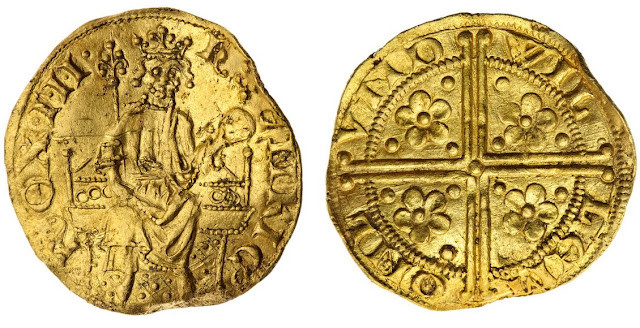
English gold penny minted by Henry III in 1257

A lucky metal detectorist just discovered a Henry III gold penny, one of the first English gold coins ever minted, on a farm in Devon in the southwest part of the U.K. My favorite thing about detectorist findings is that they give us a good excuse to learn about old coins. 

Minted in 1257, only eight of Henry III's gold pennies (pictured above) have survived. This is odd given that medieval historian David Carpenter's analysis of historical records indicates that 72,000 of these coins may have been produced within a year or two.

Why are there so few of Henry III's gold pennies still in existence? In this short post I'll suggest that the gold penny was a failure. Rather than circulating in trade, as one would expect of a coin, most of them were melted down within a year or two after issuance. And so there are very few gold pennies left for detectorists to find.

Leading up to the 1200s, the demands of English trade for coinage was mostly met by the workhorse English silver penny. Because the yellow metal was expensive, gold coins fell outside of the day-to-day spending range of the average person.

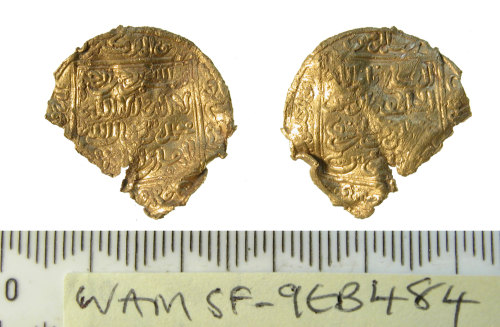
But Europe was getting wealthier and this was creating more demand for higher denomination coins. According to Alexander Del Mar, gold bezants were already circulating in England by the 13th century (page 236, [pdf]). Minted by the Byzantines, bezants had dominated Mediterranean commerce since 300 AD or so (see Munro). To boot, a handful of 11th- and 12th-century Islamic gold dinars and dinar-inspired coins have been found in England, writes historian Caitlin Green in a blog post, further suggesting a nascent demand for high-value coinage (see photo below). Del Mar cites texts from the era mentioning the circulation of Spanish maravedis, a gold dinar copycat.

Arabic gold dinar (AD 1163-84) found in Suffolk [link]

Meanwhile, the Italian city states of Genoa and Florence had begun to mint their own gold coins in 1252, the Florin and the Genovino. In the century before these two cities had pioneered the creation of large silver coins, the grosso or groat (worth 12 silver pennies) which England had yet to copy.

And so Henry III may have been eager to issue his own gold coin, one with his face on it and not someone else's stamp. But his effort failed .

When Henry III issued his gold penny, he rated it to be worth 20 silver pennies. That is, if you were an English merchant in 1256 you were required to accept a new gold penny from a customer at the same rate as 20 silver pennies. As a backstop, Henry III himself promised to redeem the gold pennies at 19 and a half pennies, the other half-penny being a fee. (See Evans, The First Gold Coins of England.)

In bimetallic coin systems, it was crucial for the monarch to choose the proper exchange ratio between silver and gold coins. If the chosen ratio diverged from the market's gold-to-silver rate, then Gresham's law kicked in. Undervalued coins disappear from circulation because they could be better spent elsewhere at their true market metal price.

In his paper Gold and Gold Coins in England in the Mid-thirteenth Century, Carpenter maintains that Henry III picked the right ratio between gold pennies and silver pennies.  A gold penny weighed the same as two silver pennies. At Henry III's chosen exchange rate of twenty silver pennies to one gold penny, this implied a price of ten grams of silver to one gram of gold. Carpenter says that this was in line with the prevailing 10:1 market rate between silver and gold bullion at the time.

But historian John Munro suggests otherwise. What Carpenter omits is that an English silver penny was only 92.5% pure, the remaining 7.5% being comprised of base metals. This means that Henry III's chosen exchange rate of twenty silver pennies to one gold penny actually valued the quantity of gold inside a gold penny at just 9.3 times that of an equivalent amount of silver, not 10 times.

Thus the king's chosen rate undervalued gold. And so Henry III's gold penny would have run smack dab into Gresham's law. It would have been more profitable for an English merchant to melt down 1 kg of gold pennies into bullion and buy 10 kg of silver with the proceeds at the going market rate than to spend that 1 kg of gold pennies as coins (since that would mean getting the equivalent of just 9.3 kg of silver).

Put differently, an English arbitrageur could engage in the following set of trades to make a risk-free return. He or she could spend 9.3 kg of silver coins to get 1 kg of gold pennies at Henry's official rate. Then they could melt that 1 kg of gold coins down and sell the gold bullion for 10 kg of silver at the market rate. Voila, our arbitrageur has magically turned 9.3 kg of silver into 10 kg of silver, earning a free 0.7 kg in silver. They would continue to execute this trade until the entire stock of Henry III gold pennies had disappeared.

There is additional evidence of the undervaluation of the gold penny. In 1265, just eight years after initially issuing them, Henry III increased the gold penny's rated value to 24 pennies from 20 pennies, writes Kemmerer (Gold and the Gold Standard, 1944). This rating would have been more in line with the market rate between gold and silver. But by then it was probably too late. All of Henry III's original issue of gold pennies would have been melted down. Nor was he minting any new ones. Specimens like the coin found this year in the farmer's field in Devon would have been one of a few to escape the melting pot. 

As for England's monarchs, they would only get gold coinage right in 1344 with the successful issuance of the gold noble.

Monday, January 17, 2022

Yemen's bifurcated monetary system

Over the last five years Yemen has stumbled into a unique monetary situation. I initially wrote about Yemen's odd currency status two years ago. Here is a quick update.

In brief, Yemen has split into two warring sides: the Houthi rebels in the North and the Saudi-backed government in the South. This split has also torn the nation's central bank into two branches the Aden branch and the Sana branch.

Likewise, it has separated Yemen's stock of Yemeni rial banknotes into two different types of banknotes. The Houthi rebels in the North (who run the Sana branch of the central bank) have adopted rial banknotes printed before 2016. The officially-recognized Aden regime in the South controls all notes printed after 2016. (Read the original blog post for the full story.)

We take it for granted that banknotes of different vintages, or years, are equal to each other. Put differently, cash is fungible. But not in Yemen. The value of the North's pre-2016 notes and the South's post-2016 notes began to diverge in 2019. Below is a chart published by the Cash Consortium of Yemen (which I've modified for clarity) showing how far that divergence has proceeded. The value of rebel's old notes relative to the U.S. dollar has stayed stable at around 600 rials to US$1 (see red line). But the value of the official Aden government's post-2016 notes has inflated. A new rial is now worth less than half a pre-2016 note (green line).


The reason for this growing gap is that the rebel North can't increase the supply of pre-2016 notes. The supply of old notes is locked. The supply of new notes, however, is not fixed. The South has been printing up new paper money and spending it into circulation.

It would be as if the northern & southern U.S. states had a civil war, the North adopting pre-2016 Federal Reserve notes and the South post-2016 notes. The South keeps printing new notes to finance itself, but the North is stuck with a fixed stock of notes. So the U.S. dollar bifurcates.

A currency war of sorts developed last summer in Yemen. It began with the Aden government printing up new notes of the same size, shape, and appearance as the rebel's pre-2016 notes and then spending them. You can see why the Aden government would want to adopt this strategy. If it could spend the replica notes at the same purchasing power as old notes, which are more valuable, the Aden government would extract twice as much goods & services than it otherwise could. If Aden's replicas succeeded in filtering into the Northern economy, we'd expect the old notesso stable till nowto finally succumb to price inflation. The price gap between old notes and new notes would collapse.

But this didn't happen. The Northern rebels reacted by banning Aden's replicas on the basis of serial number, according to the Sanaa Center. Notes with a serial number starting with the letter (أ) would be accepted, the rebels said, but those starting with the letter (د) would not be, presumably because د notes are all replicas. (According to the Sanaa Center, the government reacted by printing up serial numbers starting with أ.)

The exchange rates illustrated in the chart above suggest that the North's efforts to filter out the replicas was successful. The Northern rial notes are still worth just as much as before, around 600 rials to the U.S. dollar. Meanwhile, Aden's notes have inflated dramatically, from around 950 rials to 1290 rials per US$1.

My hunch is that some of the rebel's success may be due to the relative quality of the North's banknotes. Given years of active use, Northern rial notes must be relatively filthy right now. Crisp new notes from the South would immediately stand out. After Aden's new notes have circulated for a few years, it may become easier for them to pass as the rebel's old notes. Only then will the price gap start to shrink.